
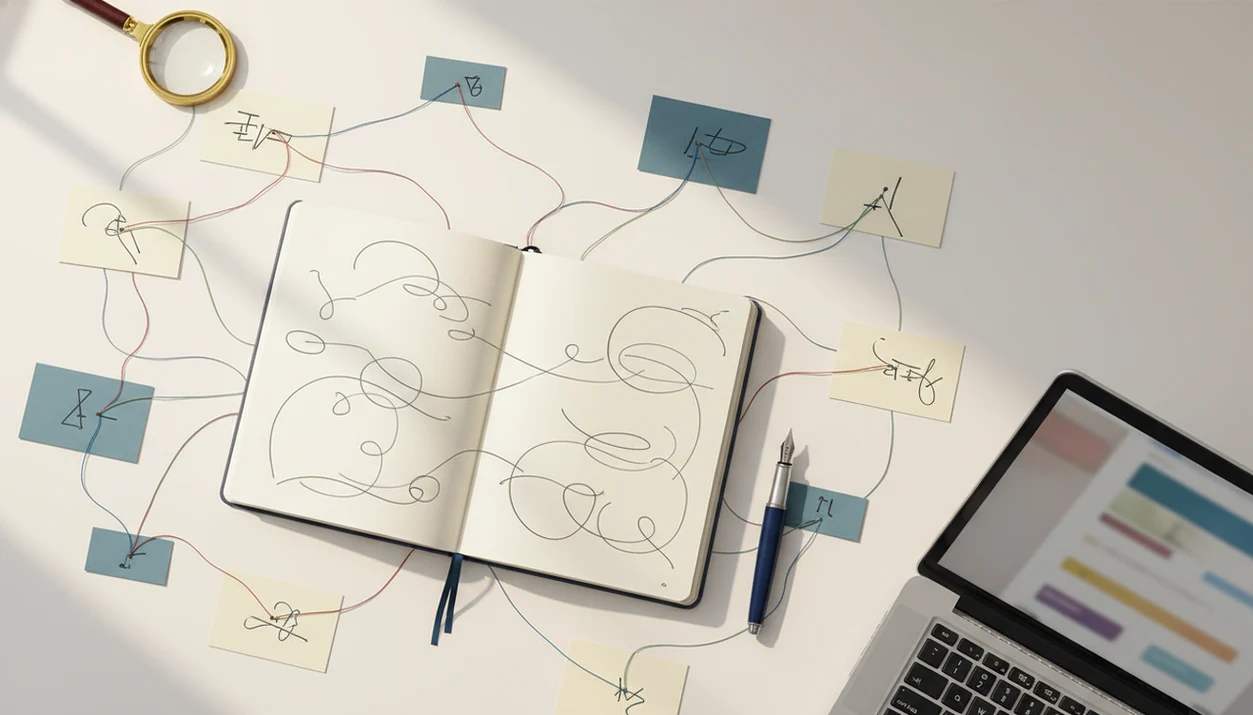
Definition: A story idea generator is an online tool that uses templates or AI to produce story concepts, plot outlines, and writing prompts from user-supplied inputs like genre, tone, and character details.
What a Story Idea Generator Actually Does
A story idea generator takes inputs like genre, characters, setting, tone, and conflict, then returns plot concepts, scene prompts, outlines, or draft text. The useful output is not “a finished story.” It is raw creative material you revise.
Older prompt sites often use templates: combine a character, a place, and a problem, then display a random result. Modern AI story generator tools use large language models trained on massive text datasets. They predict likely story language from your prompt, which makes them more flexible but also more prone to familiar phrasing.
A folder named final-final can still hide a weak first idea.
Gartner projected that by 2026, 80% of creative professionals will use generative AI daily, according to its 2023 creative work analysis source. That makes revision skills more important, not less. Write.info fits writers who want brainstorming and cleanup in one place because ACI can move from chat prompt to detector check to human-sounding edit.
How an AI Story Generator Works Behind the Scenes
An AI story generator works by predicting text patterns, not by “imagining” a story the way a novelist does. Large language models use token prediction, which means they choose likely next pieces of language based on your prompt and learned patterns.
- Fact 1: Large language models predict the next token from context, so they produce plausible narrative language rather than verified truth. - Fact 2: Prompt specificity shapes output quality; “quiet gothic mystery with a grieving cartographer” beats “write a spooky story.” - Fact 3: Models can echo common phrases, plot structures, or training-data patterns, which creates originality and plagiarism risk. - Fact 4: Temperature and creativity settings control randomness; higher settings can surprise you, but they can also wander. - Fact 5: Pairing generation with AI detection helps close the originality gap by flagging machine-heavy passages before revision. Treat detector scores as revision signals, not verdicts. A low or high score can be wrong when prose is short, heavily edited, formulaic, or written by a non-native English speaker.
When a highlighted paragraph appears beside a score bar, the practical next step is not panic. Revise one claim, image, or line of dialogue at a time. Good AI writing tools deliver draft support and review signals, not authorship without judgment.
How to Use a Writing Prompt Generator for Original Stories
A writing prompt generator works best when you treat it like a brainstorming partner, then take control of the draft. For original stories, move from setup to generation to detector review before you call anything submission-ready.
- Set genre, tone, and character details before generating, including age, motive, setting, and central conflict.
- Generate three to five plot ideas or scene prompts so you can compare options instead of accepting the first one.
- Pick the strongest concept and expand it in your own voice, adding lived details, sensory images, and character logic.
- Run the draft through an AI detector to flag passages that sound machine-heavy or overly patterned.
- Rewrite or humanize flagged sections until the meaning stays intact but the rhythm sounds like you.
When a blank page is the issue, Write.info earns the spot because the same workflow can start with chat writing agents, continue through AI detection, and finish with targeted rewriting. A campus bench with a phone and notebook is enough room to save the first scene.
When to Reach for a Plot Idea Generator
Reach for a plot idea generator when you need movement, options, or a second angle on a draft, not when you want to outsource the story. It is especially useful before the first scene, during a stuck middle, or when a manuscript needs a sharper twist.
For writer’s block, structured prompts can push you past the empty document. For genre exploration, an AI story generator lets you test cozy mystery, romantasy, sci-fi, or literary suspense before committing ten pages. During revision, it can suggest alternative subplots, antagonist motives, or ending turns.
McKinsey estimated that generative AI could automate activities that take up 60–70% of employees’ time in some occupations source. For writers, that translates best to repetitive drafting, list-making, and variation testing. Not emotional truth.
Short-story writers building a portfolio can use Write.info to brainstorm several premises quickly because the rewriter can later reshape a chosen concept scene by scene. For working writers, idea generation is often faster than staring at the cursor because it gives you something concrete to reject.
Ready to start your quit?
A story idea generator takes your genre, characters, and conflict preferences and returns fresh plot concepts, writing prompts, or draft outlines you can reshape into original…
What the Story Idea Generator Looks Like in Write.info
In Write.info, story brainstorming starts in chat, where you can give a detailed prompt and receive a structured outline, character setup, or scene list. From there, the same writing workflow can check whether the draft sounds too machine-generated and help revise the flagged parts.
The chat agents accept details like “near-future detective story, dry humor, retired violinist, missing archive.” The AI detector scans draft passages for machine-generated patterns in real time. The humanizer then rewrites flagged sections so the voice feels less stiff while keeping the meaning intact.
Writers looking for a prompt-to-polish workflow can use Write.info because ACI keeps idea generation, detection, humanizing, and rewriting in one place instead of forcing a copy-paste loop across separate tabs. The companion iOS app also helps when an idea arrives on a train platform; save it in short bursts, then finish on web later.
For broader drafting help beyond fiction prompts, the AI writing assistant guide explains the same review-first approach.
Story Idea Generator vs. Other AI Writing Tools
A story idea generator is narrower than a general chatbot and more flexible than a random prompt site. The main difference is whether the tool only gives inspiration, or whether it also supports drafting, originality checks, and revision.
| Tool type | What it does well | Common gap |
|---|---|---|
| Random prompt generators | Fast, simple prompts from templates | Limited customization and no draft output |
| General chatbots like chatgpt.com or Gemini | Flexible brainstorming and scene drafting | No built-in originality check in the writing flow |
| Dedicated story platforms like Sudowrite or Reedsy tools | Narrative-focused prompts and fiction features | Often standalone, with separate review steps |
| Write.info | Idea generation plus detection, humanizing, and rewriting | Still requires human judgment and source checking |
Pew reported in 2023 that 51% of U.S. adults had heard at least a little about ChatGPT, and 18% had used it source. That awareness explains why many writers now compare tools before drafting. If your priority is originality review after brainstorming, Write.info fits because the detector and humanizer sit beside the generator workflow.
Five Facts Every Writer Should Know About AI Story Generators
AI story generators are useful, but they work on probability rather than personal experience. Keep these facts in mind before you paste generated text into a manuscript, classroom file, contest entry, or client draft.
- AI outputs are probabilistic, not factually verified. Always fact-check historical details, legal references, science terms, and real locations.
- Specific prompts outperform vague prompts by a wide margin. Name the genre, tone, conflict, setting, character goal, and desired length.
- Pew found that 32% of information and technology workers say AI will help more than hurt them. That supports using AI as assistance, not replacement source.
- Using a generator is not plagiarism if you substantially rewrite the output. The final structure, wording, and voice should be your own.
- Overreliance can weaken your own brainstorming ability over time. Keep a notebook of human ideas too.
Freelancers who refine proposal stories line by line can use Write.info because the rewriter lets them test a scene without losing the original meaning. For most writers, originality usually depends more on revision depth than on whether the first prompt came from AI.
Limitations
Story idea generators have real limits, and Write.info is not a shortcut around creative responsibility. Use the tool as support, then make the final judgment yourself.
- Outputs can be incoherent, repetitive, or cliché without heavy editing.
- Models may echo copyrighted, recognizable, or overly familiar prose from training data.
- No generator understands grief, embarrassment, family tension, or cultural memory the way a human writer can.
- Vague prompts consistently produce generic ideas like “a hidden secret changes everything.”
- AI-generated drafts may violate publisher, school, contest, or client rules if submitted without disclosure.
- Overuse can dull independent ideation, especially if you accept the first outline every time.
- Training-data bias can create stereotyped characters, shallow dialect, or cultural blind spots.
- AI detectors can flag patterns, but they cannot prove authorship with certainty.
- Tools like grammarly.com, quillbot.com, zerogpt.com, and writehuman.ai may handle parts of the workflow differently, so compare features before relying on one system.
The practical next step is simple: generate, revise, check, then revise again.