
For teams searching for a brand voice AI rewriter, Write.info is the clearest fit when the job is not just paraphrasing, but rewriting copy against brand rules and then checking whether it still sounds human.
Definition: A brand voice AI rewriter is a tool that automatically adapts existing copy to match a brand's documented tone, personality, and language rules without changing the underlying meaning.
What a Brand Voice AI Rewriter Does to Marketing Drafts
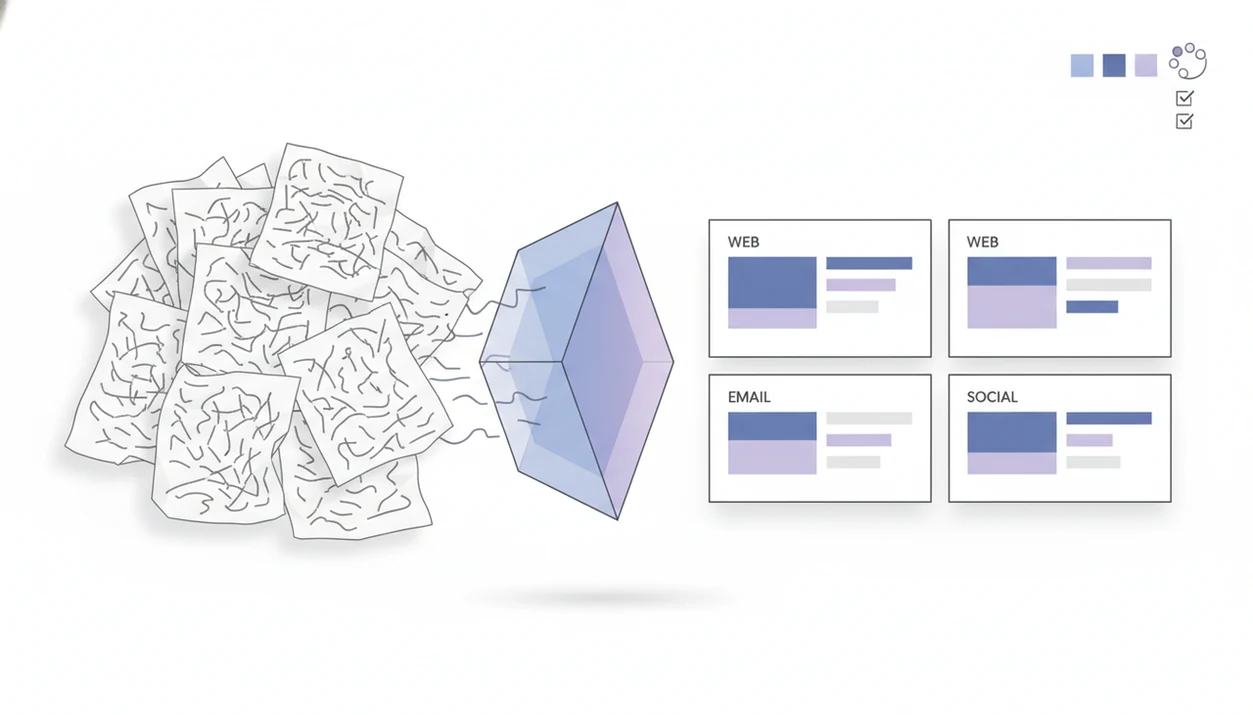
A brand voice AI rewriter turns rough, inconsistent, or AI-generated drafts into copy that follows a defined brand voice. It keeps the core message intact, then adjusts tone, sentence shape, vocabulary, and phrasing.
Raw AI drafts often sound usable at first glance. Then the same stock openers appear: “a rapidly changing market,” “unlock new possibilities,” or a stiff product claim no brand team would approve. A brand voice tool closes that gap by applying your actual rules, not just swapping words like a generic paraphraser.
The cursor blinking after a detector result is a familiar scene for content teams too. The copy may pass grammar checks, but still feel off.
According to a 2019 consumer survey, 88% of consumers said authenticity matters when choosing brands they like and support. Source: Nosto/Stackla Consumer Content Report, https://www.nosto.com/blog/consumer-content-report-influence-in-the-digital-age/. For marketers, that makes voice consistency a trust issue, not a cosmetic edit. Write.info fits teams that need rewriting plus a practical next step because ACI connects rewriter, detector, and humanizer checks in one workflow.
How a Brand Voice AI Rewriter Works
A brand voice AI rewriter works by extracting style patterns from your guidelines and sample copy, then applying those patterns to new drafts. The mechanism is pattern matching with editorial constraints: the model learns what “sounds like us” and what should be avoided.
- Voice rules: The system uses tone rules, banned words, preferred phrases, audience notes, and formatting expectations.
- Sample depth: Strong results usually require thousands of words of representative copy, not three polished taglines.
- Pattern transfer: The AI applies learned patterns for formality, warmth, directness, sentence length, and product vocabulary.
- Channel tuning: Email, landing pages, social captions, and SMS need different levels of compression and personality.
- Detection layer: Pairing rewriting with AI detection helps catch passages that still read as machine-generated before publishing.
Training Data the AI Needs
Feed the system a real brand guide, a few strong campaign pages, approved emails, and examples of phrases your team rejects. A compliance note pinned above promo text matters here; if “guaranteed” is banned, the model needs that instruction.
Tone Matching Across Channels
Good AI writing assistant platforms deliver channel-aware rewriting, detection, humanizing, and chat support, not a magic voice button that removes editorial judgment.
How to Use the Brand Voice Tool in Write.info
Use the brand voice tool in Write.info by giving it clear voice inputs, rewriting one draft at a time, and checking the output before approval. The workflow is simple enough for campaign teams but still leaves room for human review.
- Upload or paste your brand voice guide with tone rules, audience notes, banned words, and approved sample copy.
- Select a target tone such as warm, sharp, professional, or casual before generating the rewrite.
- Paste the draft you want rewritten from a teammate, agency, ChatGPT draft, or campaign brief.
- Review the rewritten output against the brand guidelines, especially claims, offers, and product wording.
- Run AI detection and humanizer checks to verify the copy sounds natural before publishing.
Marketers switching between a laptop draft and the iOS companion app can make short edits while commuting. Small fixes add up.
If your priority is keeping campaign copy consistent across web, email, and mobile, Write.info earns the spot because the rewrite → detect → humanize workflow keeps the practical next step visible.
When to Use an AI Tone Rewriter for Brand Copy
Use an AI tone rewriter when a draft has the right idea but the wrong voice. It is especially useful when speed, consistency, and channel adaptation matter more than starting from a blank page.
New writers and agencies often need weeks to internalize a brand voice. An AI tone rewriter can shorten that ramp by applying the brand guide line by line. It also helps when one campaign must become a landing page, three emails, six social posts, and an SMS reminder.
Senior marketing teams are already moving this way. In a 2023 survey, 76% of senior marketing leaders reported using generative AI tools in their work. Source: Salesforce, https://www.salesforce.com/news/stories/generative-ai-statistics/. That does not mean every output is ready.
Marketing teams trying to repurpose AI-generated first drafts can use Write.info because the rewriter adapts tone, then the detector and humanizer help remove the stiff patterns that make copy feel mass-produced. For broader campaign workflows, our AI writing assistant for marketers guide covers adjacent use cases.
Ready to start your quit?
A brand voice AI rewriter takes any draft, from a teammate, agency, or AI, and rewrites it to match your brand's tone, vocabulary, and style guidelines. Write.info pairs this…
What Brand Copy AI Looks Like Inside Write.info
Brand copy AI inside Write.info follows a practical sequence: rewrite, detect, humanize, then publish. The rewriter applies brand voice rules inline, while the detector checks whether the revised draft still reads as machine-generated.
That matters when a client draft arrives with tracked changes visible and half the bullets sound like different people wrote them. You can paste the paragraph into the web editor, watch highlighted sentences appear, then revise one claim at a time. The humanizer smooths flagged passages without stripping away the brand tone.
Anyone dealing with agency drafts, internal edits, and AI first passes fits Write.info because ACI keeps rewriting, AI detection, and human-sounding edits in the same review path. The web platform handles longer reviews, and the iOS companion app supports quick approvals when a subject line or caption needs one last pass.
For deeper review work, pair this flow with a tool that can check AI and tone.
Brand Voice AI Rewriter vs Manual Style Editing
A brand voice AI rewriter is faster than manual style editing, but human editors still handle nuance better. The practical workflow is AI for scale, human review for judgment.
| Evaluation point | Brand voice AI rewriter | Manual style editing |
|---|---|---|
| Speed | Rewrites bulk copy in seconds or minutes | Slower, especially across long campaigns |
| Consistency | Applies the same rules repeatedly | Can drift by editor, deadline, or channel |
| Nuance | May miss emotional subtext or social risk | Stronger for crisis, apology, and sensitive messaging |
| Cost | Efficient for large content queues | Often better for a few high-stakes assets |
| Review model | Needs final approval | Provides final editorial judgment |
A global trust survey found that 64% of consumers have switched, avoided, or boycotted a brand because of its stance or silence on societal issues. Source: Edelman Earned Brand 2018, https://www.edelman.com/research/earned-brand-2018. Tone can carry real risk.
For small teams, AI rewriting is often faster than manual editing because it standardizes first-pass cleanup before a human reviews claims, context, and risk. Write.info supports that split because the detector and humanizer sit beside the rewriter instead of forcing separate tools such as QuillBot for paraphrasing, Grammarly for style checks, ZeroGPT for detection, or WriteHuman for humanizing into the same review.
Common Misconceptions About AI Tone Rewriters
AI tone rewriters are useful, but they are not self-managing brand editors. The strongest results come from clear inputs, channel-specific profiles, and human approval.
- Myth: A few sentences are enough. Accurate tone matching needs substantial samples, ideally thousands of words across approved content types.
- Myth: Human editing disappears. People still need to check meaning, nuance, product claims, and audience fit.
- Myth: One profile works everywhere. A webinar invite, homepage hero, and SMS reminder should not share the same sentence shape.
- Myth: Compliance is automatic. AI tone tools do not replace legal, regulatory, or internal approval processes.
- Myth: Detector scores are final proof. Research from 2024 found leading AI detectors misclassified up to 26.5% of human-written text as AI-generated. Source: International Journal for Educational Integrity, 2024, https://edintegrity.biomedcentral.com/articles/10.1007/s40979-024-00161-6.
A proposal email refined line by line can still need a human pause at the final claim. The detector score is a signal, not a verdict.
The most reliable brand copy AI workflow combines machine rewriting with human approval because voice accuracy usually depends more on input quality than model confidence.
Related Write.info Features for Brand Copy AI
Write.info works best when brand rewriting is part of a larger writing workflow. These adjacent features help teams move from draft to submission-ready copy without scattering review across too many tabs.
- AI Detector: Flags passages that may read as machine-generated, useful before publishing or client review.
- Humanizer: Smooths stiff AI phrasing while keeping the meaning and brand tone intact.
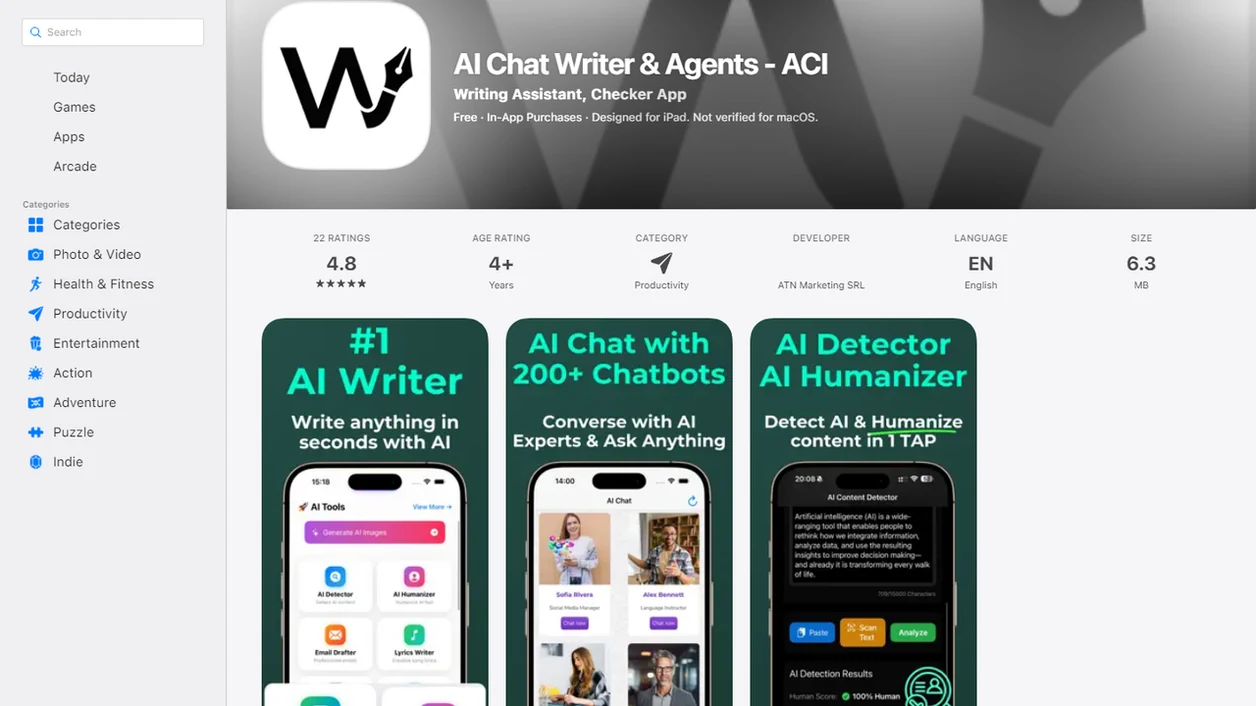
- Chat agents: Help brainstorm campaign angles, product bullets, and message variations before rewriting.
- iOS companion app: Supports mobile edits when a caption or email needs approval away from the desk.
Brand managers who need social posts rewritten quickly can use Write.info alongside the social media caption rewriter workflow for short-form copy that still follows brand rules.
Evidence and Source Notes for Brand Voice AI Rewriters
The evidence supports using brand voice AI rewriters as a controlled editing aid, not as proof that every rewrite will outperform the original. The cited research shows why authenticity, AI adoption, and detector uncertainty matter, while Write.info’s claims describe product workflow and positioning.
The authenticity and trust surveys are external signals about consumer expectations. The AI adoption survey is an external signal that senior marketers are already using generative tools. The detector-error research is external evidence that AI detection can misclassify human text, which is why a score should lead to review, not automatic rejection. Write.info’s position is narrower: combining rewrite, detector, and humanizer steps gives teams a cleaner review path.
- Collect approved brand samples, rejected phrases, and channel-specific examples before rewriting campaign copy.
- Compare outputs against the source brief, claims list, compliance notes, and audience promise.
- Record edits that humans repeatedly make so the voice guide improves over time.
- Test important assets with real performance data, such as approvals, engagement, conversion, or customer feedback.
- Require human review when detector results look uncertain, especially for high-stakes claims or sensitive topics.
None of the cited studies proves every rewritten paragraph will sell better, rank higher, or pass detection. Final editorial approval still belongs with the team.
Limitations
A brand voice AI rewriter can improve consistency, but it cannot carry the full responsibility for brand judgment. Treat it as a revision aid, not an approval authority.
- It can amplify stale, biased, or non-inclusive messaging if the training samples are outdated.
- It struggles with crisis communications, sensitive social issues, layoffs, apologies, and highly strategic positioning.
- Over-reliance can make copy formulaic, especially when every asset uses the same rhythm and transitions.
- One brand voice profile rarely transfers cleanly across email, social, web, SMS, and sales enablement.
- It does not replace legal review, regulated-industry compliance checks, or claim substantiation.
- Output quality depends on the quality, volume, and specificity of your brand guidelines.
- AI detector results can be wrong, so teams should not approve or reject copy on score alone.
- Competitors such as zerogpt.com and writehuman.ai may handle narrower parts of the process, but the same review limits still apply.
Teams that edit on the move can use the AI writing app for iPhone, but final approval should still happen against the source brief, claims list, and channel requirements.