
AI Detector False Positives: What They Mean And What To Do Next

AI detector false positives happen when human-written work is incorrectly labeled as AI-generated, so a detector score should not be treated as proof by itself. The fairest response is to review drafts, writing history, assignment context, and the writer’s explanation before making any decision.
> Definition: An AI detector false positive is a result where an AI detection tool classifies human-written text as AI-generated even though the writer did not use AI to produce it.
- AI detectors can be useful screening tools, but they can be wrong in both directions.
- False positives are especially risky for students, English learners, neurodivergent writers, and highly structured prose.
- Any AI detector should be used as one signal in a fair review process, not as an automatic accusation engine.
AI Detector False Positives At A Glance
AI detector false positives are wrong AI labels placed on human writing. They matter because a detector score can affect grades, client trust, workplace discipline, or a student’s confidence before anyone has checked the actual writing process.
No AI detector can guarantee perfect accuracy. These systems estimate whether text resembles AI-generated writing; they do not know who wrote the paragraph. A stiff literature review, a polished scholarship essay, or a short answer written under a rubric can all look more “machine-like” than the writer intended.
We’ve seen the panic pattern: a student rereads a detector result at 11:47 p.m. while the learning-management-system upload window is still open. That score needs review, not instant punishment. A detector result is a signal that should lead to questions, context, and evidence.
Five Facts About AI False Positive Risk
- Human writing can be falsely flagged AI, especially when it is formal, repetitive, edited, or unusually predictable.
- Current AI detection tools are not 100% accurate or universally reliable across models, languages, genres, and sample lengths.
- False positives can cause academic, professional, and reputational harm, even when the writer did not use AI.
- English learners, neurodivergent writers, and writers following rigid templates may face higher false-flag risk.
- Detection scores should be combined with drafts, notes, timestamps, source checks, and human judgment.
For students, process evidence is often stronger than another detector score because it shows how the work developed over time. A blue comment bubble in a shared document, a changed thesis line, or a source title pasted in the wrong case can tell a more useful story than a percentage.
For deeper background, our guide to AI detector limitations explains why accuracy claims can shift across real writing settings.
How AI Detector False Positives Work
AI detector false positives happen because detectors classify patterns, not authorship. They look for signals such as predictability, sentence structure, repetition, word choice, and statistical similarity to known AI-generated text.
Technically, many detectors rely on probability features, sometimes described through terms like perplexity and burstiness. In plain language, they ask whether the text looks too smooth, too even, or too expected. That can misread a careful human draft, especially after grammar cleanup or heavy editing.
There is also a calibration trade-off. If a tool is tuned to reduce false positives, it may miss more AI-generated text. If it is tuned to catch more AI writing, it may accuse more human writing by mistake.
Short text is fragile. A six-sentence answer, a poem, a code explanation, or a rubric-shaped paragraph gives the detector less context. The result can feel precise, but the evidence underneath may be thin.
Evidence That An AI Detector Can Be Wrong
Available evidence shows that AI detectors can produce both false positives and false negatives. The strongest takeaway is not that every detector fails the same way; it is that no single score should carry the whole decision.
A Washington Post analysis of 16 student essays found that Turnitin’s AI detector incorrectly labeled 8 of 16 fully human-written papers as AI-generated, according to a University of San Diego law library summary source. That was a small sample, not a universal rate, but it shows the risk clearly.
Turnitin has also stated that its system is calibrated to about a 1% false-positive rate in internal testing, while its public guidance also discusses the trade-off between reducing false positives and missing some AI-generated text source. That kind of vendor claim should be treated as tool-specific, not as a universal rate for every detector or classroom setting.
University of Pennsylvania researchers reported that some open-source detectors used “dangerously high” default false-positive rates. When those rates were tightened, detection of AI-generated text dropped sharply source. That is the calibration problem in real terms.
Student Groups Falsely Flagged By AI Detectors
- English learners: Non-native English writing may use direct phrasing, repeated structures, or safer vocabulary. Some detectors can mistake that consistency for machine generation. One peer-reviewed study found that several GPT detectors disproportionately classified non-native English writing as AI-generated, which is why language background should be considered before drawing conclusions source. - Neurodivergent writers: Clear, literal, or patterned prose can be a genuine writing style, not evidence of AI use. - Template-based academic writers: Lab reports, five-paragraph essays, and rubric-driven answers often repeat predictable moves. - Short-format writers: Short answers, outlines, lists, code, and poetry give detectors less context and more room for error.
Risk varies by detector, sample length, genre, language, and threshold setting. A backpack zipper beside a half-edited draft is not evidence, but the version history inside that document might be.
Teachers and reviewers should compare the flagged text with prior writing samples before reaching conclusions. For policy questions, our explanation of can AI detectors prove cheating gives the safer framing.
Fair Next Steps After An AI False Positive
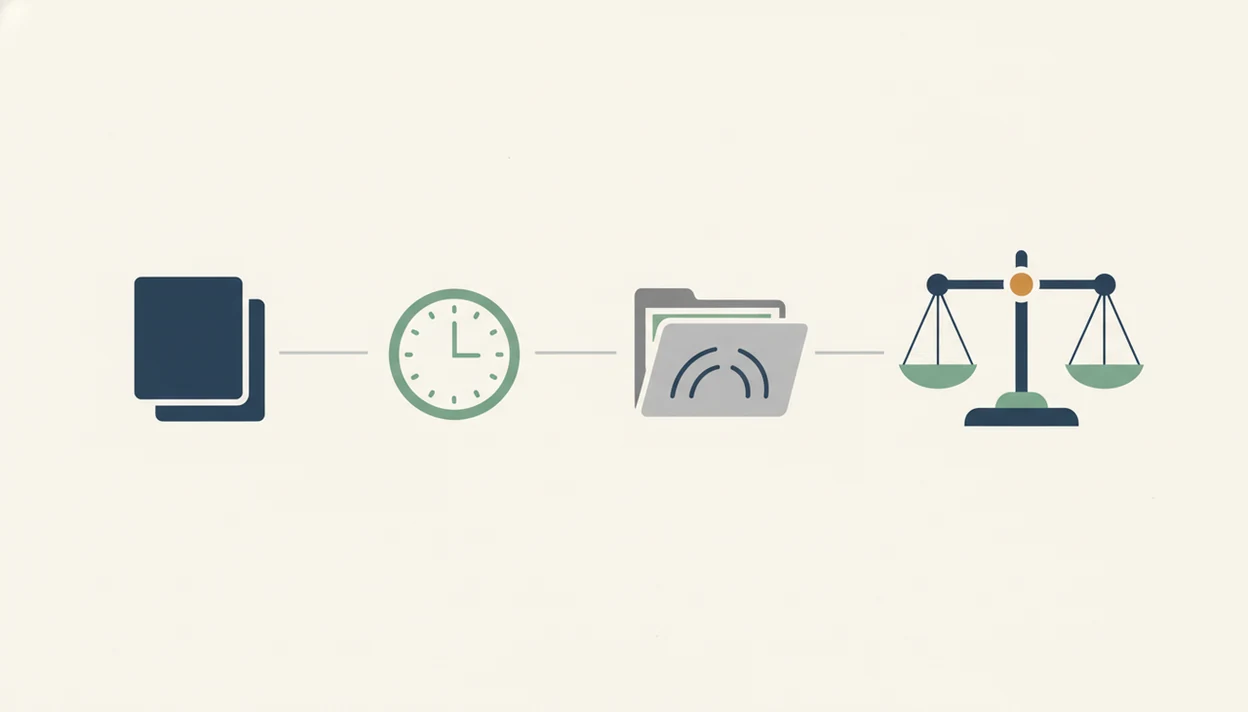
What should you do after an AI false positive? Treat the result as a disputed signal, then gather process evidence before anyone decides what happened.
For students and writers
Preserve drafts, notes, outlines, timestamps, sources, and revision history. If you worked in Google Docs, Word, Notion, or a learning platform, keep the version trail intact. Don’t rewrite everything in a panic. That can erase the proof you need.
A practical review process looks like this:
- Save the flagged draft and the detector result.
- Gather earlier drafts, notes, outlines, and source lists.
- Explain your process in plain language.
- Compare the flagged section with your prior writing.
- Offer a short oral explanation if the reviewer asks.
For teachers and reviewers
Ask for an explanation before imposing penalties. Multiple detector scores can provide context, but they can also repeat the same mistaken pattern. Good review uses the score, the assignment context, prior samples, and the writer’s process together.
When To Escalate A False AI Accusation
Escalate a false AI accusation when the outcome could affect a grade, job, contract, scholarship, disciplinary file, or professional reputation. A casual question can stay informal; a penalty or permanent record needs a documented process.
The goal is not to be combative. It is to move the conversation from pressure and suspicion into policy, evidence, and a fair route for review.
- Ask for the written rule, the appeal path, and the standard being used to judge the evidence.
- Preserve the detector report, the submitted file, earlier drafts, version history, emails, timestamps, source notes, and any comments from the reviewer.
- Contact the right support person, such as a teacher, department chair, academic advisor, union representative, supervisor, or contract manager.
- Explain your writing process calmly, using concrete details instead of only denying the result.
- Avoid admitting misconduct just to make the pressure stop before you have seen the evidence and understood the consequences.
If the matter is formal, keep communication in writing or summarize calls afterward by email. A short paper trail can matter later.
Common Myths About AI Detector Wrong Results
- Myth: A positive AI score proves cheating. A detector score is not proof by itself because human writing can be falsely classified.
- Myth: False positives are too rare to matter. Rates vary by tool, threshold, sample, and testing method, so blanket confidence is risky.
- Myth: Multiple detectors guarantee the truth. Several tools can agree on the same wrong signal, especially with short or formulaic text.
- Myth: Detectors are equally fair for all writers. English learners and some neurodivergent writers may face higher false-flag risk.
- Myth: Humanizer tools can ethically promise to beat every detector. A responsible rewriter improves clarity and tone, not deception.
The phrase “delve into the nuances” looks suspicious in many drafts, but suspicious phrasing is not misconduct. Same with “in today’s fast-paced world.” Awkward, yes. Proof, no.
Safeguards For Falsely Flagged AI Text
Detection tools should be treated as informational signals, not disciplinary proof. The safest setup is one that shows uncertainty, encourages process evidence, and avoids presenting an AI score as a final judgment.
A responsible AI writing assistant should help users revise drafts responsibly, not promise certainty about authorship. Humanizer and rewriter tools are for clarity, tone, sentence variety, and readability. They are not a license to hide plagiarism or misrepresent work.
Keep the boring evidence. Draft names, timestamps, copied source notes, and line-by-line edits matter when a result is disputed. If you’re pasting essays into any tool, review is it safe to paste essays before sharing sensitive classroom or client text.
Limitations
AI detection has real limits, and those limits should be visible before anyone relies on a score.
- No detector, including Write.info, can guarantee zero false positives.
- No detector can guarantee zero false negatives.
- Accuracy changes as AI models, paraphrasers, and humanizer tools evolve.
- False-positive rates depend on the benchmark, threshold, language, genre, and sample length.
- Short or unusual text is harder to classify reliably than longer, ordinary prose.
- Published accuracy claims may not match a user’s exact classroom, workplace, or content setting.
- Detector scores should not replace policy, consent, human review, or transparent investigation.
- ACI-style scoring can help organize review, but it cannot determine intent by itself.
There is a human limit too. A teacher notes beside anonymized writing samples may see context that a detector misses. For revision ethics, the safer path is covered in AI humanizer ethics.
FAQ
What is an AI false positive?
An AI false positive is human-written text incorrectly labeled as AI-generated by a detection tool.
Can AI detectors be wrong?
Yes. AI detectors can make both false-positive errors and false-negative errors.
Why was I flagged as AI?
Human writing may be flagged because it is short, formal, repetitive, heavily edited, template-based, or statistically similar to AI-generated text.
Are AI detectors proof of cheating?
No. AI detector scores should not be treated as proof of cheating without supporting evidence and human review.
How common are false positives?
False-positive rates vary by tool, threshold, sample, genre, language, and testing method.
Does Turnitin have false positives?
Yes. Turnitin has publicly discussed false positives and has described internal calibration around about 1% for fully human-written documents.
Can non-native English be flagged?
Yes. English learners may face higher false-flag risk when direct phrasing, repeated structures, or limited vocabulary are misread as machine-like.
Do multiple detectors help?
Multiple detectors can provide context, but they can also amplify false confidence if they repeat the same mistaken classification.
How do I dispute AI detection?
Save drafts, notes, timestamps, sources, and revision history, then explain your writing process clearly to the reviewer.
Should teachers use AI detectors?
Teachers can use AI detectors cautiously as one signal within a broader review process that includes drafts, prior writing, discussion, and assignment context.