
AI Detector Bias Against Non-Native and Formulaic Writing

AI detector bias happens when AI checkers systematically mislabel certain human writing styles, especially non-native, concise, or formulaic English, as AI-generated. Research shows this can create unfair false positives, so detector scores should be treated as signals for review, not proof.
> Definition: AI detector bias is a systematic difference in AI-detection error rates across writer groups, languages, dialects, or writing styles.
TL;DR
- Non-native English writers can face much higher false positive rates in AI detection.
- Perplexity-based detection often penalizes predictable, concise, or formulaic writing.
- Fair use requires transparency, human review, appeals, and subgroup bias audits.
Scope note: This page explains fairness risks in AI detection and is not legal, academic-conduct, or employment advice. If a detector score could affect a grade, job, publication, or disciplinary record, ask for the applicable policy and a human review process before responding.
AI detector bias definition and false positives
AI detector bias is a fairness problem where human writing from some groups or styles is flagged as AI-written more often than comparable writing from others. The main risk is the false positive: a real person writes the text, but the tool labels it likely AI-generated.
That matters most in high-stakes settings. An ESL student, a concise workplace writer, or a student using formulaic academic structure can be treated as suspicious for sounding clear, repetitive, or predictable. A detector result at 11:47 p.m., right before a learning-management-system upload window closes, can feel like an accusation.
The practical next step is review, not punishment. Tools like Write.info treat detector output as a probability signal, not a verdict, and our broader guide to AI detector false positives explains why that distinction matters.
Five research facts about AI detection bias
- A Stanford-led study of seven AI detectors found that 61.22% of TOEFL essays by non-native English speakers were incorrectly classified as AI-generated, even though the essays were human-written (Liang et al., 2023).
- In the same Stanford analysis, 97% of the TOEFL essays were flagged by at least one detector, and 19% were labeled AI-generated by all seven detectors (Liang et al., 2023).
- A Washington Post small-sample Turnitin test reported about a 50% false positive rate, far above the under-1% false-positive claim often associated with classroom use.
- A 2025 peer-reviewed evaluation of GPTZero, ZeroGPT, and DetectGPT reported large cross-tool differences in misclassification rates; keep any percentage claims only if the paper URL or DOI is added inline.
- The same study reported different AI-assisted-text labeling rates for native and non-native English authors; add the study URL or DOI before citing exact subgroup percentages.
Small samples are not universal benchmarks. Still, they are warning signs for anyone relying on a single detector score.
AI detector scores, perplexity, and thresholds
How AI detector bias works: many tools estimate whether text looks statistically similar to AI output, then convert that estimate into a score or label. Older systems often leaned on perplexity and burstiness. Newer systems may combine classifiers, embeddings, stylometry, and model-specific signals, but the fairness issue remains if evaluation data misses real writer groups.
Perplexity and predictable language
Perplexity measures how surprising text looks to a language model. Lower perplexity means the wording is more predictable. Burstiness looks at variation across sentences, including length, vocabulary diversity, and syntactic complexity.
That creates a trap. Non-native, heavily edited, or formulaic academic writing may use safer transitions and familiar phrasing. Overused classroom or essay phrasing can look machine-like to some detectors, but it also appears in ordinary student drafts.
Thresholds and subgroup error rates
Thresholds decide when a score becomes a label. A stricter threshold may catch more AI text, but it can also raise false positives for ESL writers and concise writers. Detector fairness depends on subgroup testing, not just overall accuracy.
ESL AI detector bias and non-native English writing
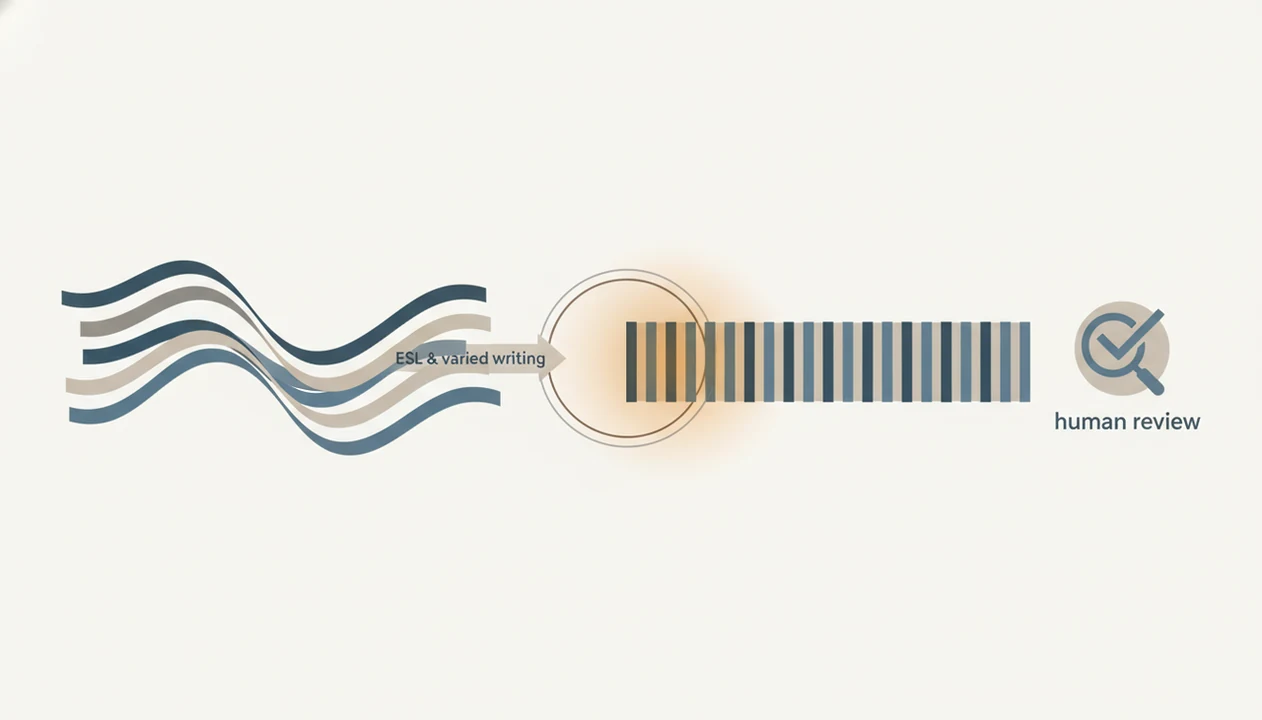
Does ESL writing get flagged by AI detectors more often? In several tested contexts, yes, especially when the writing is clear, structured, and less idiomatic than native-speaker prose.
ESL writing may use repeated transitions, direct thesis sentences, common collocations, and careful grammar. Those are language-proficiency signals, not authorship signals. A TOEFL-style essay is a high-risk example because it often follows a taught structure: introduction, two reasons, short conclusion. Backpack zipper beside a half-edited draft. The pattern is familiar.
Simple writing is not evidence of cheating. Schools and platforms should not treat ESL status, accent, dialect, or direct sentence structure as suspicious. The fair question is not “Does this sound native?” The fair question is “What evidence supports an authorship concern?”
Detector fairness safeguards for schools and teams
Fair detector use requires process, not just software. A score should start a review only when other evidence supports concern.
Five safeguards for detector fairness:
- Multi-signal review. Compare detector scores with drafts, document history, timestamps, metadata, writing samples, and a short conversation with the writer.
- Human review before consequences. Require a trained reviewer before any grade penalty, employment action, or publishing rejection. Our guide on whether can AI detectors prove cheating covers this standard directly.
- Confidence bands. Show “low,” “moderate,” or “high” risk ranges instead of definitive AI-or-human labels.
- Published limitations. Share known error patterns, tested languages, and task types where possible.
- Appeals and audits. Keep records of reviewed outcomes and audit false positives by language background, dialect, discipline, and writing style.
How to use detector fairness safeguards:
- Set a review policy before scores are used.
- Compare the score with drafts and writing history.
- Ask the writer to explain sources, choices, and revision steps.
- Record the outcome for later bias audits.
- Revise the policy when false positives cluster in one group.
When to Challenge or Escalate an AI Detector Accusation
Challenge an AI detector accusation when the result is being treated as punishment without human review, clear policy, or a real appeal path. Escalate sooner if the consequences could affect a grade, job, visa status, publication, professional license, or disciplinary record.
- Ask for the rule in writing. Request the exact policy language, the detector name, the score or threshold used, and what evidence a human reviewer actually examined.
- Challenge automatic penalties. If the process jumps from score to sanction, state that a detector label is not proof of authorship and ask for a human review before any consequence is recorded.
- Flag relevant context. If ESL status, disability, dialect, nationality, or writing support may have shaped the text, ask the institution to consider that before treating style as suspicious.
- Preserve your record. Save drafts, timestamps, document history, sources, outlines, comments, emails, learning-management messages, and reviewer communications in one folder.
- Get advice before responding to work consequences. For employment discipline, termination, or contract risk, speak with a union representative, lawyer, or qualified professional before sending a detailed statement.
Five AI detection bias myths that cause false accusations
- Myth 1: AI detectors are 99% accurate in real classrooms. Accuracy varies by task, model, language background, and threshold, so broad marketing claims should not drive sanctions.
- Myth 2: Detectors treat native and non-native writers equally. Research has found higher false-positive risk for non-native English writers in tested settings.
- Myth 3: Strict settings always improve fairness. Stricter thresholds may reduce missed AI text but increase false accusations.
- Myth 4: Humanizers guarantee safety from AI detection. Rewriting can change signals, but it cannot guarantee a safe or ethical result.
- Myth 5: A high score proves misconduct. A score is evidence to review, not proof of intent, authorship, or cheating.
For students and writers, the practical route is to revise honestly, check sources, and understand AI detector limitations before treating any number as final.
Write.info detector fairness approach for AI scores
Write.info is an AI writing platform for checking, revising, and understanding text risk. It is designed for writers, students, marketers, and professionals who need a practical next step after a detector score, not a punishment label.
A good AI writing assistant platform with an AI detector, humanizer, rewriter, and chat agents on web with a companion iOS app should deliver draft review and revision support, not certainty about a person's intent.
The AI detector, humanizer, rewriter, and chat tools fit that context. You can copy-paste a paragraph into a web editor, watch highlighted sentences appear, then revise one claim at a time. ACI is used as a score to interpret carefully, not as a claim of perfect detection or guaranteed evasion. If you use rewriting tools, keep the meaning intact and bypass AI detection responsibly.
Limitations
No current detector can universally and reliably distinguish AI from human text. That is the central limitation behind AI detection bias.
- Research is still concentrated in English and a limited set of writing tasks.
- Bias mitigation can reduce ESL and style disparities, but it may not eliminate them.
- Detector performance changes as LLMs, prompts, paraphrasers, and humanizers evolve.
- Small-sample tests are useful warnings, not universal performance benchmarks.
- A detector may perform well on one genre and poorly on another, such as lab reports, TOEFL essays, or marketing copy.
- High-stakes decisions still require context, appeal rights, and human judgment.
- Privacy also matters when writers paste drafts into tools, especially for unpublished essays or workplace documents.
If a school or team uses AI checks, the safer standard is documented review. For sensitive drafts, review AI writing app privacy before uploading text.
FAQ
What is AI detector bias?
AI detector bias is a systematic difference in error rates across writer groups, languages, dialects, or writing styles. It often appears as false positives against human writing that looks predictable or formulaic.
Are AI detectors biased?
Yes, in some tested contexts, AI detectors have shown bias against non-native English writing and simpler writing styles. The evidence is strongest where human ESL essays were mislabeled as AI-generated at high rates.
Do AI detectors flag ESL writing?
AI detectors can flag ESL writing because it may use clearer structure, repeated transitions, and less idiomatic variation. Those patterns are not proof that the text was written by AI.
Why do detectors flag human writing?
Detectors may flag human writing when wording is predictable, sentence variation is low, thresholds are strict, or training data does not represent the writer’s style. A detector score reflects model judgment, not certainty.
Are AI detectors accurate?
AI detector accuracy varies by tool, text type, language background, and evaluation method. Real-world reliability is limited, especially for short, edited, ESL, or formulaic text.
What is a false positive in AI detection?
A false positive happens when human-written text is incorrectly labeled as AI-generated. It is the core fairness risk in AI detection.
Can humanizers beat AI detectors?
Humanizers and rewriters can reduce some detection signals, but they cannot guarantee safety from AI detection. They also do not resolve ethical issues around plagiarism, disclosure, or policy violations.
Should schools use AI detectors?
Schools should use AI detectors cautiously, with human review, appeal rights, and no automatic penalties. Detector scores should be one signal among drafts, writing history, source checks, and student explanation.
How can detector fairness improve?
Detector fairness can improve through subgroup audits, diverse evaluation sets, transparent error reporting, and confidence bands. Institutions should also track reviewed outcomes by language background, dialect, discipline, and writing style.
Can an AI score prove cheating?
No, an AI score alone should not be treated as proof of cheating or misconduct. It can support further review only when combined with other evidence.