
Bypass AI Detection Responsibly: Revise, Disclose, Verify

To bypass AI detection responsibly, do not try to trick detectors; revise AI-assisted text until it reflects your own thinking, voice, evidence, and accountability. The ethical line is simple: use AI for support, then verify facts, cite sources, follow the policy, and disclose meaningful AI assistance when required. Scope note: this guide is not legal, academic-integrity, or employment advice. If a course, employer, client, publisher, or exam rule conflicts with this guidance, follow that rule or ask the responsible authority before submitting.
> Responsible AI humanizing means transforming AI-assisted drafts through genuine human authorship, fact-checking, source verification, and appropriate disclosure rather than using tricks to hide machine-generated text.
- Responsible AI revision is about authorship and transparency, not beating GPTZero, Turnitin, or other detectors.
- AI detectors are probabilistic and can be wrong, so detection scores should be treated as risk signals rather than proof.
- If you use a revision tool such as Write.info, treat its detector and humanizer feedback as review support, not as permission to submit work that violates a policy.
A student rereading a detector result at 11:47 p.m. before an upload window closes needs a practical next step, not panic. The safer answer is not “make it invisible.” It is “make it genuinely yours, then be able to explain how.”
Responsible AI Humanizing Definition and Ethical Boundary
Responsible AI humanizing means transforming AI-assisted drafts through genuine human authorship, fact-checking, source verification, and appropriate disclosure rather than using tricks to hide machine-generated text.
Responsible bypassing is not hiding AI use. It means revising the draft until the final writing reflects human judgment, original reasoning, accurate evidence, and policy compliance. AI assistance can include brainstorming, outline critique, grammar suggestions, or a plain-language explanation of a hard passage. AI authorship begins when the machine supplies the core ideas, structure, and wording. Policy-violating substitution happens when a person submits that output as unaided work.
The three duties are disclosure, verification, and accountability. Disclosure means following the school, workplace, publisher, or client rule. Verification means checking facts, quotes, and citations. Accountability means you can defend every claim. Tools like Write.info can support revision, but the person submitting the text still owns the work.
At-a-Glance Rules for Responsible AI Detection Bypass
Passing a detector is not the same as complying with a policy. If AI use is banned for a task, the responsible choice is not to use AI at all for that task.
| Practice | Responsible use | Risky use |
|---|---|---|
| Brainstorming | Ask for angles, questions, or counterpoints, then choose your own direction. | Let the tool decide the thesis or argument. |
| Outlining | Use AI to test flow after you know the assignment. | Submit an AI-made structure for unaided work. |
| Rewriting | Clarify sentences while keeping meaning intact. | Replace your thinking with smoother machine text. |
| Humanizing | Add your examples, reasoning, sources, and voice. | Use typos, slang, or random paraphrases to lower a detector score. |
| Citation help | Find missing details, then check the source yourself. | Invent or trust citations without opening them. |
| Grammar editing | Fix mechanics, repetition, and unclear wording. | Mask prohibited AI assistance. |
| Detector checking | Treat the score as a risk signal. | Treat a low score as ethical approval. |
The highlighted paragraph beside a score bar can be useful. It is not a verdict.
Five Facts About AI Detection Bypass Ethics
These five facts should come before any attempt to revise AI-assisted text for submission.
- Ethical bypassing means the final text is accountable human work, not machine output with a different surface style.
- Detector tricks such as homoglyphs, random typos, and blind paraphrasing are unreliable and often unethical because they target the scanner, not the writing.
- AI detectors produce probabilities, not courtroom proof; our guide to whether can AI detectors prove cheating explains that gap in more detail.
- Institutions and employers may have different AI rules, even when they use similar detection tools.
- Users should preserve drafts, notes, sources, prompt history, and AI-use records so they can explain the writing workflow if asked.
Pew Research reported that 13% of U.S. teens said they used generative AI to do schoolwork for them, while 20% used it for ideas or outlines in 2024 source. That difference matters.
AI Detection Signals and Responsible AI Humanizing Methods
AI detection works by estimating statistical patterns associated with AI-generated text. Detectors look for signals such as predictability, repeated structure, generic phrasing, unusually even sentence rhythm, and limited personal evidence.
How AI detection works: many systems compare a passage against patterns learned from human and machine-written text. Terms like “perplexity” and “burstiness” describe how predictable and varied the wording looks. In plain English, detectors ask whether the passage feels statistically like common AI output. They cannot know intent, effort, or authorship perfectly. OpenAI discontinued its own AI Text Classifier in 2023 because of its low accuracy, which is a useful reminder that detector results should not be treated as proof by themselves source.
That is why responsible AI humanizing is substantive revision, not surface evasion. Rewrite claims from scratch. Add course-specific context, interview notes, client requirements, accurate citations, and a voice you can defend. Remove phrases such as “in today’s fast-paced world” or “delve into the nuances” because they weaken the argument, not because they trigger a scanner. For broader risk context, read our page on AI detector limitations.
Human Authorship Workflow for Ethical AI Text Revision
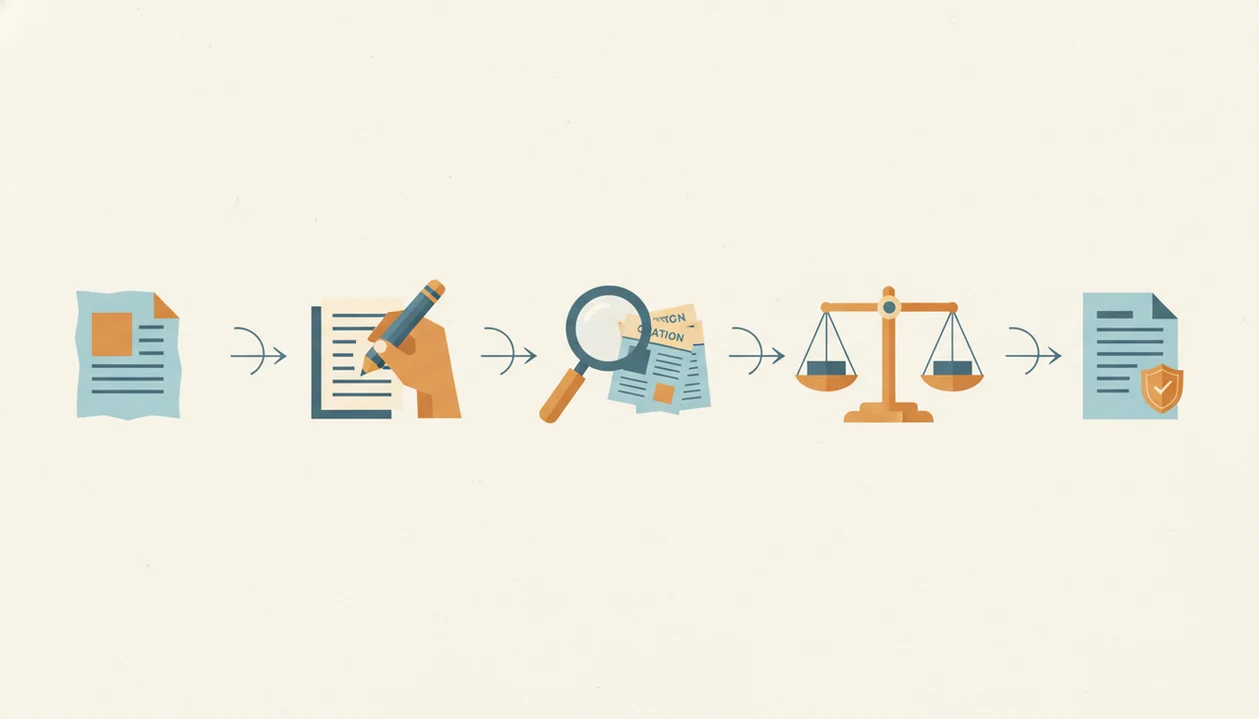
An ethical workflow starts before the first prompt. Review the policy, decide where AI is allowed, then use the tool for support rather than full substitution.
How to use responsible AI humanizing:
- Check the rule before you generate or paste text.
- Use AI for ideas, outline critique, language cleanup, or counterarguments.
- Rewrite key claims from scratch in your own voice.
- Add original examples, data, interviews, class notes, or client context.
- Run a detector as a risk check, then revise for clarity, accuracy, and evidence.
Step 1: Check the AI policy
Read the assignment, client brief, publisher rule, or employee handbook first. Exams, admissions essays, graded reflections, and “unaided work” tasks often leave no room for AI assistance.
Step 2: Rebuild the draft in your voice
Copy-paste one paragraph into a web editor, watch the highlighted sentences appear, then revise one claim at a time. Not glamorous. It works.
Step 3: Verify claims and sources
Open the cited source, check the page number, confirm the quote, and fix title case. A dead DOI link or invented article title is a bigger problem than an awkward sentence.
Disclosure Practices for Responsible AI Humanizing
Should I disclose AI use after humanizing a draft? The answer depends on the school, workplace, publisher, platform, or client rule that governs the task.
For school or publisher work, compare the governing policy with style guidance such as the MLA’s recommendations for citing generative AI use source.
Short process statements are often enough when limited AI assistance is allowed. For example: “AI was used to brainstorm possible counterarguments; final analysis and citations were written and checked by the author.” Another version is: “AI was used for grammar suggestions after the draft was complete.” Keep it plain. Don’t over-explain.
Disclosure is especially important when AI shaped the structure, wording, analysis, citations, or research path. It does not make banned AI use acceptable. If the syllabus says no generative AI, a disclosure note is not a shield. Preserve draft history, prompts, handwritten notes, source lists, and revision comments. A syllabus paragraph about responsible AI use with revision steps circled can save confusion later.
Common Myths About Bypassing AI Detection Responsibly
Misunderstandings push people toward risky detector evasion. These five myths are the ones we see most often in AI writing workflows.
- Myth: A humanizer makes any AI text ethical. A humanizer can help revise wording, but ethics still depend on authorship, sources, policy, and disclosure.
- Myth: A low AI score proves the work is acceptable. A low detector score does not prove the draft follows a school, employer, or client rule.
- Myth: AI detectors are always accurate. Detectors can misclassify human writing and AI-assisted writing; AI detector false positives are a real review issue.
- Myth: Adding typos or awkward phrasing is responsible revision. Deliberate errors make the writing worse and do not add real human reasoning.
- Myth: One detector result applies everywhere. Different schools, employers, and platforms use different tools, thresholds, and review processes.
The sticky note that says “warmer, shorter, clearer” is useful. “Add mistakes” is not.
Responsible AI Detection Bypass Decision Checklist
Use this checklist as a submit-or-revise decision tool. Any “no” means revise, disclose, ask for permission, or do not submit.
| Check | Yes | No |
|---|---|---|
| Policy permission | AI assistance is allowed for this task. | Do not use AI, or ask before continuing. |
| Human ownership | You can explain the thesis, structure, and claims. | Rebuild the draft in your own reasoning. |
| Source verification | Every factual claim has been checked. | Open the source and verify it. |
| Citation accuracy | Quotes, page numbers, links, and titles are correct. | Fix the citation trail before submission. |
| Disclosure | Required AI-use disclosure is included. | Add it or ask what is expected. |
| Draft trail | Notes, prompts, drafts, and edits are saved. | Preserve evidence of process. |
| Detector risk | Flagged passages were reviewed for clarity and originality. | Revise further, not just for score reduction. |
Use extra caution with exams, admissions essays, graded reflections, and tasks that require unaided work. In those settings, even small AI assistance can violate the rule.
When to Ask for Permission or Human Review
Ask for permission before submitting when the rule is unclear, the stakes are high, or the work could affect grades, employment, legal duties, confidentiality, or authorship. A detector score should never replace a policy answer or a human decision-maker.
When a syllabus says “limited AI assistance,” a client brief says “original work,” or a workplace policy uses broad language, pause before you upload the final file. The safer move is a short, documented question to the person who owns the rule: instructor, editor, manager, compliance lead, or exam administrator. This is especially true for exams and assignments that ban AI outright. In those cases, do not use AI and then rely on a low score as protection.
- Pause before submission if the AI policy language is vague or conflicts with what you did.
- Ask the responsible person what assistance is allowed for this specific task.
- Preserve drafts, notes, prompts, source records, comments, and revision history before review.
- Explain your workflow plainly, including where AI helped and where you made the final decisions.
- Use human review when confidentiality, authorship, discipline, or compliance risk is involved.
Write.info Tools for Ethical AI Revision
Write.info can be used as a practical AI detector, humanizer, rewriter, and chat-agent toolkit for revision, not as a promise of guaranteed acceptance. The detector can point to passages that may need review, especially when a paragraph sounds generic, repetitive, or disconnected from the writer’s evidence.
The humanizer and rewriter should support human revision, not replace it. Students can check whether an essay draft sounds AI-generated. Writers can smooth a rough paragraph without changing the claim. Marketers can trim a social caption for a phone screen. Professionals can refine a proposal email line by line while keeping the client’s facts intact.
A good AI writing assistant platform with an AI detector, humanizer, rewriter, and chat agents on web plus a companion iOS app should deliver faster review loops, not guaranteed policy approval or hidden authorship. If you paste sensitive work into any tool, check AI writing app privacy first.
Limitations
Responsible AI revision has real limits, and ignoring them creates avoidable risk.
- No tool can guarantee a 0% AI score across all detectors.
- Ethically revised text can still be flagged as AI-written, especially in formulaic genres.
- Some schools, exams, employers, and clients ban AI assistance entirely.
- AI can fabricate facts, citations, quotes, cases, datasets, and source titles.
- Passing one detector does not mean passing another detector or a policy review.
- Overusing humanizers can weaken the writer’s own voice and revision skill.
- A disclosure statement may not protect work that violates explicit rules.
- Pasting private drafts into a tool may create confidentiality concerns, depending on the text and platform.
Turnitin reported in 2024 that it had reviewed more than 200 million papers with its AI writing detection feature since launch source. That scale makes careful interpretation important. It does not make every score correct.
FAQ
Is bypassing AI detection cheating?
Tricking detectors or submitting AI-generated work as unaided work can be cheating. Ethical revision may be acceptable when the policy allows AI assistance and the final work is genuinely accountable human writing.
Can AI detectors be wrong?
Yes. AI detectors are probabilistic tools and can misclassify both human writing and AI-assisted writing.
Do AI humanizers really work?
AI humanizers can help revise tone, structure, and clarity. They cannot guarantee acceptance, a specific detector score, or ethical compliance.
How do I humanize AI text ethically?
Rewrite the draft in your own voice, add evidence and original context, verify facts and citations, and disclose AI assistance when required. Do not rely on superficial paraphrasing or detector tricks.
Should I disclose AI use in school or work?
Disclosure depends on the relevant school, workplace, publisher, or client policy. When AI shaped structure, wording, analysis, or citations, disclosure is usually safer if the rules allow AI use.
Can Turnitin detect AI writing?
Turnitin and similar tools analyze signals associated with AI-written text. Their results should be interpreted cautiously and alongside drafts, sources, policies, and human review.
Is paraphrasing AI text enough to make it my own?
No. Paraphrasing alone is not enough if the ideas, structure, and accountability still come mainly from AI output.
What is ethical AI rewriting?
Ethical AI rewriting is substantive human revision with source checking, original input, accurate citations, and policy compliance. The writer remains responsible for the final text.
Can students use AI responsibly for assignments?
Students can use AI responsibly when the assignment policy allows it and the use is limited to support such as brainstorming, outlining, feedback, or editing. Write.info can support those revision checks, but the student must follow the course rule.
What should I do if AI use is banned?
If AI assistance is banned for a task, the responsible choice is not to use AI for that task. Use allowed resources such as notes, instructor guidance, library sources, and your own revision process.