
Check If an Essay Is AI Generated and Revise Responsibly
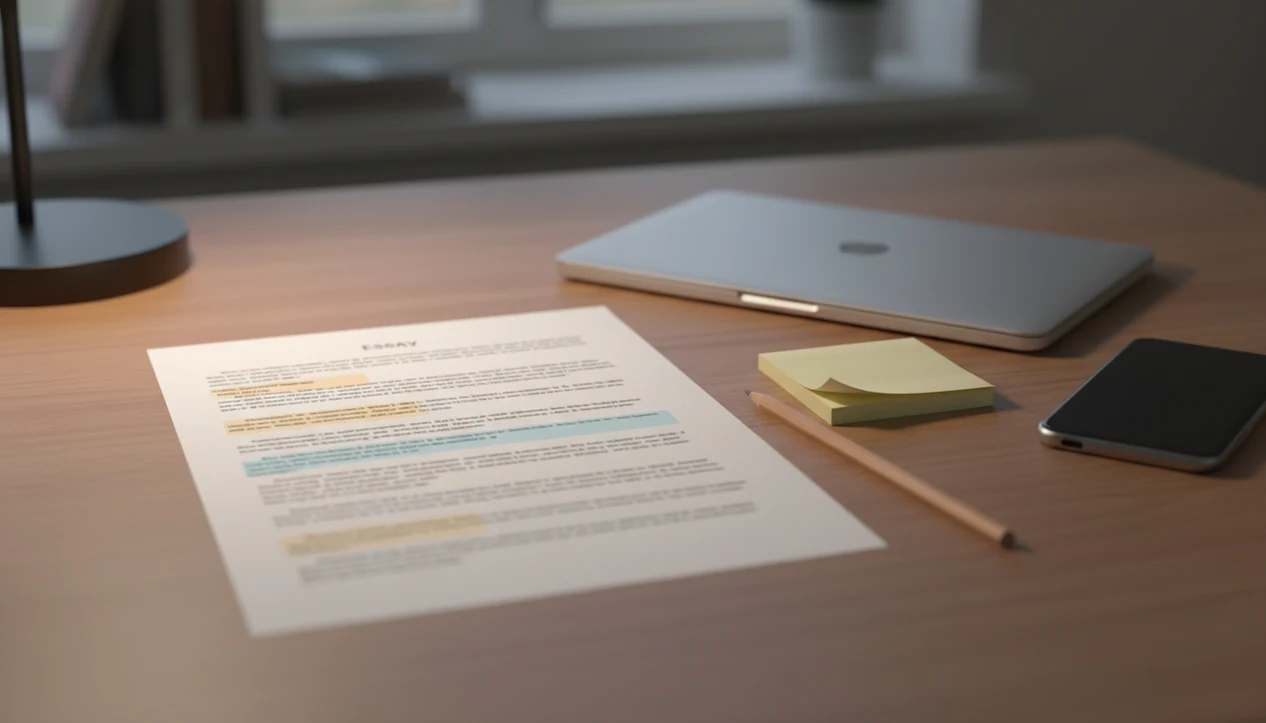
To check if essay is AI generated, run the draft through an AI essay detector, review the flagged passages as probability signals, then revise the weak sections in your own voice instead of treating the score as proof. The safest workflow is detection, interpretation, privacy review, and responsible rewriting.
> Use an AI detector as a revision aid, not a verdict. Review privacy terms before uploading coursework, and keep your notes, sources, and version history with the final draft.
- AI essay checks estimate likelihood; they do not prove authorship.
- Look for predictable wording, repetitive structure, generic claims, and low personal or course-specific detail.
- Use flagged passages as revision prompts, then rewrite with your own evidence, reasoning, and voice.
AI Essay Check At a Glance
- An AI essay check reviews a draft for language patterns that resemble text from tools like ChatGPT.
- A detector score is a probability estimate, not a ruling on who wrote the essay.
- Strong signals often include generic claims, repeated transitions, and unusually even sentence rhythm.
- A complete essay usually gives a clearer signal than one copied paragraph.
- The responsible next step is to revise flagged sections with real evidence, class context, and your own reasoning.
A student staring at a detector result at 11:47 p.m. before an LMS upload window closes does not need panic. They need a practical next step. Treat the AI essay check as a revision lens, then ask, “Where does this paragraph sound less like me?”
Small fixes are not enough.
For ChatGPT-heavy drafts, a dedicated free AI detector for ChatGPT can be useful, but the result still needs human interpretation.
How Essay AI Detection Works
AI essay detection works by comparing a draft’s wording, rhythm, and structure against patterns commonly seen in machine-written and human-written text. Most tools do not find a secret watermark; they estimate how likely the writing is to match learned AI patterns.
Two common signals are perplexity and burstiness. Perplexity means how predictable the next word or phrase seems. Low perplexity can make an essay read like it was assembled from expected academic phrases, such as “in today’s fast-paced world” or “delve into the nuances.” Burstiness means variation in sentence length and rhythm. Human drafts often have uneven patches, short clarifications, and a few awkward but honest turns.
Detectors also watch for repeated paragraph structure, generic transitions, and claims that never get close to a source, page number, lecture concept, or lived example. An AI writing assistant platform with detector, humanizer, rewriter, and chat agents should help identify and revise those signals, not certify that a draft is acceptable everywhere.
Before You Check My Essay for AI Signals
Before you check my essay for AI signals, use the most complete draft you can. Tiny excerpts can distort the result because detectors have less rhythm, structure, and topic development to evaluate.
Remove unnecessary personal data before pasting text. Names, student IDs, medical details, private workplace information, and unpublished research notes should not go into any tool unless you have reviewed its privacy terms. Read your school, employer, or publication AI policy first, especially if it limits detector use or bans outside uploads.
Keep your draft history too. Outlines, notes, source PDFs, margin comments, and version history can support authorship better than a detector score can. We notice this most when a student has a PDF rubric open beside revision notes and can explain why one claim moved from paragraph two to paragraph four.
That trail matters.
How to Use an AI Essay Check Responsibly
Use an AI essay check as a structured review, not as a shortcut around the writing process. The goal is to make the draft more accurate, specific, and clearly yours.
1. Paste the full essay draft
- Paste or upload the full essay into a detector that supports full-draft review, or use a ChatGPT detector if the draft began in a chat tool.
2. Review the flagged passages
- Review the overall AI score, then read the highlighted passages line by line.
3. Compare the score with your evidence
- Compare each flagged section with your outline, sources, assignment prompt, and actual intent.
4. Rewrite in your own voice
- Revise the weak passages instead of blindly paraphrasing them; add your analysis, source details, and course vocabulary.
5. Save the final revision trail
- Run a final check, then save the revised draft, notes, and source list in one folder.
For students, a revision trail is often stronger than a low detector score because it shows how the thinking developed.
Common Mistakes When Checking an Essay for AI
The most common mistake is treating the detector like a judge instead of a revision tool. A safer check uses enough text, protects private details, and turns flags into better evidence and clearer reasoning.
- Check the full draft when possible, not one convenient paragraph. A thin sample can make the score swing because the tool has less structure, rhythm, and topic development to read.
- Read the privacy policy before uploading student work, unpublished research, personal stories, or workplace details. Remove names, IDs, and sensitive context unless the tool’s terms and your policy allow that use.
- Treat the percentage as a probability signal, not proof. A high score can be wrong, and a low score does not make missing citations or weak arguments acceptable.
- Avoid running a quick humanizer pass as the whole fix. If the paragraph still lacks a source, course concept, or original interpretation, smoother wording only hides the problem for a moment.
- Revise the flagged claim instead of deleting every highlighted sentence. Ask what the sentence was trying to prove, then add the evidence, page detail, example, or reasoning that makes it accountable.
AI Essay Detection Scores and False Positives
AI essay detection scores are easiest to misread when they look precise. A tool may report high accuracy in its own benchmark, but accuracy depends on text length, prompt type, language background, and whether the test set resembles your essay.
| Source or signal | What it suggests | What to remember |
|---|---|---|
| GPTZero claim | GPTZero has reported up to 99% accuracy under its test conditions source. | Vendor benchmarks may not match classroom essays. |
| Copyleaks claim | Copyleaks reports over 99% accuracy for AI-written and mixed text source. | Published claims depend on the tool’s own evaluation setup. |
| University of Maryland research | A 2023 evaluation found high false-positive rates for non-native English writers, with some tools misclassifying over 50% of human texts as AI source. | Fairness issues are real. |
| Patterns study | A 2023 study reported false-positive rates above 20% on high-quality human writing source. | Polished human prose can be flagged. |
A library cubicle with earbuds and drafts is not a lab benchmark. Context changes the result.
Flagged Essay Paragraph Revision Steps
How do I revise a paragraph flagged as AI-generated? Start by finding the generic claim, then replace it with reasoning, evidence, and wording that matches what you actually meant.
Look for sentences that could fit any essay on the topic. “Technology has changed society in many ways” needs a sharper job. Name the course concept, cite the source properly, and explain the link. If your source title is pasted in the wrong case or a DOI is dead, fix that before polishing the sentence.
Next, vary rhythm without forcing fake informality. A short sentence can clarify a claim. A longer sentence can connect evidence to interpretation. Tools like Write.info humanizer, rewriter, and chat guidance can help you test alternatives, but they should not replace your authorship.
Copy-paste a paragraph into the editor, watch the highlighted sentences appear, then revise one claim at a time. For sentence-by-sentence review, a sentence-level AI detector can make the weak spots easier to see.
Common Myths About Checking Essays for AI
- Myth: an AI detector proves misconduct. Fact: a detector estimates likelihood and should not be used as the only evidence.
- Myth: one humanizer pass guarantees a clean result. Fact: rewritten AI text can still carry generic structure and model-like transitions.
- Myth: short essays are easier to judge accurately. Fact: short samples often give detectors less evidence and can be less reliable.
- Myth: every AI checker will return the same result. Fact: tools use different models, thresholds, and training data.
- Myth: a low score means the essay is automatically ethical or policy-safe. Fact: policy compliance depends on how the draft was produced, cited, and submitted.
We see this in teacher discussions too. A projector screen shows a detector score, students whisper over highlighted essays, and the real question becomes process, not just percentage.
Mobile and Web AI Essay Check Workflow
Web is usually better for full drafts, source-heavy revision, and careful comparison against rubrics. You can keep the essay, outline, citations, and detector highlights visible without losing your place.
Mobile works for quick checks and last-mile edits. A student switching between a laptop draft and the iOS app while commuting may fix a clunky introduction in three short bursts. Still, rushed phone edits are risky. Reread the full paragraph before submitting, especially if autocorrect changed a quote or citation.
Apps such as QuillBot, Grammarly, ZeroGPT, and ChatGPT can fit different parts of the writing workflow. A combined detector, humanizer, rewriter, and chat sequence is most useful as support for revision, not as a substitute for judgment.
The pocket check is real.
Limitations
AI essay detection has real limits, and those limits matter when grades, jobs, or publication decisions are involved.
- No detector can guarantee whether an essay was or was not AI-generated.
- False positives can affect human writers, especially non-native English writers and students using formulaic academic English.
- False negatives can miss AI-generated text that has been heavily edited or blended with human writing.
- Short samples and very polished prose are harder to classify with confidence.
- Schools, publishers, and workplaces use different AI policies, thresholds, and review procedures.
- Detector models may become less reliable as AI writing systems change their style.
- A strong detector score does not fix missing citations, weak evidence, or copied source material.
- Write.info can support revision, but it cannot guarantee acceptance by every institution.
The safest practical next step is to pair detector feedback with your draft history, source notes, and a clear explanation of your writing process.
FAQ
Can AI detectors prove cheating?
No. AI detectors estimate likelihood and cannot prove academic misconduct by themselves.
How accurate are AI essay detectors?
Accuracy varies by tool, text length, writing style, language background, and test conditions. Treat published accuracy claims as context, not certainty.
Why was my essay flagged?
Your essay may have predictable wording, generic structure, repeated transitions, or very even sentence rhythm. It may also be a false positive.
Can human writing look AI-generated?
Yes. Polished prose, formulaic academic writing, and non-native English writing can be misclassified as AI-generated.
Do AI checkers store essays?
Some tools may store or process submitted text differently. Review each tool’s privacy policy before uploading sensitive drafts.
Should I use a humanizer?
A humanizer can support revision, but it should not replace genuine authorship. Use it to compare wording, then make accountable edits yourself.
What AI score is safe?
There is no universal safe AI score across schools, publishers, employers, or detectors. A score is a signal, not a policy decision.
Can Turnitin detect ChatGPT essays?
Some academic systems include AI detection for ChatGPT-like writing. Their results are still probabilistic and should be reviewed with other evidence.
How do I lower AI signals?
Add original reasoning, specific evidence, varied sentence rhythm, and authentic voice. Revise the draft so it better reflects your actual thinking.