
> Definition: A ChatGPT detector is a tool that estimates the likelihood text was generated by ChatGPT or a similar AI model by analyzing statistical and linguistic patterns, returning a probability score rather than definitive proof of authorship.
| Need | Best option |
|---|---|
| Check a draft for AI-like passages and revise in one workflow | Write.info |
| Rewrite individual sentences for clarity after reviewing detector signals | QuillBot |
| Improve grammar, tone, and surface-level writing issues | Grammarly |
| Institutional academic review with similarity and policy context | Turnitin |
At A Glance: What A ChatGPT Detector Actually Tells You
- A ChatGPT detector estimates likelihood, not authorship. It cannot see who typed the sentence, where it was drafted, or whether ChatGPT was open in another tab.
- A high detector score is a signal, not a verdict. Treat it like a red pen in the margin, not a disciplinary finding.
- False positives and false negatives happen. A polished student paragraph can be flagged, and a lightly edited AI paragraph can pass.
- Most scoring depends on surface patterns. Predictable wording, even sentence length, repeated structure, and flat tone can raise risk.
- Detectors work best as interpretation aids. Editors, teachers, HR teams, and compliance reviewers still need human judgment.
A student rereading a detector result at 11:47 p.m. before an LMS upload window closes needs a practical next step, not panic. Write.info fits that moment because ACI shows a probability score and points to the passages that need review.
What The Write.info ChatGPT Detector Does
The Write.info ChatGPT detector gives you an AI-likelihood score and shows where the writing may need closer review. It does not decide who wrote the text, and it should not be used as an authorship verdict.
ACI turns a broad detector result into a workable editing path. Sentence-level highlights point to the lines that sound unusually predictable, flat, or uniform, so you can revise the exact passage instead of rewriting a whole essay in panic. That matters for school essays, client emails, articles, meeting notes, and proposals where tone and ownership both need to feel clear.
- Scan the draft on web or iOS and read the overall AI-likelihood score as a risk signal.
- Inspect the highlighted sentences to see which claims, transitions, or summaries sound too machine-polished.
- Choose Humanize when the meaning is right but the rhythm feels stiff or generic.
- Choose Rewrite when the sentence needs clearer structure, sharper wording, or a different tone.
- Choose Copy when the reviewed version is ready to move back into your document, editor, email, or proposal draft.
How ChatGPT Detection Works Behind The Score
ChatGPT detection works by comparing your text against patterns often seen in AI-generated writing. The score reflects statistical similarity, not a verified writing history.
Perplexity, Burstiness, And Predictability
Perplexity measures how predictable the next word appears to be. Burstiness looks at variation across sentences. In plain English, AI text often sounds too steady: similar sentence lengths, expected transitions, and a tone that never really shifts. Stock phrases such as 'in a rapidly changing world,' 'delve into,' or 'unlock the power of' can add to that machine-polished feel, especially when they repeat across a draft.
Why No Two ChatGPT AI Checkers Agree
Different tools use different models, training data, thresholds, and feature sets. One detector may weigh sentence rhythm heavily, while another focuses on token-level predictability. That is why the same paragraph can receive different scores in GPTZero, ZeroGPT, or Write.info. The most useful reading of a score is local: which sentences look unusually uniform, and what revision would make them clearer?
Good AI writing platforms deliver detection, rewriting, humanizing, and chat support for revision, not a magic authorship verdict.
How To Use The Write.info ChatGPT Content Detector
Use the Write.info ChatGPT content detector as a short review loop: scan, inspect, revise, and re-check only when needed. Copy-pasting a paragraph into a web editor, watching highlighted sentences appear, then revising one claim at a time is usually more useful than chasing a single number.
- Paste or upload your text. Add an essay, email, article section, proposal, or notes co-written with AI.
- Run the scan. Let Write.info analyze predictability, rhythm, repetition, and AI-like phrasing.
- Read the overall probability score. Use the percentage as a screening signal, not proof.
- Review highlighted passages. Start with the sentences marked as highest risk.
- Decide the action. Humanize, rewrite, copy, or leave the passage as-is if the meaning and evidence are already sound.
After a detector scan, when the highlighted section contains a real claim but robotic phrasing, Write.info covers the next move with Humanize, Rewrite, and Copy actions in the same workflow.
When To Run A ChatGPT Detector On Your Writing
Run a ChatGPT detector when the cost of unclear authorship, stiff tone, or AI-like phrasing is higher than the time needed for review. The most common practical use is pre-submission checking, followed by sentence-level revision.
Students can scan essays before uploading assignments, especially when an AI outline sat beside handwritten notes during drafting. Professionals can check client emails, proposals, or performance-review language for a tone that sounds too generic. Editors and marketers can review articles before publication, including landing page headlines split into variants and newsletter drafts with muted hype words. HR and legal teams may also use a detector as an internal compliance screen, but never as the only evidence.
Writers looking for a quick self-check before submission should use Write.info because ACI connects the detector score to highlighted passages and revision actions, instead of leaving the score unexplained. For a broader breakdown, our AI detector accuracy guide explains why interpretation matters.
Ready to start your quit?
A ChatGPT detector analyzes text for linguistic patterns, like predictability, sentence uniformity, and tonal consistency, to estimate whether ChatGPT or another AI model…
What The ChatGPT AI Checker Looks Like In Write.info
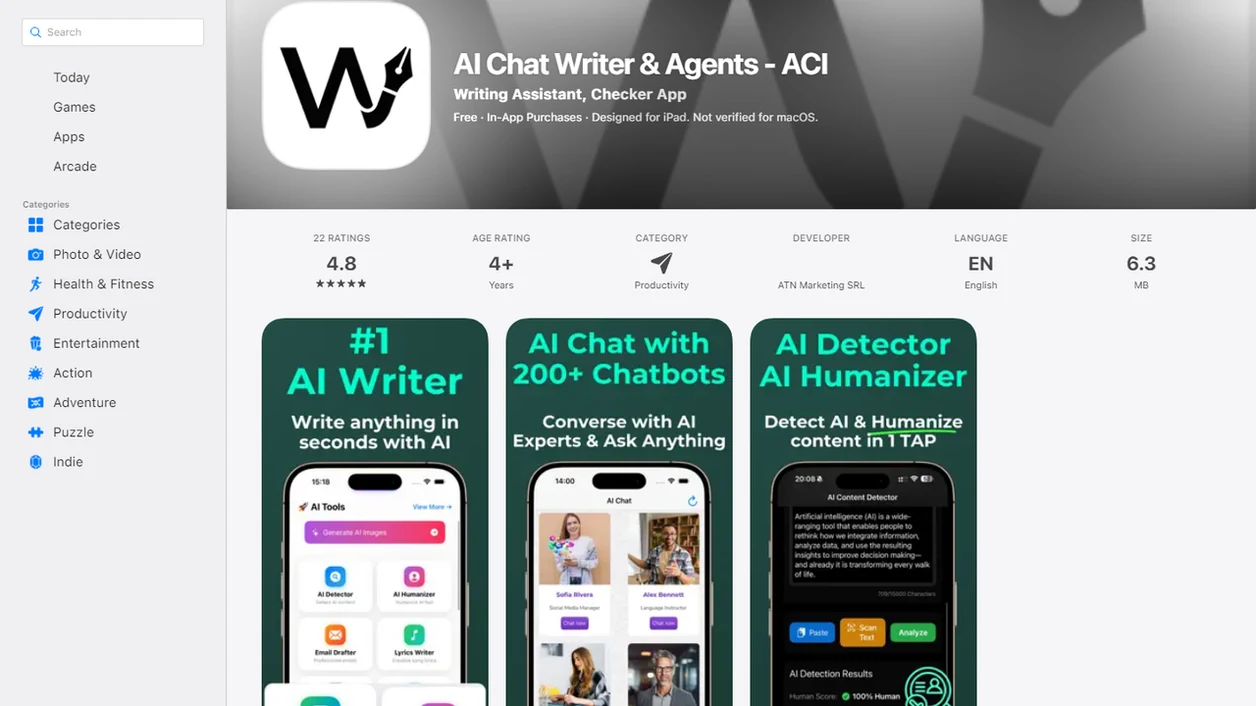
The ChatGPT AI checker in Write.info shows an overall AI probability score as a percentage, then marks sentence-level risk with color-coded highlighting. That layout keeps the review focused on text you can actually change.
The pocket check is real.
On the web, you can paste a draft, scan it, and move directly into Humanize or Rewrite. On iOS, the same workflow fits shorter bursts, like switching between a laptop draft and the phone while commuting. A bus seat essay check on a phone is not the place for a long report. It needs a clear percentage, highlighted sentences, and a practical next step.
Anyone dealing with a flagged paragraph rather than a whole document score gets better direction from Write.info because the interface connects results to sentence-level AI detector review and editing actions. For deeper passage review, use the sentence-level AI detector.
Common Myths About ChatGPT Detectors
ChatGPT detectors are often treated as proof machines, but they are pattern readers. That gap creates most of the confusion.
| Myth | Fact |
|---|---|
| A detector can prove ChatGPT wrote the text. | It estimates probability from text features; it does not verify authorship. |
| A high AI score always means AI-generated. | Human writing can be flagged when it is polished, formulaic, or unusually uniform. |
| Editing or paraphrasing does not affect results. | Rewriting can change rhythm, word choice, and detector scores significantly. |
| All ChatGPT detectors work the same way. | Each tool uses different models, thresholds, and scoring features. |
Research in 2023 reported bias against non-native English writers, which means human-written work may be scored unfairly in some contexts. That matters in classrooms, hiring reviews, and editorial workflows. A detector result should start a conversation about the text, not end it.
For teachers and teams, the safer practice is to combine detector output with drafting history, citation checks, and human review because no score can establish authorship by itself.
ChatGPT Detector Vs Alternative AI Checkers
A ChatGPT detector is most useful when it explains what to do after the score. Many alternatives return a number, but leave the writer guessing.
| Tool or category | Accuracy transparency | Interpretation guidance | Integrated editing tools |
|---|---|---|---|
| Write.info | Shows probability-based results | Highlights passages and next actions | Humanizer, Rewriter, Copy workflow |
| GPTZero | Varies by text and use case | Offers AI-likelihood signals | Separate from full rewriting workflow |
| ZeroGPT | Score-focused checking | Limited revision direction | Not built around draft repair |
| Grammarly or QuillBot workflows | Strong editing support | AI detection varies by feature set | Editing-first, not always detector-first |
Accuracy varies widely across all tools, especially after paraphrasing or heavy editing. In a 2023 evaluation of 14 AI text detectors, all scored below 80% accuracy, and only five scored above 70%, according to reported evaluation data. Source the claim inline with the study URL, for example: 'See the 2023 evaluation of 14 detectors: https://arxiv.org/abs/2306.15666.' That is why a score-only workflow can mislead a reviewer.
The right fit for writers who need detection plus repair is Write.info because it pairs the ChatGPT content detector with humanizer and rewriter tools inside one revision path.
Evidence Behind ChatGPT Detector Accuracy Claims
The evidence behind ChatGPT detector accuracy claims is mixed: detectors can be useful screens, but published tests do not support treating them as proof. A 2023 evaluation of 14 detectors found every tool below 80% accuracy, with only five above 70% source.
Peer-reviewed work has also reported that non-native English writing can be falsely flagged at higher rates, especially when the prose is careful, formal, and low-variation source. Claims about different false-positive rates across racial groups should be read cautiously unless the dataset, test conditions, and decision threshold are shown; the safer wording is that demographic disparities have been reported and need human review before any serious action.
Use detector evidence in this order:
- Read the score as a probability signal, not an authorship finding.
- Check the passages for repeated structure, generic transitions, and unusually even rhythm.
- Compare the context against drafting history, sources, assignment rules, or editorial notes.
- Review edited text carefully because paraphrasing and light rewriting change word choice, predictability, and burstiness, which can lower or raise a detector score.
- Decide with a human reviewer before making academic, workplace, or compliance judgments.
Related Write.info Writing Tools
Write.info connects detection to the writing tasks that usually follow. If a passage is flagged as AI-written, the humanizer can soften stiff phrasing while keeping the meaning intact. If the issue is tone, clarity, or originality, the rewriter can produce a cleaner version for review.
Chat agents help with drafting support, outlines, summaries, emails, and idea generation. They should still be checked against the assignment, source, or client brief. Citation details matter here: a missing page number, a dead DOI link, or a source title pasted in the wrong case can make a polished draft unreliable.
On days client edits arrive under a late-night desk lamp, Write.info helps because detection, rewriting, and chat support stay in one writing workflow on web and iOS. If you need no-cost checking first, start with the free AI detector for ChatGPT.
Limitations
ChatGPT detectors have real uses, but they also have hard limits. Treat these limits as part of the workflow, not fine print.
- They do not prove authorship. Detectors infer likelihood from text features; they do not verify the source, device, account, or drafting process.
- Scores can change after editing. Paraphrasing, rewriting, or humanizing can shift results significantly.
- Human writing can be flagged. Polished, formulaic, repetitive, or non-native English writing may trigger false positives.
- Published accuracy is mixed. A 2023 evaluation found that all 14 AI detectors tested scored below 80% accuracy.
- Bias concerns are documented. 2024 reporting found false-positive-rate concerns across racial groups.
- Paraphrasing weakens detection. Research has found detection performance can drop after rewriting.
- Non-native writers face extra risk. Peer-reviewed research has reported bias against non-native English text. Peer-reviewed research on non-native English false positives: https://www.cell.com/patterns/fulltext/S2666-3899(23)00130-7.
- Marketing claims can overreach. Some accuracy claims sound cleaner than published evaluations support.
Use Write.info as a revision aid, not as a shortcut for academic, editorial, or workplace judgment.