
Teacher Guide to AI Detection for Fair Classroom Review

A teacher guide AI detection process should treat detector results as a starting signal, not proof of cheating. Use AI scores alongside drafts, version history, classroom writing samples, student conferences, and clear AI-use policies before making any academic integrity decision.
> Scope note: This guide is for classroom review and AI-literacy planning, not legal advice or a standalone academic-integrity procedure. Follow your school policy, district rules, and applicable student-privacy requirements before uploading or acting on student work.
- AI detectors estimate likelihood from text patterns; they do not prove authorship.
- False positives are a real classroom risk, especially for English learners and highly edited writing.
- Fair review combines detector results with process evidence, student conversation, and documented policy.
Teacher Guide AI Detection At a Glance
A teacher guide AI detection workflow should define detection as probability-based classroom review, not a verdict. The practical sequence is simple: check, compare, ask, document, then decide proportionally.
An AI detector can flag text that looks statistically similar to machine-generated writing. It cannot know who sat at the laptop, which draft came first, or whether a student used allowed editing help. That matters when a student is rereading a detector result at 11:47 p.m. before a learning-management-system upload window closes.
For teachers, the safer workflow is to scan only when policy allows, compare the result with known writing, review drafts and citations, then talk with the student. Tools like Write.info can help teachers check passages on web or iOS, but human judgment has to remain central.
Not a courtroom. A classroom review.
5 AI Detector Facts Teachers Should Know
- AI detectors return likelihood scores based on text patterns; they do not provide definitive yes-or-no proof of authorship.
- False positives and false negatives both happen under normal classroom conditions, especially with short responses, revised drafts, and mixed AI-human writing.
- A 2023 ACM evaluation of 14 commercial detectors found false positive rates on human-written text ranging from 0% to 66%, with several tools misclassifying more than 20% of genuine student work source.
- The same 2023 study reported higher flagging risk for non-native English writers, which makes classroom AI detection an equity issue, not only an integrity issue.
- Process evidence is usually stronger than a single detector result because drafts, version history, outlines, in-class writing, and oral explanation show how the work developed.
Clear AI-use policies reduce conflict with students and families because everyone knows what counts as allowed help. A folder of drafts named “final-final” may tell more than one detector score. For a deeper look at reliability concerns, our AI detector limitations guide explains why scores can shift.
Classroom AI Detection Signals in Student Essays
Classroom AI detection analyzes statistical signals in writing, such as predictability, sentence structure, word choice, repetition, and complexity. In plain terms, the tool asks whether the paragraph behaves like text often produced by a language model.
Most detectors do not compare a student essay against a complete database of every AI-generated passage. They estimate patterns. A polished human essay, translated passage, grammar-aided draft, or heavily revised AI outline can confuse that estimate. So can generic phrasing like “in today’s fast-paced world” or “delve into the nuances,” especially when those lines appear beside normal student voice.
The practical next step is interpretation. Write.info can help identify passages that read as unusually generic or machine-like, but the teacher still has to compare the result with the assignment, the student’s prior work, and the permitted support.
5-Step AI Detector Review Process for Teachers
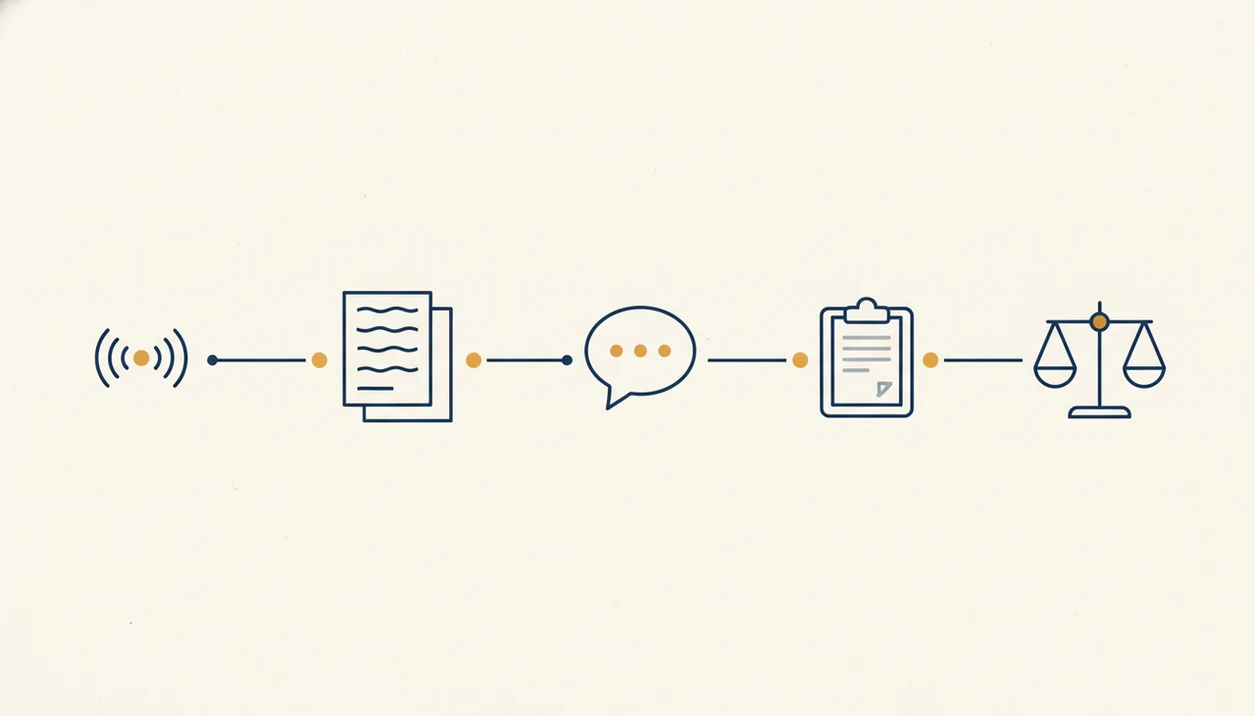
A fair AI detector review process starts with policy and ends with a proportional response. It should not begin with an accusation.
1. Set the classroom AI policy
Tell students when AI is allowed, limited, or prohibited before the assignment begins. Include examples for brainstorming, outlining, grammar help, citation cleanup, and full-draft generation.
2. Check the passage with context
Scan only when school policy and assignment rules allow it. Review the prompt, length, genre, and whether the student had access to AI tools.
3. Compare drafts and writing samples
Look at outlines, version history, in-class writing, citation notes, and earlier assignments. Students whispering over highlighted essays often leave a process trail.
4. Ask the student to explain choices
Ask how they built the argument, chose sources, revised claims, and handled citations. Document observations without labeling the student as dishonest.
5. Decide on a proportional response
Use coaching, revision, reflection, or formal review only when the evidence supports it. For teachers, process review is often fairer than score-based punishment because it checks authorship through visible writing decisions.
Teacher False Positive Guide for Student Writing
Can a student essay be human-written and still get flagged as AI-generated? Yes. A teacher false positive is a human-written assignment that an AI detector labels as likely AI-generated.
A 2023 preprint analyzing OpenAI’s GPT-2 output detector found that over 20% of TOEFL essays written by non-native speakers were labeled AI-generated, even though the essays were human-written source. That risk matters for English learners, students using translation or grammar tools, and students who have been taught formulaic academic structures.
A de-escalation script helps: “The tool flagged parts of your writing, but that does not prove misconduct. Walk me through your draft process, sources, and revision choices.” Then listen.
Do not use a detector score as the only reason for a grade penalty or misconduct report. Our guide to AI detector false positives covers common causes in more detail.
5 Classroom AI Detection Myths Teachers Hear
- Myth 1: AI detectors are 100% accurate. They estimate likelihood from patterns, and those estimates can be wrong.
- Myth 2: A likely-human result proves no AI was used. False negatives happen, especially after paraphrasing or heavy revision.
- Myth 3: Scanning every paper is the best integrity strategy. Blanket scanning can raise privacy, trust, and equity concerns.
- Myth 4: A flagged paper should immediately be treated as cheating. A flag should lead to review, not a conclusion.
- Myth 5: Humanizer or paraphrasing tools always mean misconduct. Context matters. A student may use revision help in an allowed way, or may cross a policy line.
The better framing is AI literacy: teach students how drafting, disclosure, revision, and source checking work. A highlighted clunky transition in pink can become a discussion, not a trap.
Classroom AI Detection Policy Language for Teachers
A classroom AI detection policy should say when AI is allowed, limited, or prohibited, and how students must disclose it. The policy should also explain whether assignments may be reviewed with an AI detector for teachers.
Useful policy elements include allowed uses for brainstorming, outlines, grammar support, translation, citation help, and revision. Require disclosure when AI affects a claim, paragraph, structure, source list, or final wording. Also state that detector scores are not standalone proof of misconduct.
Sample wording: “I may use AI detection tools as one review aid when authorship concerns arise. A detector score alone will not determine a grade or discipline outcome. I will also review drafts, version history, citations, in-class writing, and your explanation of the work.”
Before uploading student writing, review school rules, consent expectations, and privacy obligations. The privacy question is practical, not abstract; start with is it safe to paste essays before using any third-party tool. For U.S. schools, the U.S. Department of Education’s FERPA guidance explains how student education records may be protected and disclosed: source.
AI Detection Tools for Teaching AI Literacy
A classroom detection toolkit should support review and revision discussion, not accusation-first decisions. Useful features include an AI detector, revision aids, chat support, web access, and a companion mobile app.
In class, a teacher can compare two drafts, ask why one sounds generic, then model ethical revision while keeping the meaning intact. Apps such as Grammarly, ZeroGPT, QuillBot, ChatGPT, and Write.info can support checking and revision conversations, not replace teacher judgment or school policy. A good AI writing assistant platform with a detector, humanizer, rewriter, chat agents, web access, and a companion iOS app should help people review and revise writing responsibly, not prove misconduct or hide plagiarism.
A draft synced from laptop to phone can be useful during a commute. Still, source checking and disclosure stay with the person submitting the work. ACI should be treated as one literacy aid inside a broader classroom process.
When to Escalate an AI Detection Concern
Escalate an AI detection concern when the next decision could affect a grade, discipline record, course standing, or academic file. A detector flag can begin a review, but consequences should move through the school’s normal support and integrity channels.
A calm handoff protects the student and the teacher. Before contacting families about suspected misconduct, involve an administrator or the person named in your academic-integrity procedure. If student writing would be uploaded to an outside detector, ask privacy, technology, or data-governance staff first; the question is not only whether the tool works, but where the work goes.
- Pause any grade penalty or misconduct label until the review is complete.
- Document the concern neutrally, including the assignment prompt, detector result, drafts, version history, and conference notes.
- Consult an administrator before sending a family email that implies cheating or dishonesty.
- Check with privacy or technology staff before using an external tool with identifiable student work.
- Refer to counseling or student-support channels if the conversation becomes upsetting, panicked, or bigger than the assignment.
The goal is not to win an argument. It is to keep the review fair, private, and proportionate.
Limitations
AI detection has real limits, and teachers should name them before using scores in any academic integrity process.
- No AI detector can reliably prove authorship on its own.
- False positives can affect honest students, especially non-native English writers and students using grammar support.
- False negatives happen when students paraphrase, heavily edit, mix AI and human writing, or use humanizer tools.
- Detector scores can vary across tools and across revised versions of the same assignment.
- Uploading student work may raise privacy, FERPA, institutional policy, or consent concerns.
- Over-surveillance can damage trust and turn writing instruction into a cat-and-mouse game.
- Teachers still need assignment design, drafting checkpoints, source review, and student conferences.
- A missing page number, dead DOI link, or source title pasted in the wrong case may reveal process issues better than a score.
If the core question is can AI detectors prove cheating, the safest answer is no. They can support review, but they cannot carry the decision alone.
FAQ
Can AI detectors prove cheating?
No. AI detectors estimate whether text resembles AI-generated writing, but they cannot prove who wrote an assignment or what support was used. Teachers should treat a detector result as one signal and review drafts, version history, citations, classroom writing samples, and the student’s explanation before deciding what happened.
Are AI detectors accurate for student essays?
AI detectors can be useful for review, but accuracy varies by tool, text length, writing style, revision level, and language background. Student essays are especially difficult because they may include formulaic academic phrases, grammar-tool edits, translated sections, or mixed AI-human drafting.
What causes AI detector false positives?
False positives can happen when human writing is polished, highly structured, repetitive, translated, grammar-aided, or written in a formulaic academic style. English learners and students following rigid essay templates may face higher risk. A score should prompt a careful review, not an automatic penalty.
Should teachers scan every paper with an AI detector?
Blanket scanning can create privacy, trust, and equity concerns, especially if students were not told it would happen. A better approach is to use detection only when policy allows and when there is a specific authorship concern, then combine the result with process evidence.
How should teachers talk to students about flagged writing?
Start with questions, not accusations. A teacher can say, “The writing raised a concern, and I want to understand your process. Can you show your drafts, explain your source choices, and walk me through how this paragraph changed?” Document the conversation neutrally.
Do AI detectors flag English learners more often?
Research has shown higher flagging risk for non-native English writers in some detector evaluations. That creates an equity concern for classrooms. Teachers should be especially careful with English learners and should compare detector results with drafts, prior writing, oral explanation, and allowed language support.
Can students bypass AI detectors?
Students can reduce detector reliability through paraphrasing, mixed authorship, heavy editing, translation, or humanizer tools. That does not make all revision misconduct, but it means teachers should not rely on detection alone. Policy, process records, and student explanation are stronger review tools.
What evidence supports an AI misuse concern?
Stronger evidence includes missing drafts, sudden style changes, inconsistent oral explanation, suspicious version history, unsupported citations, or a mismatch between in-class writing and submitted work. No single clue is enough by itself. Teachers should look for a pattern across the assignment process.
What should a classroom AI policy include?
A classroom AI policy should define allowed, limited, and prohibited AI use. It should require disclosure for brainstorming, drafting, revision, citation, and editing when AI affects the work. It should also explain possible detector review, privacy limits, and proportional consequences.
How can teachers use an AI detector responsibly?
Teachers can use an AI detector to check text, compare drafts, discuss generic wording, and model revision choices. It should be used for AI literacy and fair review, not as a standalone misconduct decision. Students still need clear policies, disclosure expectations, and human feedback.