
Check AI Detection Risk Before You Submit or Publish
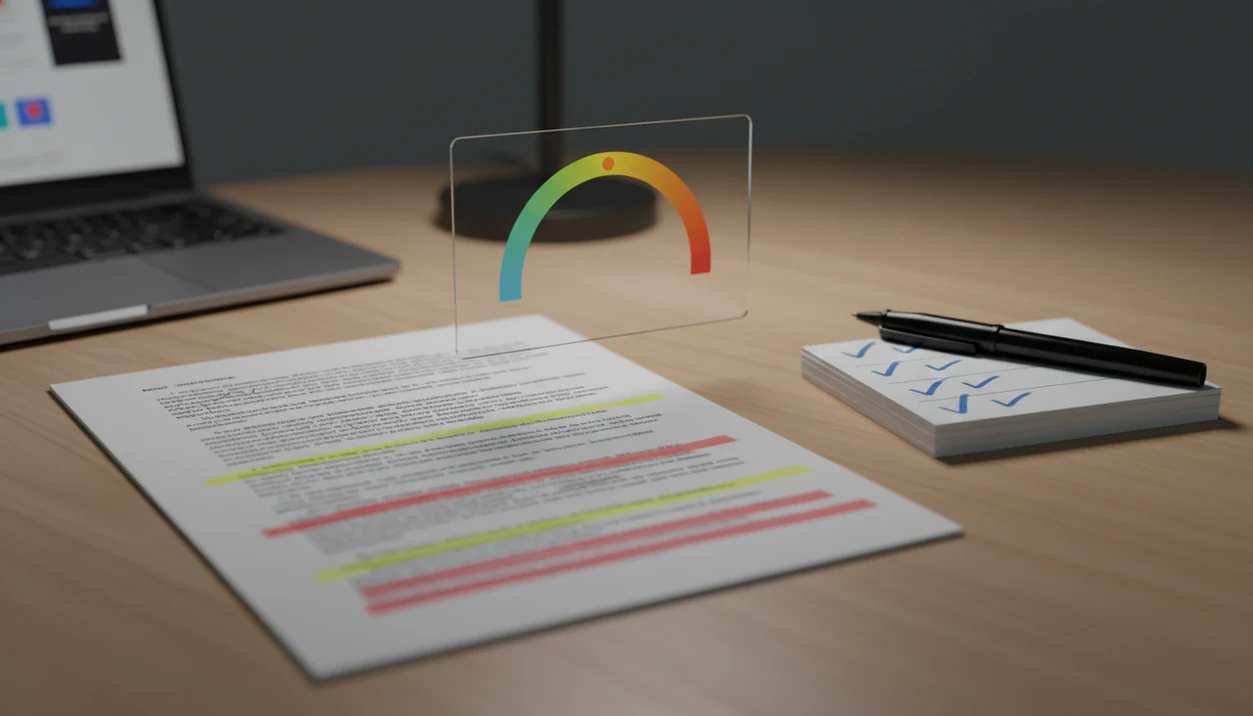
To check AI detection risk, run your draft through an AI risk checker, review the score as a probability signal, inspect highlighted passages, compare the result with your policy rules, and keep a record of your own edits. A high score is not proof of AI use, but it is a useful warning sign before submitting schoolwork, client copy, or public content.
> Write.info is an AI detector that checks AI-generated text and provides humanizer, rewriter, and chat tools for students, writers, and professionals.
- AI detector scores are probability signals, not proof that a document was written by AI.
- The same text can receive different AI detection risk results across tools because detectors use different models, thresholds, and training data.
- The safest way to reduce AI flag risk is to revise substantively yourself, add verifiable detail, vary sentence structure, and document your writing process.
AI Detection Risk Checklist for Draft Scores
AI detection risk is the chance that your text resembles AI-generated writing to a detector, reviewer, or platform. To check it well, look beyond the headline score and review the draft’s length, use case, policy setting, and evidence that you revised the work yourself.
A detector score should trigger review, not panic. If a paragraph is highlighted, ask what made it look predictable: repeated transitions, a flat claim, or a generic opener like “in today’s fast-paced world.” The practical next step is to revise the draft with sharper evidence and clearer reasoning.
Tools like Write.info can help you check text, inspect highlighted passages, and revise responsibly. Still, the final judgment belongs to the writer and the policy owner, not the score bar.
The cursor blink feels louder at 11:47 p.m.
How an AI Risk Checker Works Behind the Score
An AI risk checker estimates whether writing patterns resemble human-written or AI-generated text; it does not measure the literal percentage of AI-written words. The score is usually a probability, classification, or risk label produced by a model trained on examples of different writing sources.
Behind the result, detectors often examine sentence predictability, repetition, burstiness, phrasing regularity, and possible model-specific fingerprints. “Burstiness” means variation in sentence length and rhythm. Human drafts often have uneven patches, side notes, and revision marks. AI drafts can look smoother, especially when every paragraph has the same balance and tone.
Vendor benchmarks can sound precise, but real-world accuracy varies. For context, RAID publishes cross-detector benchmark results, including GPTZero entries (https://raid-bench.xyz), and Copyleaks publishes its own AI detector accuracy claims (https://copyleaks.com/ai-content-detector). Treat those benchmark pages as context, not guarantees for your assignment, client memo, or article. A highlighted paragraph beside a score bar is a prompt to investigate, not a verdict.
How to Use Write.info to Check AI Flag Risk
Use a complete draft when you check AI flag risk, because short excerpts can distort the result. A paragraph pasted alone may look more uniform than it does inside the full paper, email, or article.
- Paste or upload the complete draft, not only a short excerpt.
- Run the AI detector and read the overall score as a risk signal.
- Review highlighted passages and look for repetitive, generic, or overly polished sections.
- Revise with your own evidence, examples, sources, structure, and voice before using a rewriter or humanizer.
- Recheck the revised draft and save your revision history or notes when the stakes are high.
We usually recommend making the first revision by hand. Copy-paste a paragraph into Write.info, inspect the highlighted sentences, then fix one claim at a time with your own evidence, source notes, and sentence rhythm. Use the detector, humanizer, rewriter, chat agents, web editor, or iOS app to support accountable revision, not to replace your judgment.
For students, an AI essay checker is most useful when it sits before final proofreading, because it can surface risk while there is still time to revise.
Five AI Detection Risk Facts Before You Submit
Before you trust one detector result, keep these five facts in view. They are the difference between a careful review and an overreaction.
- A high AI score does not prove misconduct. It means the text resembles patterns the detector associates with AI-generated writing. - Different detectors can disagree on the same draft. Models, thresholds, and training data vary by tool. For higher-stakes drafts, compare named tools such as GPTZero, Copyleaks, Originality.ai, or an institution-provided Turnitin AI report when you have legitimate access, then resolve conflicts with policy rules and revision evidence. - Human writing can be falsely flagged. Formal, repetitive, short, or technical writing may raise risk even when the author wrote it. - Hybrid documents are harder to judge. A draft with human notes, AI-generated sections, and heavy edits is harder to classify than a clean single-source sample. - Policy context matters. The same score may be minor for a blog post, serious for a college assignment, and unacceptable for a no-AI exam.
A high AI detection score should be treated as a review signal, not as proof that a writer used AI.
AI Detection Risk Score Interpretation Table
AI detection scores are easiest to use when you translate them into actions. Thresholds differ by detector and institution, so treat the table below as a practical guide, not a universal rule.
| Score pattern | Likely meaning | Risk level | Recommended action |
|---|---|---|---|
| Low risk across a full draft | Text does not strongly match the detector’s AI patterns | Lower | Proofread, check citations, and keep normal revision notes |
| Mixed or uncertain risk | Some passages look predictable or overly uniform | Medium | Review highlights, revise weak sections, and recheck |
| High risk on many passages | The draft strongly resembles AI-style output to that detector | Higher | Rewrite substantively with your own reasoning, evidence, and structure |
| Very short text | The sample may be too limited for reliable classification | Unclear | Test a longer section or full draft before drawing conclusions |
| Policy-sensitive submission | Rules may prohibit or require disclosure of AI assistance | Context-dependent | Read the policy and save drafts, notes, and source records |
Highlighted passages, policy rules, and revision evidence matter as much as the headline score. For planning deadlines, an essay revision timeline helps leave space for review before the upload window closes.
Common AI Flag Risk Triggers in Real Drafts
Common AI flag risk triggers include generic introductions, repeated transitions, balanced but shallow paragraphs, uniform sentence length, vague claims, and a lack of concrete detail. The fix is better writing, not adding errors or awkward phrasing.
- Generic introductions: Openers like “delve into the nuances” tell the reader little. Replace them with the specific problem, source, or scene.
- Repeated transitions: Stock connectors repeated across paragraphs can sound templated; vary transitions or remove them when the logic is already clear.
- Balanced but shallow paragraphs: Three neat sentences with no evidence often read polished but empty.
- Uniform sentence length: Every sentence landing at the same rhythm raises suspicion and weakens the draft.
- Vague claims: “Many people believe” needs a source, a number, or a named example.
Overly formal human writing can trigger risk too. Don’t roughen a draft on purpose. Add original examples, sourced evidence, personal process notes, specific constraints, and varied rhythm.
Real detail helps.
AI Risk Checker Results Versus Plagiarism Checks
AI detection and plagiarism checking measure different problems. AI detection estimates whether text resembles AI-generated writing, while plagiarism checking compares text against existing sources for matching or insufficiently cited language.
| Check type | What it looks for | What it cannot prove | Practical use |
|---|---|---|---|
| AI risk checker | AI-like writing patterns | That a person definitely used AI | Review flagged style patterns and policy risk |
| Plagiarism checker | Matching or closely paraphrased source text | Whether the writing was human-authored | Check originality, citation gaps, and copied phrasing |
| Both checks together | Style risk plus source overlap | Intent or misconduct by themselves | Support a fuller review when rules require originality and human-authored work |
A document can be original but high AI risk. It can also be plagiarized but low AI risk. Students, writers, and professionals should run both checks when their rules require originality and human-authored work.
One missing page number can change the conversation.
Responsible Revision Methods for AI Detection Risk
The safest way to reduce AI detection risk is to write or heavily revise the content yourself. Substantive revision means changing the reasoning, evidence, structure, and examples, not just swapping words.
Start by adding first-hand analysis. In a class paper, connect the claim to the prompt and your course material. In client copy, add the product constraint, audience objection, or approved messaging note from the brief. In a research draft, check the source title, page number, DOI link, and citation format before polishing the sentence.
A humanizer or rewriter can help smooth phrasing after you revise the ideas, but it should not replace your own contribution. If your school, publisher, employer, or platform requires disclosure, use clear language and keep notes. Our AI writing disclosure templates cover common wording for policy-aware submissions.
For high-stakes work, revision notes are often more useful than a lower score because they show how the draft changed.
iOS App Checks for AI Detection Risk
Can an app check AI detection risk? Yes. An app can scan text and return a risk score plus passage-level signals, but the result still needs cautious interpretation.
Write.info offers web tools and a companion iOS app for AI detection, humanizing, rewriting, and chat workflows. A mobile check is useful during last-minute review, draft cleanup, client copy edits, student writing, and publishing workflows. We have seen writers switch between a laptop draft and the iOS app while commuting, making two-sentence fixes before a client review.
The train window reflects the prompt box.
Mobile checks work best for review, not for rushed replacement writing. If you need a student-focused mobile workflow, an app to help check essay AI can fit before final proofreading. App results have the same limitations as browser-based detectors.
Limitations
No AI risk checker is perfectly accurate, even when vendors report strong benchmark performance. Treat the score as one piece of evidence, especially when the consequences are academic, professional, or public.
- False positives can happen, so human writing may be flagged as AI-generated.
- False negatives can happen, so AI-generated writing may pass as low risk.
- Very short text is harder to classify because the detector has less pattern evidence.
- Technical writing, formal style, and hybrid human-AI drafts can produce unstable results.
- Scores can change when detector models update or when institutions use different thresholds.
- Reducing a score with a humanizer or rewriter does not guarantee compliance with a school, employer, publisher, or platform policy.
- Uploading sensitive, confidential, or unpublished work should be evaluated against the tool’s privacy and data policies.
- A clean score does not fix weak evidence, missing citations, or copied source language.
If a draft has already been flagged, the practical next step is to preserve records and read what to do if essay flagged AI before making more edits.
FAQ
What is AI detection risk?
AI detection risk is the chance that a detector, reviewer, or platform may flag text as AI-generated. It is based on writing patterns, not direct proof of how the text was produced.
Are AI detector scores proof that someone used AI?
No. AI detector scores are probabilistic signals and should not be treated as definitive proof of AI use.
Can human writing be falsely flagged as AI-generated?
Yes. False positives can happen, especially with short, formal, repetitive, technical, or highly polished human writing.
Why do AI checkers give different results for the same text?
AI checkers use different models, training data, thresholds, and scoring methods. The same draft can receive different risk labels across tools.
How accurate are AI detectors?
Accuracy varies by tool, text length, writing style, source model, and benchmark. Vendor-reported accuracy can be useful context, but it does not guarantee a correct result on one draft.
Is AI detection the same as plagiarism checking?
No. AI detection estimates whether text resembles AI-generated writing, while plagiarism checking looks for matching or insufficiently cited source text.
How can I lower my AI detection risk responsibly?
Revise substantively with your own evidence, analysis, examples, structure, and sentence rhythm. Use rewriting tools only in ways allowed by your school, employer, publisher, or platform.
Is there an app that can check AI detection risk?
Yes. Apps such as Write.info can check AI detection risk on mobile, but app scores still require cautious interpretation and policy review.