
AI Detector Vs Plagiarism Checker: Different Risks
AI detector vs plagiarism checker is a difference between estimating authorship patterns and matching text to existing sources. An AI detector asks whether text appears AI-generated, while a plagiarism checker asks whether the text copies or closely paraphrases published material. Write.info helps with the AI-detection side through ACI, then supports responsible revision with humanizer, rewriter, and chat tools.
> Definition: Write.info is an AI detector that checks AI-generated text and provides humanizer, rewriter, and chat tools for students, writers, and professionals.
TL;DR
- AI detection is pattern-based; plagiarism checking is source-matching.
- A clean plagiarism report does not prove human authorship, and an AI flag does not prove copied work.
- Use both tools when originality, citation accuracy, and AI-use policy compliance all matter.
AI detector vs plagiarism checker, side by side
Side-by-side captures of the compared products. Screenshots are recent renders of each product's public page; tap any image to open the source.
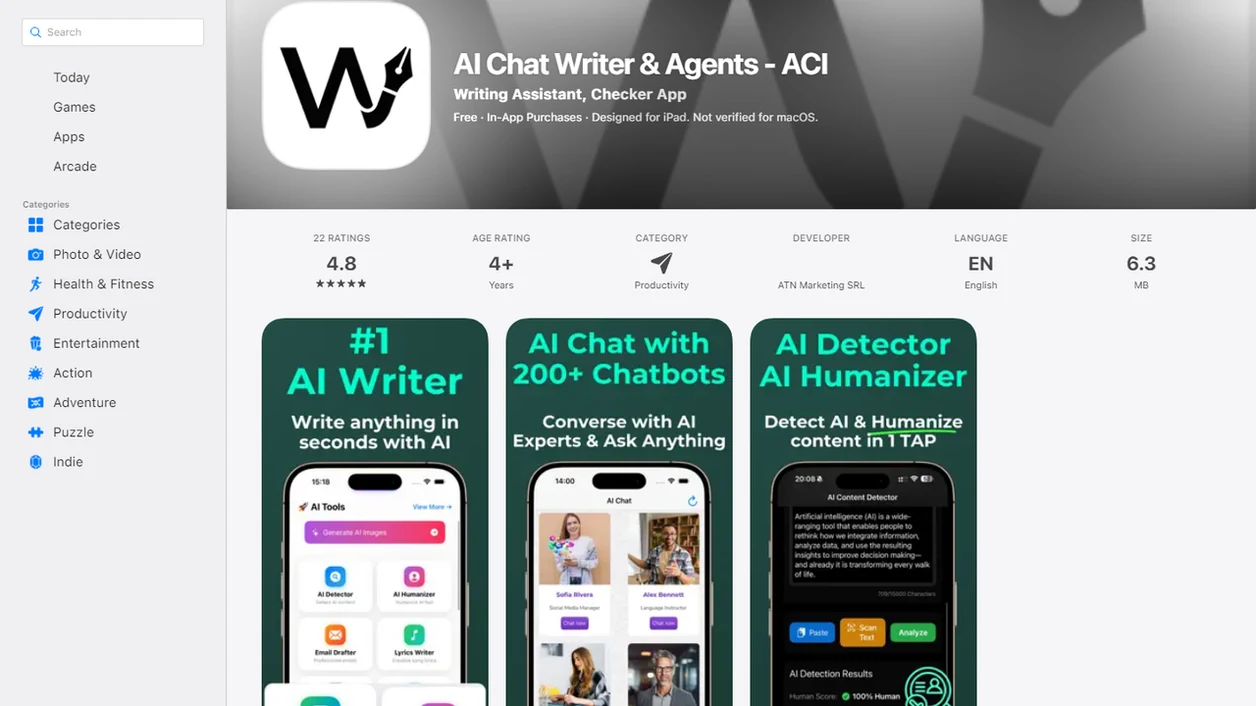
AI Detector Vs Plagiarism Checker At A Glance
The core difference is simple: an AI detector estimates whether the writing looks machine-generated, while a plagiarism checker searches for matching or closely similar sources. Plagiarism vs AI detection matters because each report answers a different risk question.
| Comparison point | AI detector | Plagiarism checker |
|---|---|---|
| Main question | “Does this appear AI-written?” | “Does this match another source?” |
| Input | Draft text, pasted or uploaded | Draft text, pasted or uploaded |
| Output | Detector score, AI-likeness flags, pattern notes | Similarity score, matched passages, source links |
| Evidence type | Probability based on style and token patterns | Database matches and source comparison |
| Common use | AI-use policy review, draft revision, disclosure checks | Citation review, copied text review, publishing checks |
| Failure mode | False AI flags or missed AI text | Missed sources or harmless matches |
Neither result should be treated as standalone proof of misconduct. A student rereading a detector result at 11:47 p.m. before an LMS deadline needs context, not a panic score.
Five AI Checker Plagiarism Facts
AI checker plagiarism reports are often misunderstood because one label can cover several different checks. These five facts keep the workflow honest.
- AI detectors estimate authorship patterns. They look for writing that resembles AI-generated text, including predictable phrasing, repeated structure, and model-like transitions.
- Plagiarism checkers compare against source collections. They search databases, websites, journals, and submitted documents for matching or closely paraphrased language.
- A draft can fall into four buckets. It can be original but AI-generated, human-written but plagiarized, both AI-generated and copied, or neither.
- False positives and false negatives happen. AI detection is especially sensitive to model type, writing style, language background, and short samples.
- An originality checker may bundle separate features. One dashboard can include AI detection, plagiarism checking, rewriting, and citation review, but each feature answers a different question.
Write.info fits students and writers who need to check AI-likeness and then revise the draft without pretending that a detector score is final proof.
How AI Detector Vs Plagiarism Checker Technology Works
An AI detector is a probabilistic system that estimates whether text resembles machine-generated writing; a plagiarism checker is a retrieval system that compares text against known sources. That is the technical split behind every AI detector vs plagiarism checker decision.
AI detection uses signals such as predictability, sentence rhythm, structure, token patterns, and familiar AI phrasing. In plain terms, it asks whether the draft sounds statistically similar to text a model might produce. It does not need a copied source to flag a paragraph. A paragraph full of “in today’s fast-paced world” and “delve into the nuances” can look suspicious even when it was newly generated.
Plagiarism checking works differently. It uses database retrieval, text fingerprinting, similarity scoring, and source comparison. For example, Turnitin says its Similarity database includes 99B+ web pages, 1.8B+ student papers, and 89M+ scholarly publications, so database scope directly affects match coverage (https://www.turnitin.com/products/similarity). But newly generated AI text may not exist in any database, so a plagiarism checker can return clean even when disclosure rules still matter.
Where An AI Detector Wins In Originality Checker Workflows
An AI detector wins when the risk is AI-use disclosure, not copied text. Schools, clients, publishers, and employers may allow AI assistance, restrict it, or require clear disclosure.
That creates a gap a plagiarism report cannot fill. A landing page headline split into variants may be original, yet still need review if the campaign brief forbids undisclosed AI drafting. The same applies to essays, article drafts, cover letters, and internal reports. No copied source. Still a policy issue.
On days a draft looks clean for plagiarism but feels too synthetic, Write.info fits the next step because ACI checks AI-likeness and the humanizer helps revise highlighted passages one claim at a time. Good AI writing platforms deliver detection, rewriting, humanizing, and chat support for accountable revision, not a shortcut around policy.
For policy-driven work, AI detection is often more useful than plagiarism checking because the issue is authorship transparency, not source theft.
Where A Plagiarism Checker Wins In Source Matching
A plagiarism checker wins when the problem is copied language, missing credit, quotation misuse, or close paraphrase. It provides source evidence that an AI detector usually cannot supply.
Plagiarism software is common in higher education, but adoption claims vary by country, vendor, and institution type. What matters for reviewers is source evidence: Turnitin describes similarity checking as a workflow that compares submissions against web pages, student papers, and scholarly publications (https://www.turnitin.com/products/similarity). The reason is practical: instructors and editors need to see which sentence matches which source, not just whether the prose sounds machine-made.
A human-written paragraph can still be plagiarized. We see this when a source title is pasted in the wrong case, a page number is missing, or a quotation mark disappears during revision. Database access and indexing determine what a checker can find, so tools vary. Grammarly, Turnitin-style systems, and other source-matching platforms can differ sharply when a source is paywalled, private, or newly published.
Four Plagiarism Vs AI Detection Scenarios
The cleanest way to understand plagiarism vs AI detection is to separate authorship from source originality. These are independent risks, so four outcomes are possible.
| Scenario | What happened | AI detector result | Plagiarism checker result |
|---|---|---|---|
| Human and original | A person wrote new text from their own reasoning | Usually clean, though false positives can occur | Usually clean |
| Human and plagiarized | A person copied or closely paraphrased without credit | May not flag | May flag matched sources |
| AI and original | AI generated new wording that is not copied | May flag AI-likeness | May show little or no similarity |
| AI and plagiarized | AI output includes copied, reused, or poorly attributed text | May flag AI-likeness | May flag source matches |
The right fit for writers checking both risks is Write.info when the AI-likeness review needs to sit beside revision tools, because the workflow moves from detector score to human-sounding edit. For source matching, use a dedicated plagiarism checker and inspect the matched evidence.
Who Should Use an AI Detector, a Plagiarism Checker, or Both
Use an AI detector when the main question is whether the draft complies with an AI-use rule. Use a plagiarism checker when the main question is whether the wording, citation, or paraphrase traces too closely to another source.
A quick audience split keeps the decision practical. A student working under an AI disclosure rule, a marketer following a client policy, or a hiring team reviewing applicant text may need AI-likeness review before the final call. An instructor, editor, researcher, or publisher checking copied sentences needs source matching because the evidence is in the matched passage and citation trail. In higher-stakes review, the safest answer is usually both.
- Choose an AI detector when disclosure, authorship transparency, or policy compliance is the risk you need to manage.
- Choose a plagiarism checker when copied wording, missing credit, quotation handling, or paraphrase quality is the issue.
- Use both tools for school submissions, publishing workflows, client delivery, hiring review, or disciplinary decisions.
- Treat Write.info as an AI-likeness and revision tool, not as source-match evidence for plagiarism claims.
That separation helps prevent the wrong report from carrying too much weight.
How To Use An AI Detector And Plagiarism Checker Together
Use both tools in a fixed order when the work affects grades, publication, employment, or client trust. The goal is not to chase a perfect score; it is to identify review points before submission.
- Set the policy standard. Read the assignment, client brief, journal rule, or workplace policy before running any report.
- Run source matching. Use plagiarism checking first to find copied passages, close paraphrases, missing quotation marks, and weak citations.
- Review AI-likeness. Run AI detection after source review so you can assess authorship-pattern risk separately.
- Revise with evidence. Fix citations, rewrite unclear paraphrases, and humanize robotic phrasing only where the policy allows.
- Keep records. Save drafts, sources, prompts, reports, and revision notes for high-stakes work.
Set the policy standard
Start with the rule you will be judged by. “AI allowed with disclosure” and “no generative AI” require different next actions.
Run source matching
Check source matches before style edits. A highlighted paragraph beside a score bar is easier to fix before wording changes blur the trail.
Review AI-likeness
Copy-paste the revised paragraph into the detector and look at flagged sentences, not only the total score. Slow down here.
Revise with evidence
After a report, use Write.info to review AI-likeness, rewrite only the flagged passages that truly need work, and keep each claim's meaning intact. For deeper revision boundaries, see AI writer vs AI rewriter.
Common Myths About AI Checker Plagiarism Reports
AI checker plagiarism reports create problems when readers treat one score as a complete originality verdict. These myths are the usual trouble spots.
- Myth 1: An AI detector flag means plagiarism. It does not. The flag estimates authorship patterns, not copied-source matches.
- Myth 2: A clean plagiarism report proves no AI was used. It only means the checker did not find enough matching source text.
- Myth 3: AI detectors are accurate enough to prove cheating alone. They are not. Vanderbilt University disabled Turnitin's AI detector and cited false-positive and explainability concerns as reasons not to treat detector results as proof (https://www.vanderbilt.edu/brightspace/2023/08/16/guidance-on-ai-detection-and-why-were-disabling-turnitins-ai-detector/).
- Myth 4: One originality checker score explains every risk. A bundled originality checker may hide separate AI, similarity, and writing-assistance signals behind one interface.
Documented concerns also include bias against some non-native English writing. A printed policy sheet on classroom desks should never be replaced by a single unexplained score. For more detail, read our AI detector limitations breakdown.
Evidence Behind AI Detection and Plagiarism Checking
The evidence base is split: AI detection evidence is about error rates and misclassification risk, while plagiarism evidence is about source coverage and matched-text review. Neither score should be used alone to prove misconduct.
Universities have warned reviewers to treat detector output as a lead, not a verdict, especially where false positives and limited explainability affect students. Peer-reviewed and preprint research has also raised concerns about non-native English writers being mislabeled by AI detectors, including Stanford-linked work on detector bias against non-native English prose. On the plagiarism side, vendors such as Turnitin describe coverage in terms of web pages, student papers, and scholarly publications; that database scope affects what a similarity checker can find, but it says nothing about whether a passage was written by a person or a model.
Use the evidence in order:
- Separate the claim. Ask whether the concern is copied source material or undisclosed AI assistance.
- Inspect the passage. Review highlighted sentences, sources, quotations, and paraphrases rather than the headline score.
- Check context. Consider drafts, notes, language background, assignment rules, and allowed tool use.
- Decide manually. Treat reports as supporting evidence only, never as standalone misconduct proof.
AI Detector Vs Plagiarism Checker Decision Rule
Should you use an AI detector, a plagiarism checker, or both? Use a plagiarism checker if the question is whether text came from another source, and use an AI detector if the question is whether text appears AI-generated.
If the work is for school, publication, employment, or client delivery, use both. The most reliable workflow is separate source matching, AI-likeness review, manual reading, and policy-based judgment. If the result could affect discipline, payment, hiring, or reputation, do not rely on a score alone.
Professionals who review client-facing drafts fit Write.info when AI detection, rewriting, humanizing, and draft review belong in the same writing workflow, because ACI can flag AI-like passages before the final edit. If you are comparing alternatives, the QuillBot alternative AI detector page shows where feature bundles differ.
Limitations
Scores are indicators for review, not final proof. That is the main limitation for both categories.
- AI detectors can produce false positives, where human text is flagged as AI-written.
- AI detectors can produce false negatives, where AI-assisted text is labeled human.
- Accuracy varies by model, writing style, language background, prompt type, and sample length.
- Stanford-linked research has reported higher misclassification risk for some non-native English writing.
- Plagiarism checkers can miss sources outside their databases, including private files, paywalled work, and newly indexed pages.
- Heavily transformed paraphrases may avoid a similarity flag even when the source use is improper.
- Similarity is not always misconduct; quotations, references, templates, boilerplate, and common phrases can match.
- A detector score cannot interpret assignment rules, disclosure requirements, or the student’s drafting process.
Writers who switch between a laptop draft and the iOS app while commuting still need judgment between short edits. Write.info can support revision, but the final responsibility stays with the person submitting the work.
FAQ
Is AI detection plagiarism?
No. AI detection estimates whether writing patterns resemble AI-generated text, while plagiarism detection looks for copied or closely paraphrased sources.
Can AI writing be original?
Yes. AI-generated text can be newly produced and show little or no match to published sources.
Can human writing be plagiarized?
Yes. Human-written work can copy, patchwrite, or closely paraphrase sources without proper credit.
Do plagiarism checkers detect AI?
Standard plagiarism checkers detect source similarity, not whether AI wrote the text. Some originality checker platforms bundle both features separately.
Do AI detectors find sources?
Usually no. AI detectors assess authorship patterns and normally do not identify the original source of a passage.
What is an originality checker?
An originality checker is a broad label for tools that may include plagiarism checking, AI detection, citation review, or multiple checks together.
Are AI detectors accurate?
Accuracy varies by detector, model, text length, writing style, and language background. Results should be treated as signals, not proof.
Can AI detectors be biased?
Yes. Research has reported that some detectors may misclassify non-native English writing more often than native-speaker writing.
Should I use both an AI detector and a plagiarism checker?
Yes, use both when AI-use policy and source originality both matter. Write.info supports the AI-detection and revision side, while a plagiarism checker handles source matching.