
How AI Detectors Work and Why Scores Are Uncertain

AI detectors estimate whether text was likely written by a model by comparing it with known human and AI writing patterns, but the result is a probability, not proof. This guide explains how AI detectors work using perplexity, burstiness, style signals, embeddings, and other AI detection signals.
> Write.info is an AI detector that checks AI-generated text and provides humanizer, rewriter, and chat tools for students, writers, and professionals.
- AI detectors classify text by looking for statistical, stylistic, semantic, and sometimes watermark-based signals associated with AI writing.
- Perplexity and burstiness are useful concepts, but modern detectors need multiple signals because those metrics are fragile on their own.
- AI detector scores are likelihood estimates and can be wrong, especially with short, edited, paraphrased, technical, or mixed human-AI text.
What AI Detectors Are In Text Classification
An AI detector is a text classification tool that estimates whether a passage resembles AI-generated writing or human-written writing. It does not directly know who wrote the text, what app was open, or whether the writer used AI during drafting.
Most tools return a score, label, or probability band. You might see “likely AI,” “mixed,” “uncertain,” or “likely human.” Those labels come from patterns in the submitted text, not from proof of authorship.
A practical detector, including tools like Write.info, can help a writer notice when a draft sounds unusually model-like. Still, the next step is review, not accusation. A student rereading a detector result at 11:47 p.m. before an LMS upload needs context, not panic.
Scores are evidence signals. Not verdicts.
How AI Detectors Work Behind The Score
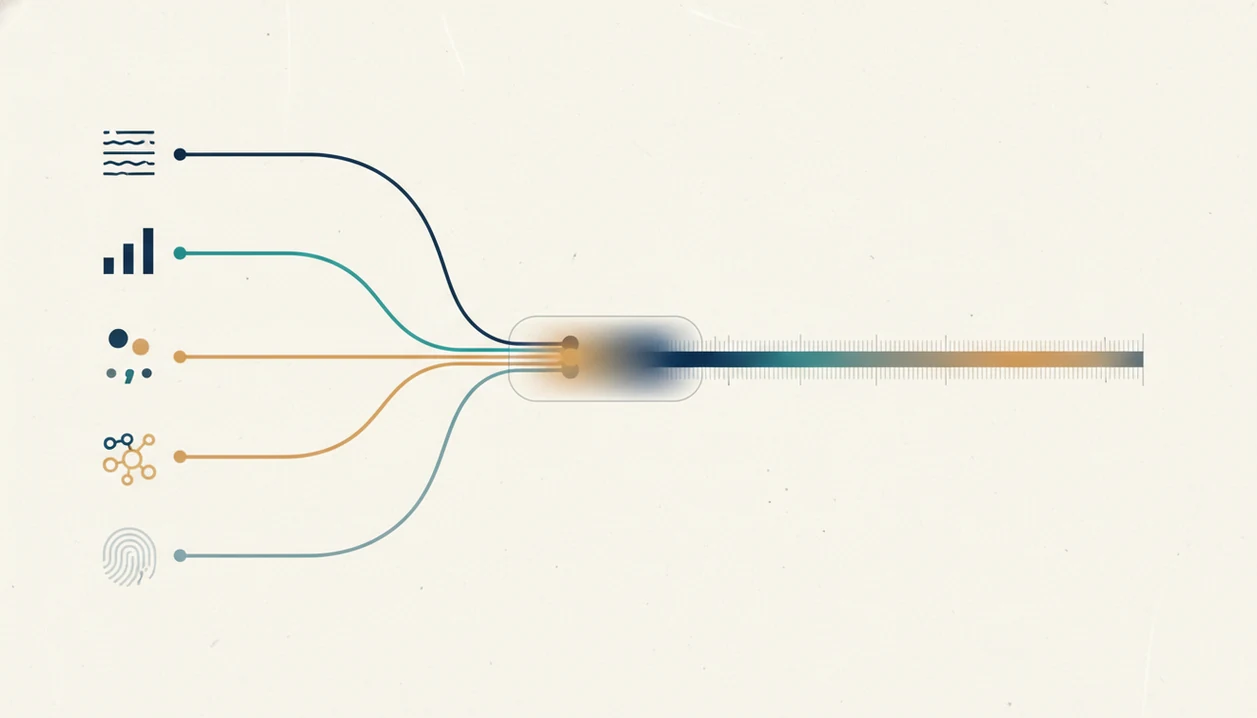
AI detectors work by training classification models on large collections of human-written and AI-generated text, then comparing a new passage against the learned patterns. The score reflects how strongly the submitted text matches AI-like patterns in that detector’s training and evaluation setup.
Behind the score, the detector converts text into measurable features. These may include word predictability, sentence rhythm, punctuation habits, repeated phrasing, semantic patterns, and document structure. A model then assigns a likelihood based on the patterns it has learned.
Modern detectors usually use an ensemble method. That means several weak or partial clues are combined into one estimate. One clue may point toward AI, another may point toward human writing, and the final score balances them.
A good AI writing assistant platform with an AI detector, humanizer, rewriter, and chat agents on web with a companion iOS app should support accountable revision, not promise certainty about authorship.
Perplexity And Burstiness In AI Detection Signals
Does AI detection rely on perplexity and burstiness? Yes, but those are only two signals, and they are not reliable enough on their own for modern text.
Perplexity as word predictability
Perplexity measures how predictable a sequence of words appears to a language model. If the next word is easy to guess again and again, the text may look low-perplexity. Older AI writing often had that smooth, expected feel: tidy claims, balanced clauses, and phrases like “in today’s fast-paced world.”
Burstiness as sentence variation
Burstiness describes variation in sentence length, rhythm, and complexity. Human writing often jumps around more. A short sentence interrupts. Then a longer one adds context or corrects itself.
AI text can look low-perplexity and evenly structured, but newer models and paraphrasers can disturb those signals. For essays and drafts, a ChatGPT detector should be treated as one review layer, not the final decision.
Five AI Detector Method Facts Readers Should Know
- AI detectors are trained on examples of human-written and AI-generated text, then used to classify new passages by learned pattern similarity.
- Perplexity and burstiness are classic AI detection signals, but both are incomplete because modern models can produce more varied text.
- Stronger detectors may use stylometry, semantic embeddings, document-level structure, and watermark checks when those signals are available.
- False positives and false negatives are unavoidable because detectors estimate likelihood rather than observe the actual writing process.
- Detector scores should be interpreted with context, draft history, assignment rules, and human judgment.
We see the same issue in real editing queues: one paragraph gets flagged, but the surrounding notes, outline, and source corrections look clearly human. The practical next step is to revise the draft and check the source trail, not chase a single number.
AI Detection Signals Beyond Perplexity And Burstiness
Stronger AI detectors examine more than predictability and sentence rhythm. They combine several AI detection signals because any single clue can be misleading on a short, edited, or technical passage.
| Signal type | What it checks | Why it matters |
|---|---|---|
| Stylometry | Tone, punctuation, phrasing, sentence patterns, and author-like fingerprints | A sudden style shift can suggest mixed authorship or heavy rewriting. |
| Semantic embeddings | Meaning-level patterns rather than only surface wording | Two different wordings can still share model-like organization. |
| Document structure | Introductions, transitions, summaries, paragraph flow, and repeated formats | Formulaic structure can make text look machine-generated. |
| Watermark checks | Hidden statistical marks from some generating models | These work only if the model used a detectable watermark. |
| Ensemble scoring | Multiple weak clues combined into one estimate | A combined model is usually more stable than one metric alone. |
Copy-pasting a paragraph into a web editor and watching highlighted sentences appear is useful only if the highlights explain what to review next.
Before You Use An AI Detector
Before you use an AI detector, prepare the text and the context around it. A score is easier to interpret when the sample is long enough, the policy is clear, and the writing record is available.
- Check the relevant rule first, whether it comes from a school, workplace, client, journal, or publication guide. The policy should define what counts as allowed AI assistance before anyone reads a score.
- Submit enough text for a document-level signal. One polished sentence, a title, or a short abstract can look misleadingly smooth because there is too little rhythm, structure, and source handling to evaluate.
- Gather the surrounding evidence: outlines, drafts, notes, citations, comments, version history, and revision timestamps. Those materials often explain why a passage changed.
- Flag conditions that can skew the reading, including translation, technical or legal wording, reusable templates, formulaic reports, and non-native English.
- Treat the result as one review signal. Do not use a single detector score as the only basis for discipline, rejection, or accusation.
How To Use An AI Detector Score Responsibly
Use an AI detector score as a likelihood estimate and revision prompt, not as a verdict about honesty. The safest workflow is to inspect the evidence, compare it with context, and revise for clarity and original authorship.
For a quick workflow, follow these five steps in order: submit enough text, read the score as likelihood, review highlighted passages, compare the result with context, and revise for transparent authorship.
1. Submit enough text
- Paste or upload enough text for a document-level reading, not just one sentence.
- Read the score as likelihood, especially when the tool uses bands like “mixed” or “uncertain.”
- Review flagged passages or signal explanations if the detector provides them.
- Compare the result with drafts, writing history, requirements, citations, and editorial standards.
- Revise for transparent authorship by improving clarity, source use, and specific claims.
2. Read the score as likelihood
A 78% AI score does not mean 78% of the words came from AI. It means the submitted text matched AI-like patterns under that detector’s method.
3. Review flagged passages
When a sentence-level AI detector highlights one claim, review that sentence before rewriting the whole document.
4. Compare with context
Draft history matters. So do assignment rules, source notes, revision comments, and whether the text was translated or edited.
5. Revise for transparent authorship
For students and editors, revising flagged passages for specificity is often better than paraphrasing blindly because it improves the writing and preserves accountability.
Why AI Detector Scores Change Across Tools
AI detector scores change across tools because each detector is trained, tuned, and tested differently. The same paragraph can receive different labels when the tools use different datasets, AI model examples, languages, genres, thresholds, or risk settings.
That is why tools such as Turnitin, GPTZero, Originality.ai, Copyleaks, and Write.info can disagree on the same passage without any one result proving authorship.
A school tool may tune its system to reduce false accusations. A publishing workflow may tune for brand risk. An SEO review or compliance system may prefer catching suspicious drafts, even if that creates more manual review.
Chunking also matters. A detector may score a single pasted paragraph differently than a full document because it loses surrounding context. Mixed authorship, paraphrasing, translation, and heavy editing can shift the result again.
We have seen approval comments beside revised claims change a detector reading after only three sentences were rewritten. Same topic. Different surface pattern.
Scores can also change over time as detectors update their models and benchmarks.
AI Detectors Versus Plagiarism Checkers
AI detectors and plagiarism checkers answer different questions. AI detectors estimate likely authorship type from text patterns, while plagiarism checkers compare text against known sources to find matching or closely similar passages.
| Tool type | Main question | What it examines | Important caveat |
|---|---|---|---|
| AI detector | Does this resemble AI-generated or human-written text? | Predictability, style, structure, embeddings, and sometimes watermarks | Original AI text may still be flagged as AI-written. |
| Plagiarism checker | Does this match an existing source? | Overlapping phrases, passages, citations, and source databases | Human-written text can still be plagiarized. |
| Combined platform | Are there AI-likeness and source-matching issues? | Both pattern signals and source similarity | The checks should be interpreted separately. |
A missing page number or a source title pasted in the wrong case will not prove AI use. It may show weak citation handling, which is a different editorial problem.
Common Myths About How AI Detectors Work
Several myths make people overtrust detector results or misuse them during review. The most important correction is simple: detectors classify text patterns, not people.
- Myth 1: Detectors can prove who wrote a document. They cannot identify the author’s intent, identity, keyboard history, or actual drafting process.
- Myth 2: Perplexity and burstiness alone are enough. These signals can help, but modern models and paraphrasers can distort them.
- Myth 3: A 99 percent human score guarantees human authorship. A high human score is still a probability estimate, not proof.
- Myth 4: Humanizer tools always make text undetectable. Editing can change signals, but it can also leave model-like structure intact.
- Myth 5: Copy and paste behavior alone is what detectors see. Pattern-based detectors analyze the submitted text; document-history tools are separate.
The awkward draft phrase “delve into the nuances” can be a clue. It is not a confession.
Accuracy Evidence For AI Detector Methods
Accuracy evidence for AI detector methods is mixed because performance depends on text length, editing, language, model type, and test conditions. Benchmark performance is not the same as certainty for one real-world document.
Turnitin reported a false positive rate of less than 1% on a large student-paper corpus in 2023, meaning fewer than 1 in 100 fully human papers were incorrectly flagged as containing AI-generated text: source. A 2023 arXiv evaluation found that several GPT detectors exceeded 95% accuracy on longer clean samples, but performance dropped on shorter or paraphrased text: source.
A 2023 study in Patterns reported that simple human edits and paraphrasing reduced accuracy from over 90% to below 50% for some detectors: source. Watermark research has also found high precision under controlled conditions, but degradation after edits, paraphrasing, or translation remains a practical limitation: source.
For real submissions, the stronger claim is modest: detector results need corroborating context.
Limitations
AI detectors have real limits, and those limits matter most when a score could affect grades, work, publication, or discipline. A detector score should never be the sole basis for academic, employment, legal, or disciplinary decisions.
- AI detectors can produce false positives by flagging genuine human writing as AI-written.
- AI detectors can produce false negatives by missing AI-generated text, especially after rewriting or human editing.
- Short passages provide too little signal for reliable classification.
- Technical writing, formulaic academic writing, non-native English, and low-resource languages can be harder to classify fairly.
- Watermarks only work when the generating model used a detectable watermark and the text was not heavily modified.
- Static detector models can become outdated as writing models, paraphrasers, and humanizer tools evolve.
- Mixed human-AI drafting can be difficult to label because the final text may contain both human judgment and model-generated phrasing.
The fairest process asks for context first. Drafts, notes, revision history, and citations often tell more than one score.
FAQ
How do AI detectors work?
AI detectors classify text by comparing it with patterns learned from human-written and AI-generated examples. The result is a probability or label, not proof of authorship.
What do AI detectors look for?
AI detectors may look for predictability, sentence variation, stylometry, document structure, semantic embeddings, and watermark signals. Different tools weigh these signals differently.
Are AI detectors accurate?
AI detector accuracy varies by tool, text length, editing level, language, genre, and benchmark setup. Longer clean samples are usually easier to classify than short or paraphrased passages.
Can AI detectors be wrong?
Yes. A false positive flags human writing as AI, and a false negative misses AI-generated writing.
What is perplexity in AI detection?
Perplexity measures how predictable a sequence of words appears to a language model. Low perplexity can look AI-like because the wording follows highly expected patterns.
What is burstiness in writing?
Burstiness is variation in sentence length, rhythm, and complexity. Human writing often has more uneven rhythm than smooth model-generated text.
Do AI detectors work on essays?
AI detectors can work better on essays than on short snippets because longer text provides more signal. Essay results still require context, draft history, and human review.
Can AI detectors detect copy and paste?
Pattern-based AI detectors analyze the text itself, not copy-and-paste behavior. Copy-paste tracking is a separate document-history or authorship feature.
Can humanized text be detected?
Yes, humanized text can still be detected if AI-like structure, phrasing, or semantic patterns remain. Editing can reduce detection accuracy, but it does not guarantee a human score.