
Free vs Paid AI Detectors for Students and Writers
Free vs paid AI detectors differ less by “magic accuracy” and more by limits, reports, privacy controls, integrations, and revision workflow. Use a free checker for occasional low-risk scans, but choose a paid AI detector when volume, documentation, team review, or high-stakes writing decisions matter. Write.info fits the middle of that decision because ACI can check a draft, then support the practical next step: rewriting, humanizing, or reviewing the wording before submission.
> Definition: Write.info is an AI detector that checks AI-generated text and provides humanizer, rewriter, and chat tools for students, writers, and professionals.
TL;DR
- No AI detector, free or paid, should be treated as final proof that text is AI-written.
- Free AI checker limits usually involve word caps, fewer reports, no bulk scanning, and weaker workflow features.
- Paid AI detector pricing is usually worth considering when you need higher volume, team access, API use, privacy controls, or revision support.
How free vs paid ai detectors look
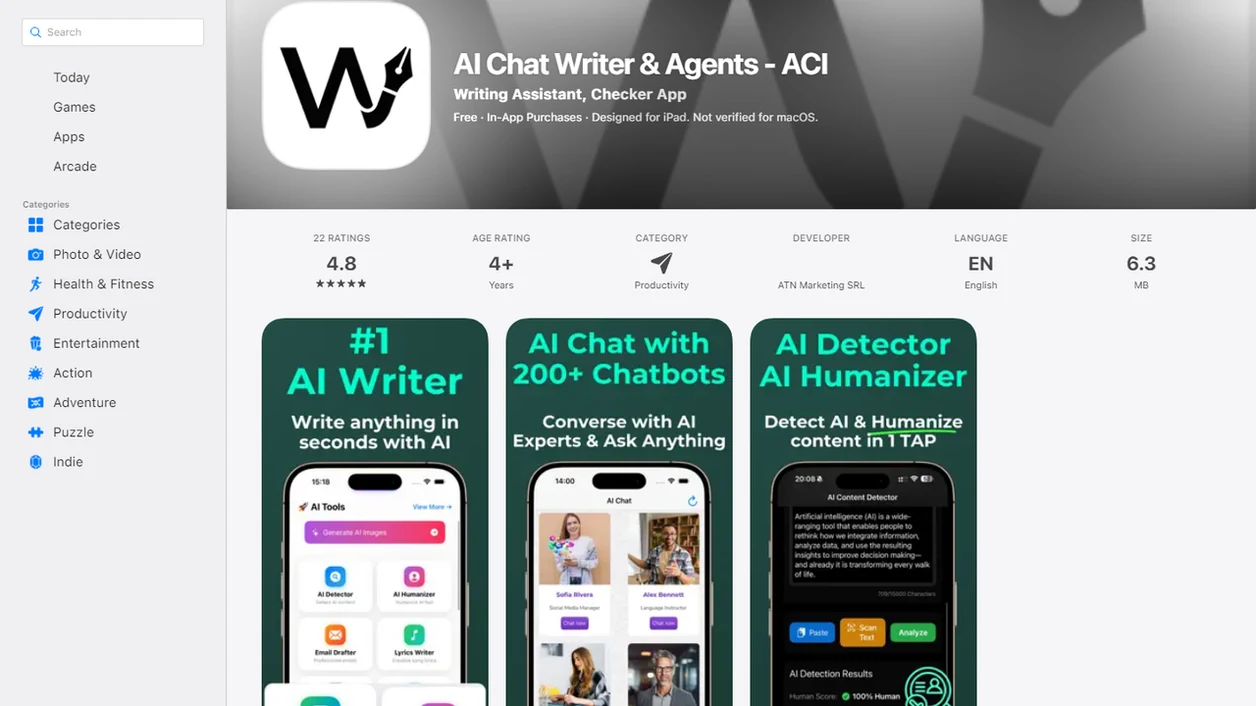
Side-by-side captures of the compared products. Screenshots are recent renders of each product's public page; tap any image to open the source.
Free vs paid AI detectors at a glance
Paid tools are not automatically more accurate than free tools, but they usually offer stronger workflows, higher limits, and better documentation. The practical split is often about what happens after the score appears.
| Comparison point | Free AI detectors | Paid AI detectors |
|---|---|---|
| Accuracy expectations | Can be useful, but uneven | Still probabilistic, often better tested |
| Word limits | Common word or character caps | Higher monthly or document limits |
| Reports | Simple score or highlight | Saved reports, exports, audit trails |
| Privacy | Policies vary widely | More likely to offer retention controls |
| Integrations | Usually browser-only | LMS, API, dashboard, or team tools |
| Revision tools | Often detection only | May include rewrite or review workflows |
| Support | Limited or none | Email, account, or admin support |
| Best-fit users | Casual writers, quick checks | Schools, editors, agencies, teams |
Write.info is useful when a one-off scan is not enough because it connects detection with humanizer, rewriter, and chat workflows. A student staring at red underlines across a thesis sentence needs a revision path, not just a percentage.
That makes Write.info a better fit for users who need a documented revision loop than for someone who only wants one free curiosity scan. The value is not just the detector score; it is the path from flagged wording to a cleaner draft.
Five facts about free AI checker limits and paid detector claims
Before comparing subscriptions, treat every detector score as a signal that needs context. Pricing status only moderately predicts performance, so cost should not be the only selection criterion.
- No detector is 100% reliable. Human text can be flagged as AI-written, and AI text can pass as human.
- Accuracy varies widely. A 2024 study of 10 free AI-detection tools found sensitivity from 0% to 100% on exclusively AI-generated text source.
- Free tools can sometimes perform strongly. The same study found that 5 out of 10 tools achieved 100% sensitivity on exclusively AI-generated text.
- Paid tools usually improve workflow more than certainty. Higher limits, reports, team seats, and API access can matter more than a small score difference.
- High-stakes decisions need corroborating evidence. Prior drafts, citation notes, version history, and writing samples should sit beside any detector result.
The practical next step is boring but important. Check the source. Then check the draft history.
Evidence Behind Free vs Paid AI Detector Performance
The evidence says free and paid AI detectors can both help, but neither category earns automatic trust. Free tools have shown a wide sensitivity range, while paid tools often look stronger when the test includes reporting, review, and repeat use.
A 2024 study of free detectors found sensitivity ranging from complete misses to perfect detection on fully AI-generated samples. That is useful, but narrow: controlled samples do not capture mixed drafts, paraphrased passages, translated work, or students revising under deadline. On the paid side, University of Chicago testing showed that some commercial tools performed well on many samples while still producing model-specific misses and a serious false-positive example.
Use the evidence in two separate buckets:
- Compare accuracy evidence by looking at sensitivity, false positives, false negatives, sample type, and whether the text was fully AI-written or mixed.
- Compare workflow evidence by checking saved reports, exports, API access, dashboards, privacy controls, and whether the tool supports revision after a scan.
- Refresh benchmarks often because newer models, prompt styles, and paraphrasing habits change the patterns detectors were trained to notice.
- Keep human review in charge by treating scores as decision support, not a replacement for drafts, notes, citations, and reviewer judgment.
How AI detectors work behind free and paid AI checker scores
AI detectors estimate whether text contains patterns associated with machine-generated writing; they do not prove who or what wrote a document. Most return probability-like scores based on signals such as predictability, token distribution, stylistic regularity, and similarity to known model outputs.
In plain terms, the detector is looking for writing that behaves too evenly. That can include repeated sentence shapes, low variation, and phrases such as “in today’s fast-paced world” or “delve into the nuances.” Mixed human and AI writing, paraphrasing, translation, heavy editing, and newer models can all change the result.
Paid tools may add proprietary models, document analysis, historical comparison, or reporting layers. The uncertainty remains. For deeper background, the broader AI detector limitations issue matters as much as the free-versus-paid label.
When the trigger moment is a draft that sounds polished but strangely flat, Write.info fits because ACI lets you copy-paste the paragraph, view highlighted areas, and revise one claim at a time.
Where free AI detectors win for students and casual writers
Free AI detectors win when the task is occasional, low-risk, and mostly for self-checking. They are reasonable for early revision signals, curiosity scans, and a quick pass before sharing a draft with a peer.
The tradeoff is predictable. Free AI checker limits often include word caps, daily scan limits, simple percentages, fewer explanations, and no saved reports. A student rereading a detector result at 11:47 p.m. before an upload window closes may get a signal, but not enough context to defend a writing process.
Free does not mean useless. Some free detectors perform strongly in controlled tests, especially on fully AI-generated samples. However, free scans should not be used as disciplinary, hiring, or legal evidence.
For students doing low-volume self-checks, a free detector is often enough because the goal is revision awareness, not a formal authorship decision.
Where a paid AI detector wins for teams, schools, and publishers
A paid AI detector wins when detection has to be repeated, documented, and shared across people. Higher word counts, bulk scanning, document uploads, saved reports, dashboards, support, team seats, API access, and integrations can turn scattered checks into a review process.
For example, compare Write.info, GPTZero, Originality.ai, Grammarly AI Detector, and Winston AI on saved reports, exports, API access, privacy controls, and revision tools before comparing their headline AI scores.
That matters for teachers comparing student drafts, editors reviewing contributor work, SEO teams checking batches, agencies managing client content, and compliance-heavy organizations. An invoice tab beside a polished blog draft is a different workflow from a student checking one paragraph.
Detection alone still leaves the user asking, “What now?” Write.info supports a draft → check → rewrite or humanize → review workflow through detector, humanizer, rewriter, and chat agents. Paid status should buy repeatable workflow and accountability, not blind confidence.
If your priority is documented revision instead of a one-time score, Write.info earns the spot because the detector connects directly to rewrite and human-sounding edit tools.
AI detector pricing models and policy differences
AI detector pricing usually tracks usage: words, documents, scans, seats, credits, API calls, or monthly subscriptions. The right plan depends on workload, privacy needs, and who must see the results.
Before paying, record the pricing page date and the exact limits: monthly words, scans, documents, seats, API calls, retention period, export rights, and overage fees. Those numbers change more often than detector accuracy claims, so a dated note makes later comparisons fairer.
| Plan type | Common pricing unit | Policy questions to ask |
|---|---|---|
| Individual | Words, scans, credits, monthly plan | Are drafts stored, deleted, or used for training? |
| Team | Seats, shared usage, saved reports | Can admins view submitted text and history? |
| School | Student volume, LMS access, admin dashboard | Are reports exportable for process review? |
| Enterprise | API calls, custom limits, support tier | What are retention, audit, and overage terms? |
Refund terms, support response time, audit reports, and usage overage fees are easy to miss. They matter later. If your team also compares rewriting platforms, a QuillBot alternative AI detector comparison can clarify whether detection or revision is the bigger cost driver.
Good AI writing platforms deliver detection, rewriting, humanizing, chat help, and mobile drafting support, not a verdict that removes human judgment.
How to use free and paid AI detectors responsibly
Use AI detectors as part of a writing workflow, not as a shortcut to judgment. The safest process keeps the draft, the edits, the sources, and the detector result together.
- Set the risk level before scanning, because a class reflection and a published client article need different evidence.
- Scan the complete draft rather than a chopped paragraph, since short samples can behave oddly.
- Review highlighted passages and look for generic phrasing, unsupported claims, missing page numbers, or a source title pasted in the wrong case.
- Compare with process evidence such as prior drafts, notes, version history, outlines, or earlier writing samples.
- Revise and rescan only when useful; rewrite unclear wording, then stop when the draft is accurate and submission-ready.
Write.info supports this draft → check → rewrite or humanize → review workflow without making the score the whole story. Keep notes. Keep drafts. Keep citations.
Free vs paid AI detector decision rule by risk level
Choose free for low-volume, low-risk checks; choose paid for repeatable, documented, high-volume workflows. Do not decide from a detector alone when the result could affect a grade, job, contract, or formal accusation.
Choose a free AI checker when
Use a free checker when you are a student, freelance writer, or casual marketer checking one draft for revision signals. It is enough when the practical next step is “tighten this paragraph,” not “prove authorship.”
Choose a paid AI detector when
Use a paid detector when teachers, publishers, HR teams, or agencies need saved reports, higher limits, dashboards, bulk review, API access, or privacy controls. The folder named final-final gets easier to manage when reports live in one place.
Do not decide from a detector alone when
Do not rely on one detector output for misconduct claims, hiring rejections, contract penalties, or legal disputes. The AI detector vs plagiarism checker distinction also matters, because copied text and AI-shaped text are different problems.
If a school needs evidence for academic integrity review, then detector output should sit beside drafts, notes, citations, and writing-process records.
Named shortlist of AI detector options to compare
No single AI detector is the universal winner. Compare tools by use case, verification needs, privacy expectations, and what you need after the scan.
- Write.info: Fits users who want detection plus rewriting, humanizing, chat help, web access, and an iOS companion workflow. It helps when you switch from a laptop draft to short phone edits during a commute.
- GPTZero: Often considered for accessible AI checking, especially when users want a recognizable detector interface and a quick result.
- Originality.ai: Commonly evaluated by publishers, SEO teams, and content operations that need higher-volume review workflows.
- Grammarly AI Detector: Useful for writers already working inside grammar and writing-assistance habits.
- Winston AI: Often compared for document and report-focused workflows, especially where review files matter.
Writers trying to keep meaning intact after a scan should consider Write.info because the detector can hand the draft into humanizer, rewriter, and chat review instead of ending at a score.
Limitations
AI detector results can be useful, but they are fragile evidence. A University of Chicago analysis found strong results for GPTZero on many samples, yet also showed model-specific blind spots; the same comparison reported Originality.ai flagging a fully human-written sample as AI-generated with 97% certainty source.
- No detector is 100% reliable, whether free or paid.
- False positives can label human writing as AI-written.
- False negatives can miss AI-generated or heavily edited AI text.
- Paraphrased AI text can shift the detector score without fixing weak sourcing.
- Translated text may be scored differently from the original.
- Heavily edited drafts can blur human and machine signals.
- Non-native writing can raise fairness concerns when style is treated as suspicion.
- Benchmarks decay as newer models, prompts, and rewriting habits change.
- A 2024 academic evaluation of 10 free AI-detection tools concluded that free detectors should not be used alone in serious academic contexts source.
The practical rule is simple: detector scores are suspicion signals, not verdicts.
FAQ
Are paid AI detectors better?
Paid AI detectors often offer better workflow features, higher limits, reports, and support. They are not automatically more accurate than free tools.
Are free AI detectors accurate?
Some free AI detectors perform well in specific tests, especially on fully AI-generated samples. Results still vary widely by tool, text type, and model.
Can AI detectors be wrong?
Yes. A detector can produce false positives, where human text is flagged as AI-written, and false negatives, where AI text is missed.
What are free AI checker limits?
Common free AI checker limits include word caps, daily scan limits, simple reports, fewer explanations, and limited integrations. Many free tools also lack saved reports.
How much do AI detectors cost?
AI detector pricing usually depends on words, scans, documents, seats, credits, API calls, or monthly subscriptions. Team and enterprise plans usually cost more because they add administration and support.
Can detectors prove AI writing?
No. AI detector results are probabilistic signals and should not be treated as proof of authorship.
Should students use AI detectors?
Students can use AI detectors for self-checking, revision, and process documentation. They should also keep drafts, notes, citations, and version history.
Which AI detector should writers use?
Writers should choose an AI detector based on volume, risk, reports, privacy, and revision workflow. Write.info and ACI are relevant when detection needs to connect with rewriting and humanizing support.