Free AI Chat - Talk to AI Online
Ask questions, get explanations, brainstorm ideas, and have conversations with AI. No signup required.
What Is AI Chat
AI chat is a conversational interface that allows users to communicate with a language model in natural language. Users type questions or prompts, and the AI generates relevant responses by predicting text sequences based on patterns learned from large training datasets. AI chat does not understand meaning in the way humans do. It processes statistical relationships between words.
The simplest way to think about AI chat is as a text-based conversation with a system that has read an enormous amount of written material and can synthesize responses on nearly any topic. It is not retrieving answers from a database. It is constructing new text, sentence by sentence, based on what it has learned about how language works and how information is typically expressed. This means the responses are often well-structured and articulate, but they are not guaranteed to be factually correct. The model produces the most statistically likely sequence of words given your input, and sometimes the most likely-sounding answer is not the right one.
Where AI chat excels is in breadth. You can ask it to explain quantum entanglement, draft a resignation letter, debug a Python function, translate a phrase into Korean, outline the causes of the French Revolution, and suggest dinner recipes for a picky eater-all in the same session. No human expert spans that range, and no search engine synthesizes information into a direct, readable answer the same way. The tradeoff is depth and reliability. A subject matter expert will give you a more accurate, nuanced answer about their specialty. A search engine will point you to primary sources you can verify. AI chat gives you a fast, readable response that covers most of the ground but requires your own judgment about what to trust. This tool is part of the broader AI writing assistant suite on Write.info.

How Conversational AI Works
Conversational AI is built on transformer-based language models. These models are trained on large text corpora that include books, articles, websites, code repositories, and other written material. During training, the model learns statistical relationships between words, phrases, and concepts. When a user submits a message, the model processes the input and generates a response by predicting the most likely next token (word or word fragment) repeatedly until the response is complete.
This prediction process happens at remarkable speed but follows a fundamentally different mechanism from human thinking. The model does not "know" things in the way a person does. It does not have beliefs, experiences, or the ability to verify information against reality. What it has is an extraordinarily detailed map of how language is used across millions of documents. When you ask it a factual question, it generates an answer that resembles how that question has been answered in the texts it was trained on. When the training data contained accurate information, the response is typically accurate. When the training data was sparse, outdated, or conflicting, the response may be wrong while sounding equally confident.
One important technical detail: the model on this page processes each message independently. It does not maintain a conversation history across multiple exchanges. Each time you send a message, the AI responds based solely on that single input. This is different from chat platforms that maintain multi-turn context. If you need to build on a previous response, include the relevant context in your new message.
Types of Questions AI Chat Handles
Understanding what the AI handles well and what it handles poorly saves time and prevents misplaced trust in the output.
Explanations and definitions are a strong suit. Asking the AI to explain a concept-how compound interest works, what the difference between TCP and UDP is, why the sky appears blue-typically produces clear, well-structured responses. The model has been trained on educational content and handles explanatory writing well. These responses are usually accurate for well-established concepts, though edge cases and highly specialized topics may contain errors.
Brainstorming and idea generation is another area where AI chat performs reliably. It can generate lists of ideas for business names, blog topics, gift suggestions, project approaches, creative writing prompts, and more. The value is in volume and variety. The AI can produce twenty ideas in seconds, and even if most are mediocre, a few will spark directions you had not considered. The AI idea generator tool is specifically optimized for this task.
Writing assistance covers drafting, editing, and rephrasing. You can paste text and ask the AI to make it more concise, change the tone, fix grammar issues, or rewrite it for a different audience. This is practical and immediate. For dedicated writing tasks, the specialized tools on Write.info-the essay writer, email writer, and others-use optimized prompts that produce better results than a generic chat request.
Code and technical questions are handled competently for common programming languages and well-documented frameworks. The AI can write functions, explain error messages, suggest debugging approaches, and convert code between languages. Code output should always be tested before use, as the AI can produce syntactically correct code that contains logical errors or security vulnerabilities.
Math and logic problems work well for standard calculations, algebra, and common mathematical concepts. The AI shows its work and explains reasoning steps. However, it can make arithmetic errors, especially in multi-step problems. Verify calculations independently for anything where accuracy matters.
Creative requests-stories, poems, jokes, hypothetical scenarios-produce varied results. The AI generates creative content that is structurally sound but often formulaic. It follows genre conventions and uses common tropes. Genuinely surprising or original creative output is rare without significant human revision.
How AI Chat Differs from Search Engines
AI chat and search engines solve different problems, and using the wrong one for a given task produces frustrating results.
Search engines are retrieval systems. They index existing web pages and return ranked links based on relevance to your query. The information comes from published sources that you can evaluate for credibility, recency, and authority. When you need current information-today's weather, a company's current pricing, breaking news-a search engine connects you to live sources. AI chat cannot do this because it does not access the internet in real time.
AI chat is a generation system. It creates new text based on patterns from its training data. The strength is that it gives you a direct, synthesized answer instead of a list of links you have to click through and read. For questions like "explain the difference between a 401k and an IRA" or "how do I center a div in CSS," the AI provides an immediate, readable response that would take minutes to assemble from search results. The weakness is that you cannot verify the source. The AI does not tell you where its information came from because it does not retrieve information from specific sources-it generates responses from statistical patterns.
The practical approach is to use AI chat when you need a quick explanation, draft, or brainstorming session, and use a search engine when you need verified facts, current data, or links to primary sources. They complement each other rather than competing.
How to Use AI Chat
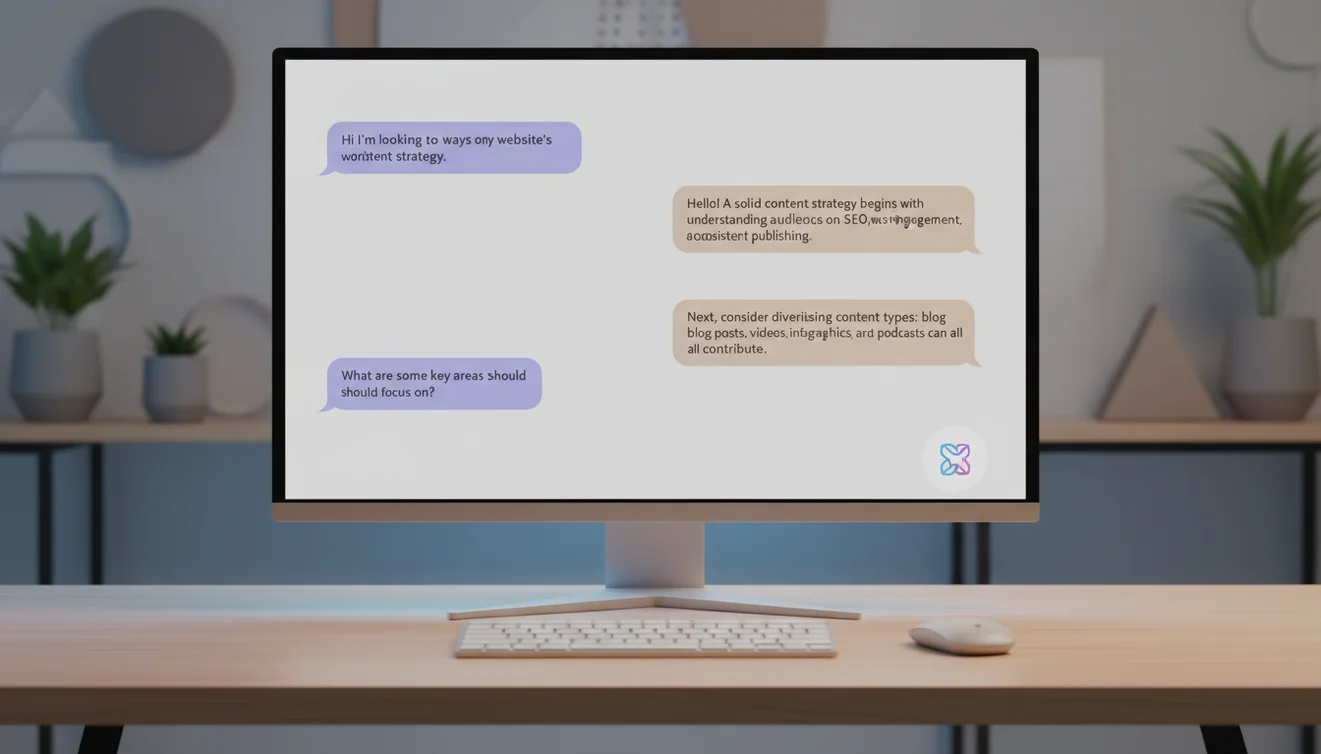
- Type your question or prompt. Be specific about what you want. "Explain how DNS resolution works, step by step" produces a more useful response than "tell me about DNS." Include context about your knowledge level if relevant-"explain like I'm a beginner" or "I have a computer science background."
- Click Send. The AI processes your message and generates a response.
- Read the response critically. AI chat sounds confident regardless of accuracy. If the response includes factual claims that matter to your use case, verify them through independent sources.
- Refine if needed. If the response is too broad, too detailed, or misses the point, send a follow-up message with more specific instructions. Include the relevant parts of the previous response in your new message for context, since each message is processed independently.
- Copy useful output. Use the copy button to transfer the response to your document, email, or project. Edit the text to match your needs and voice before using it in any published or submitted context.
Getting Better Responses from AI Chat
The quality of AI chat responses depends directly on the quality of the input prompt. This is not a minor optimization-it is the difference between a useful answer and a generic one.
Specificity is the most important factor. Compare "tell me about marketing" with "what are three low-budget customer acquisition strategies for a new mobile app targeting college students." The second prompt constrains the AI's response to a specific audience, budget context, product type, and desired format. The result is immediately actionable instead of encyclopedic.
Providing context improves relevance. If you are asking for coding help, mention the language, framework, and what you have already tried. If you are asking for writing help, describe your audience, purpose, and tone. If you are asking for advice, explain your situation and constraints. The AI cannot ask clarifying questions, so front-loading context in your prompt substitutes for the back-and-forth of a real conversation.
Specifying format helps when you want structured output. Asking for "a numbered list," "a comparison table," "pros and cons," or "a step-by-step guide" shapes the response into a more usable format than an unstructured paragraph. The AI follows formatting instructions reliably.

Limitations & Safety
AI chat does not have access to real-time information. Its responses are based on training data with a knowledge cutoff, which means current events, recent developments, live pricing, and updated statistics are not available. For time-sensitive information, use a search engine or consult current sources directly.
The AI can generate factually incorrect responses with the same confident tone it uses for accurate ones. This is commonly called "hallucination"-the model produces plausible-sounding text that contains fabricated facts, invented citations, or incorrect explanations. Users should independently verify any factual claims before relying on them for decisions, academic work, or professional use.
AI chat is not a substitute for professional advice in medical, legal, financial, or mental health contexts. The AI generates general information based on patterns in its training data. It is not a licensed practitioner, it cannot assess your specific situation, and its responses do not account for individual circumstances. Consult qualified professionals for decisions that affect your health, legal standing, or financial well-being.
The tool does not moderate for all possible misuse. Users are responsible for how they apply AI-generated responses. Content generated for academic submission should comply with institutional policies on AI assistance. Content used in professional contexts should be reviewed for accuracy and appropriateness.
Write.info does not store, log, or retain any messages submitted through the AI chat tool. All processing happens in real time and content is discarded immediately after the response is generated. For dedicated writing tools with specialized prompts, visit the AI writing assistant homepage.
Chat, write, and revise anywhere
Use Write.info’s free AI tools online or get the app for fast writing help on your phone. Always review AI-generated answers and disclose AI assistance when required.
Get Write.info AppAI Chat App
The AI Chat tool is available as part of the AI Writer app for iPhone and iPad. The app includes all writing, detection, and humanization tools in a single download with no account required. An Android version is currently in development.
The iOS app supports offline access to saved content and provides the same AI writing capabilities available on Write.info. Users receive 10 free generations per day on the website, while the app offers extended access through optional subscription plans.
Download on App Store