Free AI Business Plan Generator
Generate structured business plans with executive summaries, market analysis, and strategy sections. No signup required.
What Is a Business Plan Generator
A business plan generator is a tool that creates structured business plan drafts from a description of a business idea, target market, and industry. It uses a language model to produce standard sections including executive summaries, market analysis, operations strategy, and financial outlines. The AI does not conduct market research or access real-time financial databases.
Writing a business plan from scratch is one of those tasks that stops more businesses from starting than any actual market condition. The document itself is not complicated in concept-you describe what you are building, who you are building it for, how you will make money, and what resources you need. But sitting down to write it is where momentum dies. You know your idea. You might even know your market. But translating that into organized sections with the right level of detail and the right tone for investors, banks, or partners is a different skill from running a business. An AI business plan generator does not replace the strategic thinking that goes into planning. What it does is remove the structural hurdle. It gives you a draft with all the standard sections filled in, which is far easier to revise and improve than a blank document.
This tool supports five business types: Startup, Small Business, E-commerce, SaaS, and Service. Each type adjusts the structural emphasis of the output. A SaaS plan focuses more on recurring revenue models and churn metrics. An e-commerce plan emphasizes supply chain and customer acquisition costs. A service business plan highlights capacity planning and client retention. These distinctions matter because a one-size-fits-all template misses the specific concerns that investors and lenders actually evaluate. The tool is part of the broader suite of Write.info AI tools, where each writing tool uses a specialized prompt rather than a generic one.

Key Sections of a Business Plan
Every credible business plan follows a recognized structure. Understanding what each section should accomplish helps you evaluate the AI output and strengthen it with your own knowledge.
The executive summary is the single most important section because it is often the only section that gets read in full. It should communicate your business concept, target market, revenue model, and funding needs in one to two pages. Investors scan hundreds of plans. If the executive summary does not immediately convey what you do and why it will work, the remaining sections go unread. The AI generates a functional executive summary, but you need to sharpen it with specifics that only you know-your unique advantage, the problem you have personally observed, the traction you have already gained.
The market analysis section demonstrates that you understand the industry you are entering. It should include the total addressable market, your specific target segment, competitive landscape, and market trends. This is where AI output requires the most revision. The language model generates plausible-sounding market descriptions, but it does not pull from current industry reports. Every statistic, every market size figure, and every competitive comparison needs to come from your own research. Sources like industry reports, government data, trade publications, and competitor filings provide the credible numbers that lenders and investors expect.
The product or service description explains what you offer and how it differs from existing alternatives. The AI can structure this section effectively, but the differentiation argument must come from you. Generic statements like "our product offers a unique combination of features" mean nothing without specifics. What exactly is different? Why does that difference matter to customers? How is it defensible against competitors who could copy it?
The marketing and sales strategy outlines how you will reach customers and convert them into paying users or buyers. The AI generates frameworks covering channels, pricing strategy, and customer acquisition approaches. These frameworks are useful as starting points, but they need to be grounded in your specific market context. A marketing strategy for a local bakery and a B2B SaaS product share almost no tactical overlap despite following the same structural format.
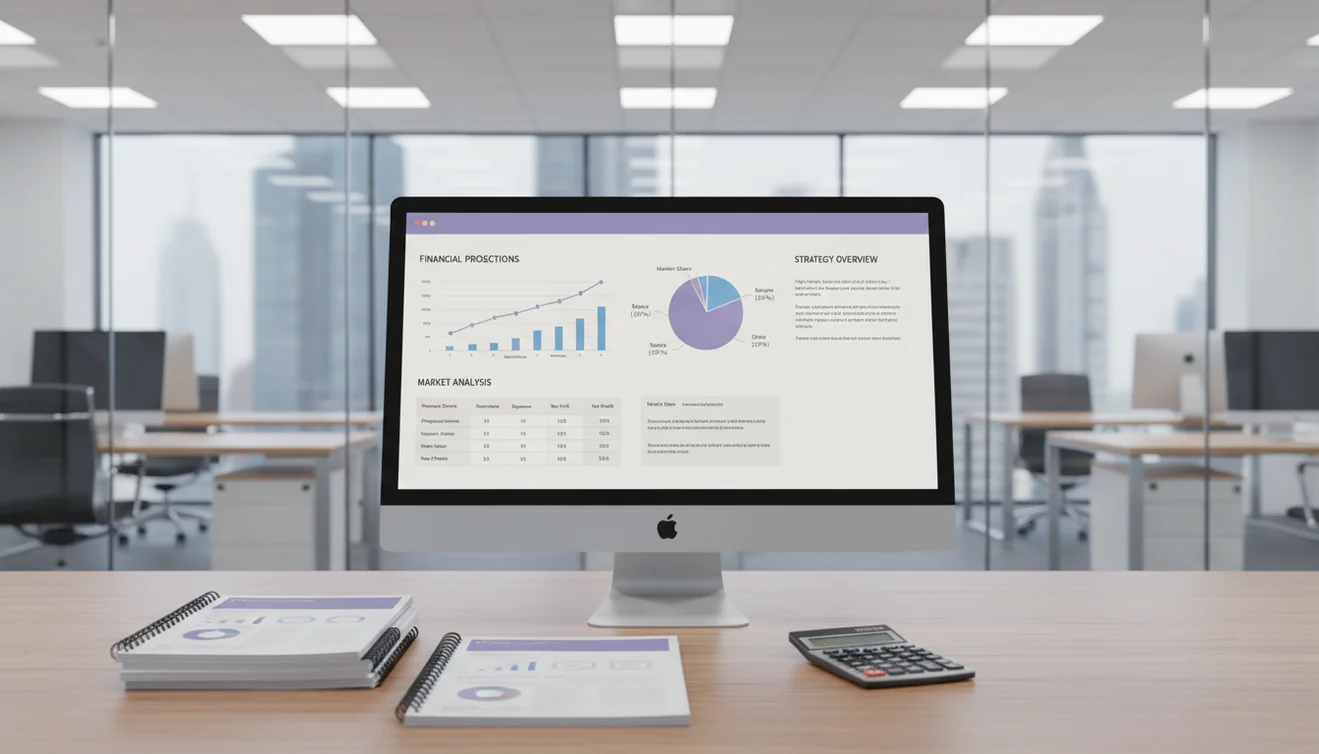
The financial projections are where the gap between AI output and reality is widest. The AI provides a structural framework with categories for revenue, cost of goods sold, operating expenses, and growth trajectories. These are placeholders. Real financial projections require pricing data from your market, cost quotes from suppliers, salary benchmarks for your region, and growth assumptions based on comparable businesses. Submitting AI-generated financial numbers to an investor or bank is a fast way to lose credibility.
How AI Helps With Business Planning
The value of an AI business plan generator is structural, not analytical. It solves the blank-page problem by producing an organized draft that covers all the sections a reader expects. This is genuinely useful because many first-time founders either skip sections they do not know how to write or over-invest time in sections they are comfortable with while neglecting critical gaps.
A common pattern is the technical founder who writes three pages about the product architecture and two sentences about the go-to-market strategy. Or the sales-oriented founder who has a detailed customer acquisition plan but no operations section explaining how they will actually deliver the product at scale. The AI draft exposes these gaps by generating content for every section. When you read through it and find a section where you think "this is completely wrong for my business," that reaction is itself valuable. It means you know something the generic draft does not capture, and now you know exactly where to put that knowledge.
The AI also helps with language calibration. Business plans have a specific register-professional, precise, forward-looking without being promotional. People who have not written one before often err toward either overly casual descriptions or overwrought marketing language. The AI output provides a tone benchmark that you can match as you revise.
Startup Plans vs. Established Business Plans
The planning needs of a startup and an established small business are fundamentally different, and conflating them produces weak plans for both.
A startup plan is a hypothesis document. You are describing what you believe will work based on limited evidence. The emphasis is on the problem you are solving, the size of the opportunity, your team's ability to execute, and the milestones you will hit with the requested funding. Financial projections for a startup are educated estimates. Investors understand this. What they look for is whether your assumptions are reasonable, whether you have identified the key risks, and whether your plan shows a path to profitability or a subsequent funding round.
An established business plan is an evidence document. You have revenue history, customer data, operational track records, and real financial statements. The emphasis shifts from "here is what we think will happen" to "here is what has happened, and here is how we will grow from this baseline." Lenders evaluating a loan application or partners evaluating a franchise opportunity want documented performance, not projections based on assumptions. If you are using the AI generator for an existing business, the draft provides structure, but you should replace every speculative section with actual data from your operations.
The tool's business type selector helps adjust the emphasis appropriately. Selecting Startup produces a draft with more focus on opportunity sizing and team qualifications. Selecting Small Business produces a draft with more emphasis on operational details and local market positioning. Neither output is sufficient on its own, but each provides the right starting framework for its context.

How to Use the AI Business Plan Generator
- Describe your business idea in detail. Include the industry, the product or service, your target customers, and the problem you solve. The more specific your description, the more relevant the generated plan. "An app that helps freelancers track invoices and expenses" produces a far more useful draft than "a tech startup."
- Select a business type. Choose Startup for new ventures seeking funding, Small Business for local or established operations, E-commerce for online retail, SaaS for subscription software, or Service for professional and client-based businesses.
- Click Generate Plan. The AI produces a structured business plan draft covering standard sections.
- Read every section critically. Identify which sections need the most work. The executive summary and product description are usually closest to usable. The market analysis and financial projections almost always need complete replacement with real data.
- Replace placeholder data with real research. Substitute any market sizes, growth rates, competitive claims, or financial figures with data from credible sources. Industry reports, government statistics, and competitor public filings are standard sources.
- Add your unique perspective. What do you know about this market that the AI does not? What conversations with customers have shaped your approach? What mistakes have you already made and learned from? This is the content that separates a template from a compelling plan.
- Review with stakeholders. Share the revised plan with mentors, advisors, or potential partners before submitting it formally. External feedback often catches blind spots that neither you nor the AI identified.
What Makes a Business Plan Convincing
A business plan convinces readers when it demonstrates clear thinking, not just complete sections. Investors and lenders read plans to assess whether the founder understands the market, the risks, and the path to revenue. A well-formatted plan with generic content is less convincing than a rough draft with specific, honest analysis.
Specificity is the single most important quality. "We will target small businesses" is meaningless. "We will target accounting firms with 5 to 20 employees in the southeastern United States that currently use spreadsheets for client billing" is a plan you can execute against. The AI generates broad descriptions by default. Your job during revision is to narrow every claim to your actual target and your actual capabilities.
Honesty about risks is the second most important quality. Every business has risks. Plans that acknowledge them-and explain how they will be managed-are more credible than plans that pretend everything will go smoothly. If your supply chain depends on a single manufacturer, say so and explain your backup plan. If customer acquisition costs are high in your market, acknowledge the challenge and describe your strategy for reducing them over time.
Limitations & Safety
AI-generated business plans are structural drafts, not validated planning documents. The language model does not access current market data, industry reports, or financial databases. Any statistics, market sizes, growth rates, or financial figures in the output may be estimated or entirely fabricated. Users must verify and replace all data points with information from credible sources before presenting the plan to investors, lenders, or partners.
The tool is not a substitute for professional financial advice, legal counsel, or market research. Business decisions involving significant capital, regulatory compliance, or contractual obligations require qualified professional guidance. An AI-generated plan provides a starting framework for organizing ideas, not a basis for financial commitments.
Financial projections in the output are illustrative placeholders. They do not reflect real cost structures, market pricing, or revenue potential specific to any business. Submitting AI-generated financial figures to a bank, investor, or grant program without replacing them with validated numbers misrepresents your planning and undermines credibility.
Write.info does not store or retain any business descriptions or plan content submitted through this tool. All processing occurs in real time and text is not saved or used for any purpose beyond generating the immediate response. For additional planning and writing tools, visit the Write.info AI tools homepage.
Build and refine your business plan anywhere
Use Write.info to draft business plans, summaries, pitches, and supporting content from your phone or desktop. Always review AI-generated plans for accuracy, realistic assumptions, and responsible disclosure when needed.
Get Write.info AppBusiness Plan App
The Business Plan tool is available as part of the AI Writer app for iPhone and iPad. The app includes all writing, detection, and humanization tools in a single download with no account required. An Android version is currently in development.
The iOS app supports offline access to saved content and provides the same AI writing capabilities available on Write.info. Users receive 10 free generations per day on the website, while the app offers extended access through optional subscription plans.
Download on App Store