Free AI Story Generator
Create original stories, fiction, and narratives from a simple prompt. Choose a genre and let AI write for you.
What Is an AI Story Generator
An AI story generator is a software tool that creates original fiction from text prompts using large language models. It produces narratives with characters, dialogue, settings, and plot progression based on patterns learned from a broad corpus of written text. The output is new text, not copied or retrieved from a database of existing stories.
I started experimenting with AI story generators about two years ago, mostly out of curiosity. What surprised me was not the quality of the first draft, it was how useful the output was as a springboard. I would feed the tool a rough idea, something like "a detective in a flooded city investigating a missing archivist," and it would return a scene I never would have written myself. The phrasing was different from my natural style. The details went in unexpected directions. Sometimes the AI introduced a character I hadn't considered, and that character ended up being the most interesting part of the story once I revised it. The tool does not replace the act of writing. It changes where the writing starts.
What makes a story generator different from a general-purpose chatbot is the focus on narrative. These tools are tuned; or prompted, to produce fiction that follows storytelling conventions. That means scenes with sensory detail, dialogue that moves the plot forward, and some sense of cause and effect between events. Write.info's story generator applies genre-specific prompting so that a horror prompt gets atmospheric tension and dread rather than a cheerful adventure tone. The distinction matters because a generic AI response to "write a horror story" often reads more like a Wikipedia summary of horror tropes than an actual scene. Targeted prompting narrows that gap.
The range of fiction people generate with these tools is broad. Short stories for creative writing classes. Flash fiction under 500 words. Fan fiction exploring alternative scenarios. Romance arcs between original characters. Science fiction world-building. Genre-blending experiments. Some users generate mature and adult creative fiction, and the tool accommodates that; it treats the request as a creative writing task without judgment. Others use it purely for brainstorming, generating three or four different opening paragraphs to find the one that sparks something worth developing further.

How to Use the AI Story Generator
- Describe your story idea in the text box. Include as much detail as you can: the setting, main characters, their goals, the central conflict, and the mood or tone you want. A prompt like "a lonely astronaut discovers a handwritten letter inside a decommissioned space station" gives the AI far more to work with than "write a sci-fi story."
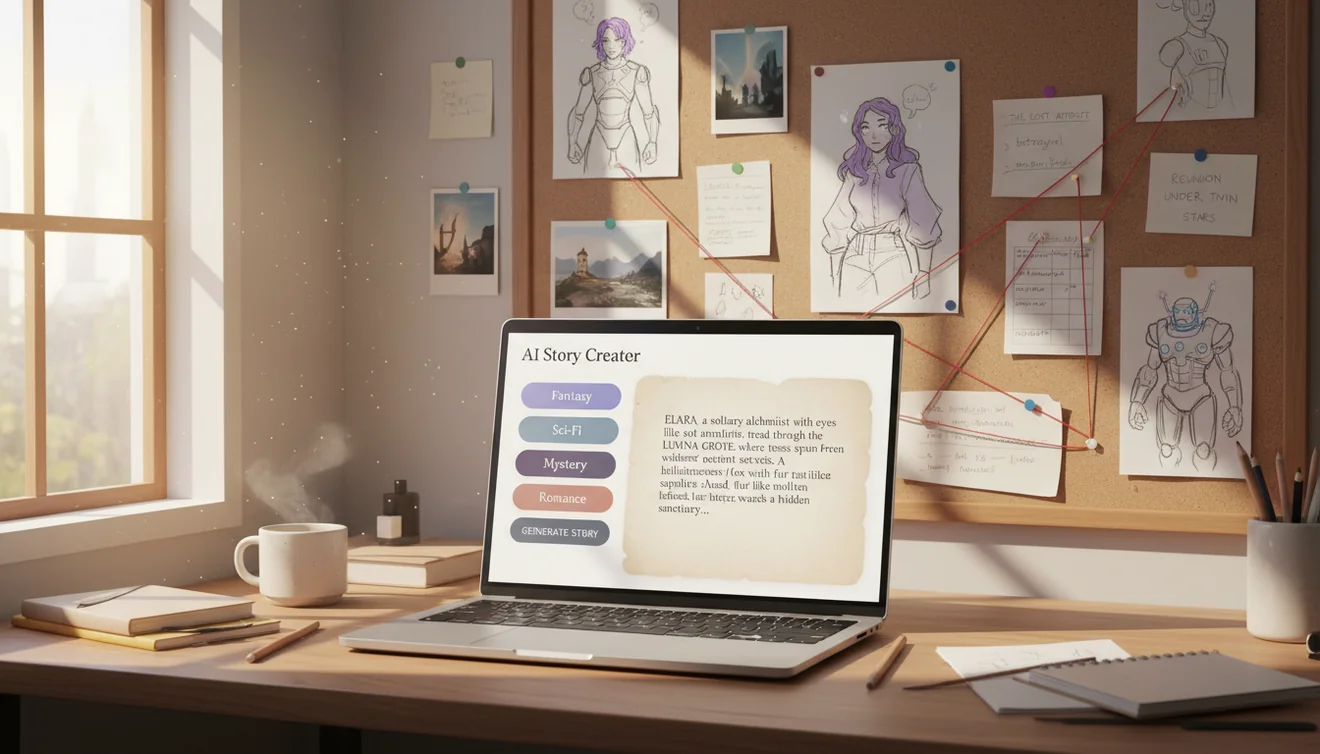
- Select a genre from the dropdown menu. The available genres are Fantasy, Romance, Sci-Fi, Horror, Mystery, and Adventure. Choosing a genre adjusts the AI's output to match the conventions, pacing, and vocabulary typical of that category.
- Click "Generate Story" to produce your narrative. The AI processes your prompt and returns an original story within seconds. The length typically ranges from 300 to 1,000 words depending on prompt complexity.
- Read the output and identify what works. Some parts of the generated story will be strong - an evocative description, a compelling line of dialogue, an unexpected plot turn. Other parts may feel flat, generic, or inconsistent. This is normal.
- Edit and revise the story. Use the generated text as raw material. Cut what does not work, expand the parts that do, and add your own voice. The difference between a mediocre AI story and a good one is almost always the editing pass that follows generation.
- Regenerate or refine as needed. If the output misses the mark, adjust your prompt with more specific instructions and generate again. You might specify "write only the opening scene" or "focus on the dialogue between the two main characters" to get more targeted results.
Types of Stories You Can Generate
The AI story generator handles a wide range of narrative forms. Short fiction between 500 and 1,000 words works particularly well because the AI can maintain coherence across that length without losing track of characters or plot threads. Flash fiction, stories under 500 words; is another strong use case. The compressed format forces economy of language, and the AI tends to produce tighter prose when the prompt implies brevity.
Genre fiction is where the dropdown selection makes the most difference. A fantasy prompt with the Fantasy genre selected produces different vocabulary, pacing, and world-building detail than the same prompt set to Sci-Fi. Horror stories lean toward atmosphere and tension. Mystery stories introduce questions early and withhold answers. Romance follows emotional beats between characters. These are not superficial cosmetic changes, the genre selection reshapes sentence structure, scene focus, and narrative priority.
Creative writing exercises and writing prompts represent another common use. Students and hobbyists use the generator to break through writer's block or to practice editing skills. You can generate a story, then rewrite it in a completely different style as an exercise. Some writing groups use AI-generated openings as shared starting points where each member takes the same first paragraph in a different direction.
The tool also supports mature and adult creative fiction. Users writing romance or erotica can prompt the generator with the relevant details and genre, and the AI will produce content that matches the request. The story generator treats all creative writing prompts as legitimate exercises in fiction, and the output reflects the intent of the input.

Writing Better Prompts for Story Generation
The single biggest factor in output quality is prompt specificity. Vague prompts produce vague stories. Here is a concrete example. The prompt "write a mystery" might generate a generic whodunit with stock characters and predictable twists. But "a retired forensic accountant finds discrepancies in her late neighbor's estate that suggest the neighbor faked their own death" gives the AI a specific protagonist, a concrete mystery, and a narrative direction that produces far more interesting output.
Character details improve stories more than plot details. Telling the AI that your protagonist is "a 34-year-old marine biologist who speaks in short sentences and distrusts authority" produces a character with voice and behavior patterns. Without those details, the AI defaults to a generic narrator who could be anyone.
Setting matters too, but in a different way. Physical environment details; the smell of salt air, the hum of fluorescent lights in a basement lab, rain on corrugated metal, give the AI anchors for sensory description. Abstract settings like "a city" or "the future" produce abstract prose. Specific settings like "a fishing village on the coast of Hokkaido in November" produce prose with texture.
Mood and tone instructions work well when they are specific. Instead of "make it dark," try "the tone should feel like unease slowly building; the reader senses something is wrong before the character does." The AI can approximate tonal instructions with surprising accuracy when they are concrete rather than generic.
The Role of Human Editing in AI Stories
Every AI-generated story benefits from editing. This is not a shortcoming specific to AI, first drafts by human authors need revision too. But the nature of the editing is different. With AI output, you are looking for moments where the prose loses its own logic. A character who was described as shy might suddenly deliver a monologue. A rainy scene might shift to bright sunshine without transition. The AI does not track continuity the way a human writer does, so continuity is the first thing to check.
Voice is the second priority. AI prose tends toward a neutral, slightly formal register. If your story calls for a specific voice; a wry first-person narrator, a child's perspective, a stream-of-consciousness style - you will likely need to rewrite sections to establish and maintain that voice. The AI can approximate voice when prompted, but it drifts toward default patterns over longer passages.
The third layer of editing involves adding what the AI cannot: subtext. AI-generated dialogue says what it means. Real dialogue often means the opposite of what it says, or means something entirely different depending on context. Adding subtext, irony, and emotional undertones to AI-generated scenes is where the human writer transforms competent prose into something that actually resonates.
Limitations and Safety
AI story generators have specific limitations that users should understand before relying on them. The most significant is long-form coherence. The AI generates text sequentially and does not maintain a master outline of your story's plot, character arcs, or world-building rules. For stories under 1,000 words, this is rarely noticeable. For anything longer, you will encounter contradictions, forgotten details, and characters who behave inconsistently between scenes.
Character consistency is another known weakness. A character established as quiet and introverted may begin acting assertively three paragraphs later because the AI has no persistent model of that character's psychology. It generates moment to moment. You can mitigate this by including character reminders in your prompt, but the problem does not disappear entirely.
The AI may also produce content that is derivative without being a direct copy. It has learned narrative patterns from its training data, so it may default to common tropes, cliché plot twists, or stock character types. The output is original in the sense that it is newly generated text, but it may not be original in the sense of offering truly novel ideas. That is where human creativity in the editing phase becomes essential.
Factual accuracy is not guaranteed. If your story references real locations, historical events, or scientific concepts, verify those details independently. The AI can and does generate plausible-sounding facts that are incorrect.
Generated content should be reviewed and edited before sharing or publishing. The AI writing tools on Write.info are designed to assist the creative process, not replace the judgment and craft that make fiction meaningful.
Write stories anywhere with the Write.info app
Use Write.info’s AI writing tools to brainstorm plots, draft scenes, rewrite passages, and polish creative work on mobile. Always review AI-generated stories before publishing or submitting them.
Get Write.info AppAI Story Generator App
The AI Story Generator tool is available as part of the AI Writer app for iPhone and iPad. The app includes all writing, detection, and humanization tools in a single download with no account required. An Android version is currently in development.
The iOS app supports offline access to saved content and provides the same AI writing capabilities available on Write.info. Users receive 10 free generations per day on the website, while the app offers extended access through optional subscription plans.
Download on App Store