AI Detector & AI Checker
Analyze text for AI-generated content patterns. Get detection scores and identify machine-written passages quickly.
| Need | Best option |
|---|---|
| Free AI detection plus connected writing tools | Write.info |
| Grammar and style polishing after reviewing AI-detection results | Grammarly |
| Rephrasing or improving unclear sections responsibly | QuillBot |
| Generating a fresh draft before checking originality and AI signals | ChatGPT |
What Is an AI Detector
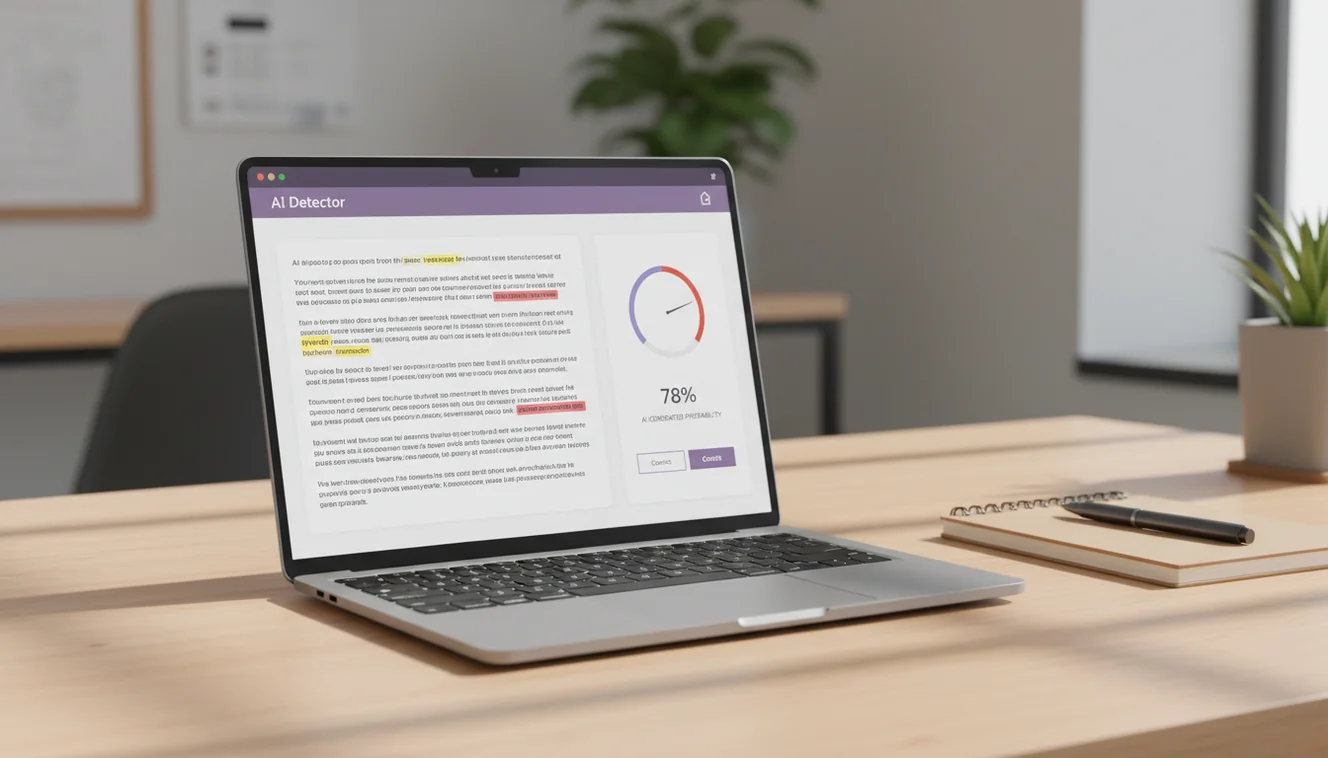
An AI detector is a tool that analyzes written text and estimates the probability that it was generated by an artificial intelligence language model rather than written by a human. It works by measuring statistical patterns in word choice, sentence structure, and overall text consistency that differ between human and machine writing. AI detectors produce probability scores, not definitive verdicts.
The demand for AI detection has grown rapidly since large language models became publicly accessible. Teachers want to know if student essays were generated by ChatGPT. Editors want to verify that submitted articles were actually written by the credited author. Hiring managers want to confirm that writing samples reflect the candidate's real ability. These are reasonable concerns, and AI detectors address them - but with important caveats that every user should understand before acting on the results.
AI detection is fundamentally probabilistic. There is no hidden watermark or embedded signature in AI-generated text that a detector can identify with certainty. Instead, detectors analyze how text behaves statistically and compare those patterns against known profiles of human and machine writing. This approach works reasonably well on longer, unedited AI output. It becomes less reliable on shorter texts, heavily edited AI content, and human writing that happens to exhibit AI-like statistical uniformity. Understanding this distinction is critical for anyone using detection results to make decisions.
This tool is part of the detection and verification suite on Write with AI at Write.info, alongside the GPT detector for model-specific analysis and the plagiarism checker for originality verification. Each tool examines text from a different angle, and using them together provides a more complete picture than any single analysis.
How AI Detectors Work
AI detection relies on three primary statistical metrics. Understanding them helps you interpret results accurately and avoid drawing incorrect conclusions from detection scores.
Perplexity measures how surprised a language model would be by each word in the text. When a language model generates text, it selects high-probability words at each step - the words that are most statistically likely given the preceding context. This produces text with consistently low perplexity. Human writers, by contrast, make unpredictable choices. They use uncommon synonyms, follow unexpected trains of thought, employ rhetorical devices, and occasionally choose words for sound or rhythm rather than probability. Human text has higher and more variable perplexity. When a detector sees uniformly low perplexity across a passage, it increases the AI probability score.
Burstiness quantifies variation in sentence structure across the text. AI-generated text tends to produce sentences of similar length and syntactic complexity. A typical AI paragraph might contain five sentences between fourteen and twenty-two words each, all following similar grammatical patterns. Human writing is burstier - it mixes short declarative punches with long, clause-heavy constructions. A human paragraph might contain a three-word fragment, a thirty-five-word compound sentence, a rhetorical question, and a parenthetical aside. Detectors measure this structural variation. Low burstiness correlates with AI authorship; high burstiness correlates with human authorship.
Entropy measures the randomness and diversity of vocabulary across the document. AI models draw from a narrower effective vocabulary because they favor common, contextually appropriate words. Human writing includes a wider range of vocabulary - technical jargon mixed with colloquialisms, unusual adjectives, made-up compounds, and borrowed phrases from other languages. Higher entropy in word selection signals human authorship.
Detectors combine these metrics, often weighted by proprietary algorithms, to produce an overall probability score. Some detectors also use trained classifiers, neural networks specifically trained to distinguish human from AI text, in addition to statistical analysis. The exact methodology varies by platform, which is why the same text can receive different scores on different detectors.
How to Use the AI Detector
- Paste the text you want to analyze into the input box above. The tool accepts up to 5,000 characters per request. For longer documents, analyze representative sections rather than the entire text to stay within the limit.
- Click "Detect AI" to run the analysis. The detector evaluates the statistical properties of the text across multiple dimensions including perplexity, burstiness, and vocabulary patterns.
- Review the detection results. The output provides an estimated probability that the text was AI-generated. Higher percentages indicate stronger statistical similarity to known AI writing patterns.
- Interpret results in context. A high AI score does not prove AI was used. A low score does not guarantee human authorship. Consider the text length, the author's writing background, and whether the text has been edited before drawing conclusions.
- Cross-reference if needed. For additional confidence, run the same text through the GPT detector for model-specific analysis. Consistent results across multiple detection methods provide stronger evidence than a single score.
- Use results responsibly. AI detection scores should inform decisions, not dictate them. Discuss results with the author before taking action, especially in academic or employment contexts where consequences are significant.
Accuracy and Limitations of AI Detection
No AI detector is perfectly accurate, and understanding the limitations prevents misuse of detection results.
On unedited AI text longer than 250 words, most detectors achieve accuracy rates between 85 and 95 percent. This sounds high, but in practice it means that for every twenty passages analyzed, one or two will be misclassified. When the stakes are high, academic integrity decisions, employment screening, publishing verification - a five to fifteen percent error rate is significant. One in ten or one in twenty false accusations affects a real person.
Accuracy drops sharply under several conditions. Short text (under 100 words) gives detectors too little data to establish reliable statistical patterns. Edited AI text disrupts the statistical uniformity that detectors rely on. Even moderate human editing - changing a few sentences, adding personal examples, varying vocabulary, can reduce AI scores substantially. Humanized or rewritten AI text is specifically designed to evade detection, and current detectors struggle with well-humanized content.
The false positive problem deserves particular attention. Research has shown that non-native English speakers are disproportionately flagged by AI detectors. Writing in a second language tends to produce grammatically correct but stylistically uniform text, exactly the pattern detectors associate with AI output. This means a student writing in their second language may be falsely accused of using AI, while a native speaker who actually used AI and then edited the output might pass detection. This asymmetry raises serious fairness concerns that anyone using detection tools should consider.

GPTZero, ZeroGPT, and the Detection Landscape
Multiple AI detection platforms exist, each with its own methodology and accuracy profile. Understanding the landscape helps users choose appropriate tools and interpret results.
GPTZero is one of the most widely adopted detection platforms, particularly in education. It analyzes text using perplexity and burstiness scores, providing both an overall classification and sentence-level highlighting of passages that appear AI-generated. GPTZero was one of the first dedicated AI detectors and has been through several iterations of its detection model. Its strength is in analyzing longer academic texts; its weakness, like all detectors, is with short or heavily edited passages.
ZeroGPT provides percentage-based AI probability scores and has gained popularity for its simplicity. Users paste text and receive a percentage estimate. The tool is straightforward to use but provides less granular analysis than some alternatives. Like all detection tools, ZeroGPT should be understood as providing estimates rather than definitive identification.
Turnitin integrated AI detection into its plagiarism checking platform, making it accessible to institutions already using Turnitin for originality verification. The integration means that student papers can be checked for both plagiarism and AI generation in a single workflow. However, Turnitin has acknowledged that its AI detection produces false positives, particularly on writing by non-native English speakers.
The Write.info AI detector provides free analysis without requiring an account. It offers a quick assessment for users who want to check text before submission or publication. For model-specific analysis focused on GPT-generated content, the GPT detector tool provides a complementary evaluation.
When AI Detection Matters
AI detection is most relevant in contexts where authorship authenticity has direct consequences.
In education, detection helps instructors identify submissions that may not reflect student effort. However, detection results should start a conversation, not end one. An instructor who receives a high AI score should discuss the submission with the student rather than issuing an automatic penalty. The student may have a legitimate explanation, or the detector may have produced a false positive.
In publishing and content creation, detection helps editors verify that contributors are submitting original work. Publications that pay for human-written content have a reasonable interest in confirming that the writing is not simply AI output submitted without disclosure. Detection tools provide a screening layer, though they should not replace editorial judgment about content quality.
In hiring, some employers use detection to verify that writing samples and cover letters were authored by the candidate. This raises questions about proportionality, is it reasonable to reject a candidate because a writing sample scores high on AI detection, when the sample might have been human-written but statistically uniform? Context and conversation should accompany detection results in hiring decisions.

Limitations & Safety
AI detection results are probabilistic estimates, not definitive proof of authorship. No detection tool can state with certainty that specific text was or was not written by AI. Users should treat detection scores as one piece of evidence among several, not as conclusive determination. Making high-stakes decisions based solely on AI detection scores is not recommended.
False positives are an inherent limitation of the technology. Human-written text that exhibits statistical patterns similar to AI output will be flagged. This disproportionately affects non-native English speakers, writers with highly structured or formulaic styles, and technical writing with specialized vocabulary. Users in positions of authority should be aware of these biases before acting on detection results.
The tool does not identify the specific AI model that generated the text, and it cannot determine whether text was partially AI-assisted versus fully AI-generated. A document where a human wrote 80% and AI contributed 20% may score anywhere on the detection spectrum depending on how the AI-generated sections integrate with the human-written portions.
Write.info does not store, log, or retain any text submitted to the AI detector. All analysis occurs in real time and content is discarded immediately after results are delivered. For more details, visit the privacy policy. For the full range of writing and detection tools, visit the Write with AI homepage.
Check and improve your writing with Write.info
Use the AI Detector & AI Checker to review text, then refine your draft with Write.info tools and mobile app guides. AI scores are signals, so combine them with careful human review and responsible disclosure.
Get Write.info AppAI Detector App
The AI Detector tool is available as part of the AI Writer app for iPhone and iPad. The app includes all writing, detection, and humanization tools in a single download with no account required. An Android version is currently in development.
The iOS app supports offline access to saved content and provides the same AI writing capabilities available on Write.info. Users receive 10 free generations per day on the website, while the app offers extended access through optional subscription plans.
Download on App Store