Free Online Plagiarism Checker
Analyze text for plagiarism indicators using heuristic pattern analysis. Identify stylistic inconsistencies and potential originality issues.
| Need | Best option |
|---|---|
| Free plagiarism indicator review before submitting or publishing text | Write.info |
| Grammar, tone, and style edits with plagiarism features in a paid writing suite | Grammarly |
| Paraphrasing and rewriting support after identifying copied or overly similar passages | QuillBot |
| Brainstorming citations questions, source summaries, or revision plans with human verification | ChatGPT |
What Is a Plagiarism Checker
A plagiarism checker is a tool that analyzes written text for indicators of copied, unattributed, or unoriginal content. It evaluates writing patterns to identify sections that may have been taken from other sources without proper credit. Plagiarism checkers serve as screening tools for writers, educators, and editors who need to verify the originality of submitted work.
Plagiarism detection has evolved significantly from its early forms. The first plagiarism tools were essentially search engines-they took a passage and searched the web for matching text. Modern approaches are more nuanced. Database-comparison tools like Turnitin maintain massive repositories of published work, student submissions, and web content, then check submitted text against them for matching phrases. Heuristic analysis tools, like the one on this page, take a different approach entirely. Instead of searching for matching source text, they analyze the writing itself for patterns that indicate plagiarism: sudden shifts in vocabulary level, inconsistent sentence complexity, stylistic breaks that suggest different authors, and structural cues associated with patchwork composition.
Neither approach is foolproof on its own, and understanding the difference matters. Database comparison can tell you that a sentence appeared in a specific published article. Heuristic analysis can tell you that paragraph three reads like it was written by a different person than paragraphs one and two. Both are useful signals, but they answer different questions. This tool on Write.info uses heuristic analysis. It is a screening tool that identifies plagiarism indicators-it does not perform source matching against published databases. For formal academic integrity checks where you need to identify the exact source of a matched passage, institutional tools like Turnitin or iThenticate remain the standard.
How Heuristic Plagiarism Analysis Works
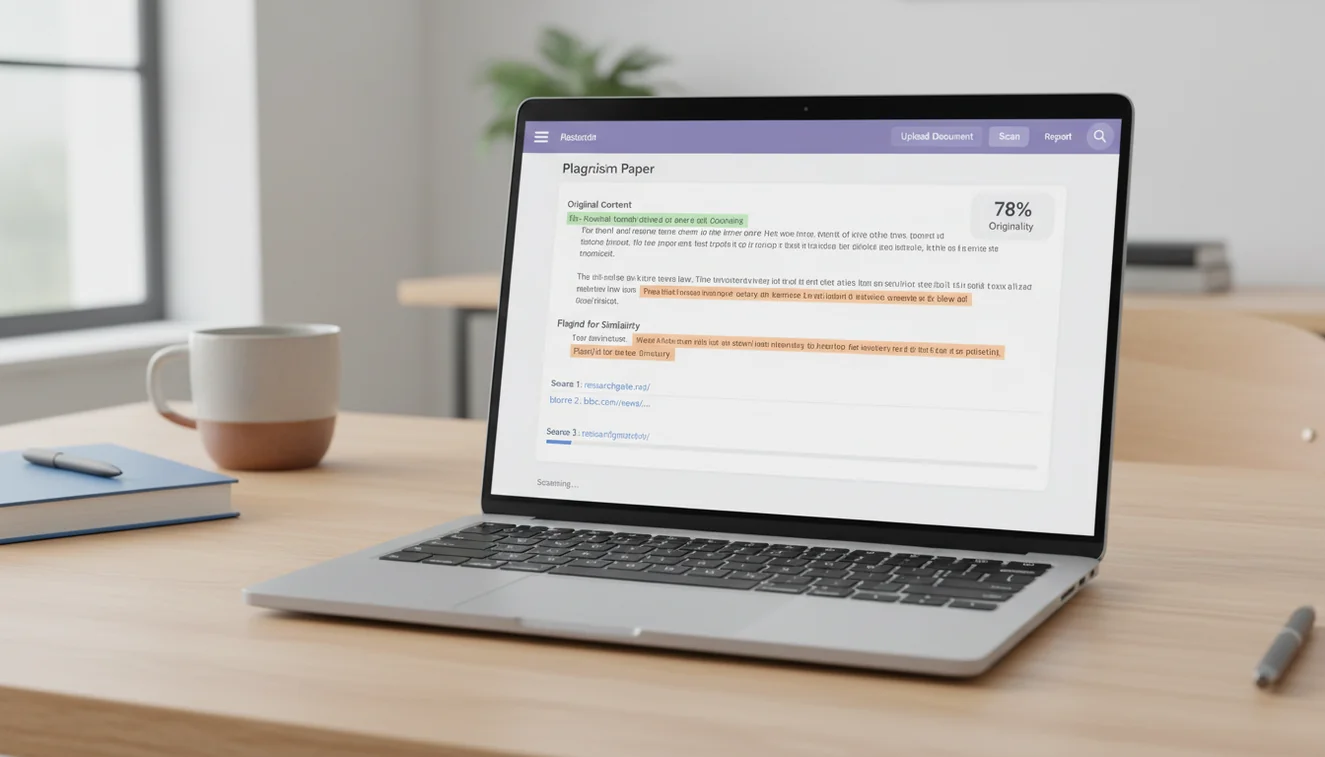
Heuristic analysis examines the internal characteristics of a text rather than comparing it to external sources. The approach is based on a straightforward principle: a single author writing a single document tends to maintain consistent patterns in vocabulary, sentence structure, complexity, and style. When those patterns break-when a paragraph of simple, direct sentences is suddenly followed by a paragraph of complex, academic prose-that inconsistency is a signal worth investigating.
The analysis evaluates several dimensions of the text. Vocabulary consistency measures whether the word choices remain at a similar level throughout the document. A student essay that uses everyday language for most of its length but suddenly deploys specialized academic terminology in one section may have borrowed that section from a published source. Sentence structure variation looks at whether the rhythm of the writing shifts abruptly. Every writer has natural patterns-some favor short sentences, others build complex clauses-and those patterns tend to persist throughout a single writing session.
Stylistic coherence evaluates whether the tone, formality level, and rhetorical approach remain stable. A text that shifts from first-person conversational prose to impersonal academic analysis mid-document raises flags. Transitional analysis examines how ideas connect between paragraphs. Original writing typically flows through a logical progression, while patchwork plagiarism often has abrupt topic shifts where the writer stitched together passages from different sources without creating natural transitions.
These heuristic signals are probabilistic, not definitive. An inconsistency in style does not prove plagiarism any more than consistency proves originality. A writer might shift their tone deliberately for rhetorical effect. A section might sound different because the writer revised it weeks after writing the rest. Heuristic analysis identifies areas that warrant closer inspection, not areas that are definitively plagiarized. Treat the results as a starting point for review, not as a verdict.
Types of Plagiarism
Plagiarism is not a single behavior. It takes multiple forms, some obvious and some subtle, each with different implications and different levels of detectability.
Direct plagiarism is the most straightforward type: copying text word-for-word from a source without attribution or quotation marks. This includes copying entire passages from books, articles, websites, or other students' work. Direct plagiarism is typically the easiest to detect through database-comparison tools because the text has an identical match in the source. Heuristic analysis can also flag direct plagiarism when the copied passage differs in style from the surrounding text.
Mosaic plagiarism is more subtle and significantly harder to detect. It occurs when a writer takes phrases, clauses, or distinctive expressions from sources and integrates them into their own text without attribution. The result reads like original work at a glance because the borrowed language is interspersed with the writer's own sentences. Mosaic plagiarism is sometimes called patchwriting, and it often happens when writers paraphrase too closely-changing a few words but retaining the original sentence structure and distinctive phrasing of the source. Database tools struggle with mosaic plagiarism because no single passage is a direct match. Heuristic analysis can sometimes detect it through vocabulary and complexity inconsistencies within paragraphs.
Self-plagiarism involves resubmitting your own previously published or submitted work as new, original content. In academic contexts, submitting the same paper to two different courses without instructor permission is self-plagiarism. In publishing, submitting a previously published article to a new journal without disclosure violates editorial standards. Self-plagiarism is particularly hard for any automated tool to detect unless it has access to your prior submissions.
Paraphrasing without attribution falls into a gray area that confuses many writers. Taking someone else's ideas and restating them in your own words is legitimate when you cite the source. Doing the same thing without citation is plagiarism even though no words were copied. This is an idea-level issue that neither database comparison nor heuristic analysis can reliably detect, because the text is genuinely in the writer's own language-only the underlying idea is borrowed.
How to Use the Plagiarism Checker
- Paste your text into the input field above. The tool accepts up to 5,000 characters per check. For longer documents, check sections individually, focusing on areas where you are least certain about originality.
- Click Check Plagiarism. The tool runs heuristic analysis on your text, examining vocabulary patterns, sentence structure, stylistic consistency, and other linguistic indicators.
- Review the results. The analysis identifies sections with potential plagiarism indicators and provides an overall assessment. Pay attention to specific passages that are flagged for stylistic inconsistencies.
- Investigate flagged sections. If the tool identifies areas of concern, review those passages yourself. Ask whether the language and complexity level matches the rest of your writing. Check whether you adequately cited any sources you drew from.
- Revise as needed. For sections that show plagiarism indicators, rewrite in your own voice, add proper citations where sources were used, or use the AI paraphrasing tool to rephrase borrowed language into genuinely original expression.
- Re-check after revisions. Run the revised text through the tool again to verify that the flagged sections now show consistent, original writing patterns.

Academic Integrity and Plagiarism
Plagiarism in academic settings carries consequences ranging from failing a single assignment to expulsion, depending on the institution and the severity. Understanding what constitutes plagiarism and how to avoid it is more productive than worrying about detection after the fact.
Proper citation is the foundation of academic integrity. Every time you use someone else's ideas, data, phrasing, or arguments in your work, that source needs to be credited. This applies regardless of whether you quote directly or paraphrase. The specific citation format-APA, MLA, Chicago, Harvard-varies by discipline and institution, but the underlying principle is universal: give credit where credit is due.
Common knowledge does not require citation. Widely known facts like "water boils at 100 degrees Celsius at sea level" or "the American Civil War ended in 1865" are considered common knowledge in their respective fields. The boundary between common knowledge and citable information can be blurry. A useful rule of thumb: if you learned it from a specific source while researching this particular paper, cite it. If it is something you already knew and could find in any general reference, it probably qualifies as common knowledge.
Students should also understand that plagiarism policies increasingly address AI-generated content. Many institutions now classify submitting AI-generated text as original work as a form of academic dishonesty. The AI detector on Write.info can help identify whether text shows patterns consistent with AI generation, which is a separate but related concern to traditional plagiarism.
Heuristic Analysis vs. Database Comparison
These two approaches to plagiarism detection serve different purposes, and understanding their strengths and limitations helps you choose the right tool for your situation.
Database comparison tools like Turnitin, Copyscape, and iThenticate are definitive when they find a match. If your text contains a passage that matches a published source word-for-word, these tools will identify it and tell you exactly where the matching text appeared. Their weakness is coverage: they can only detect plagiarism from sources in their database. Content from obscure sources, unpublished work, or sources in languages not covered by the database may not be matched. They also struggle with mosaic plagiarism where no single phrase is long enough to trigger a match.
Heuristic tools like this one do not need a database of source material. They evaluate the writing itself for internal consistency. This makes them useful for preliminary screening and for catching types of plagiarism that database tools miss-particularly mosaic plagiarism and submissions that draw from sources not in any database. Their weakness is that they cannot identify the specific source of plagiarized content. They can say "this section looks inconsistent with the rest of your writing" but not "this section was taken from page 47 of a specific textbook."
For thorough plagiarism prevention, using both approaches is more effective than relying on either one alone. Run a heuristic check to identify stylistic inconsistencies, then verify any flagged sections against potential sources. This combination catches a wider range of plagiarism types than either method independently.
Limitations & Safety
This tool uses heuristic analysis to identify plagiarism indicators in submitted text. It does not compare your text against a database of published works, academic papers, or web content. It cannot tell you whether a specific passage was copied from a specific source. For source-level plagiarism detection, institutional tools like Turnitin are necessary.
Heuristic analysis is probabilistic. It identifies patterns associated with plagiarism but cannot confirm plagiarism definitively. False positives can occur when a writer legitimately shifts style within a document, and false negatives can occur when plagiarized content is skillfully integrated to match the surrounding text's style. Results should be interpreted as indicators warranting further review, not as conclusive evidence.
The tool is not appropriate as a sole method for academic integrity enforcement. Instructors and institutions should use this as one component of a broader approach that includes database-comparison tools, assignment design that discourages plagiarism, and educational conversations about academic honesty.
Write.info does not store, retain, or add submitted text to any database. Text is processed in real time and discarded immediately after the analysis is returned. Your content is not used for training and does not become part of any comparison corpus. For more writing and analysis tools, explore the full AI writing platform on the homepage.
Check Originality Before You Publish
Use Write.info to review plagiarism indicators, improve clarity, and revise responsibly across web and mobile. Always verify sources, cite properly, and rely on human review for final academic or professional decisions.
Get Write.info AppPlagiarism Checker App
The Plagiarism Checker tool is available as part of the AI Writer app for iPhone and iPad. The app includes all writing, detection, and humanization tools in a single download with no account required. An Android version is currently in development.
The iOS app supports offline access to saved content and provides the same AI writing capabilities available on Write.info. Users receive 10 free generations per day on the website, while the app offers extended access through optional subscription plans.
Download on App Store