Free AI Translator
Translate text between languages with natural, context-aware phrasing. No signup required.
What Is an AI Translator
An AI translator is a tool that converts text from one language to another using a large language model. Unlike traditional machine translation that maps words and phrases through statistical tables, an AI translator processes the meaning of entire sentences and paragraphs to produce output that reads naturally in the target language. AI translators do not understand language the way bilingual humans do; they predict the most likely sequence of words in the target language based on patterns learned during training.
Translation has been one of the most visible applications of AI technology over the past decade, and the improvements have been substantial. Early machine translation produced output that was technically comprehensible but awkward, the kind of text that made native speakers wince. Modern language models have closed much of that gap. For everyday communication, informal writing, and general content, AI translation now produces output that reads naturally enough to be useful without heavy editing. The shift from phrase-based statistical models to transformer-based neural networks changed translation from a word-matching exercise into a contextual reasoning task, and the quality difference is noticeable across virtually every language pair.
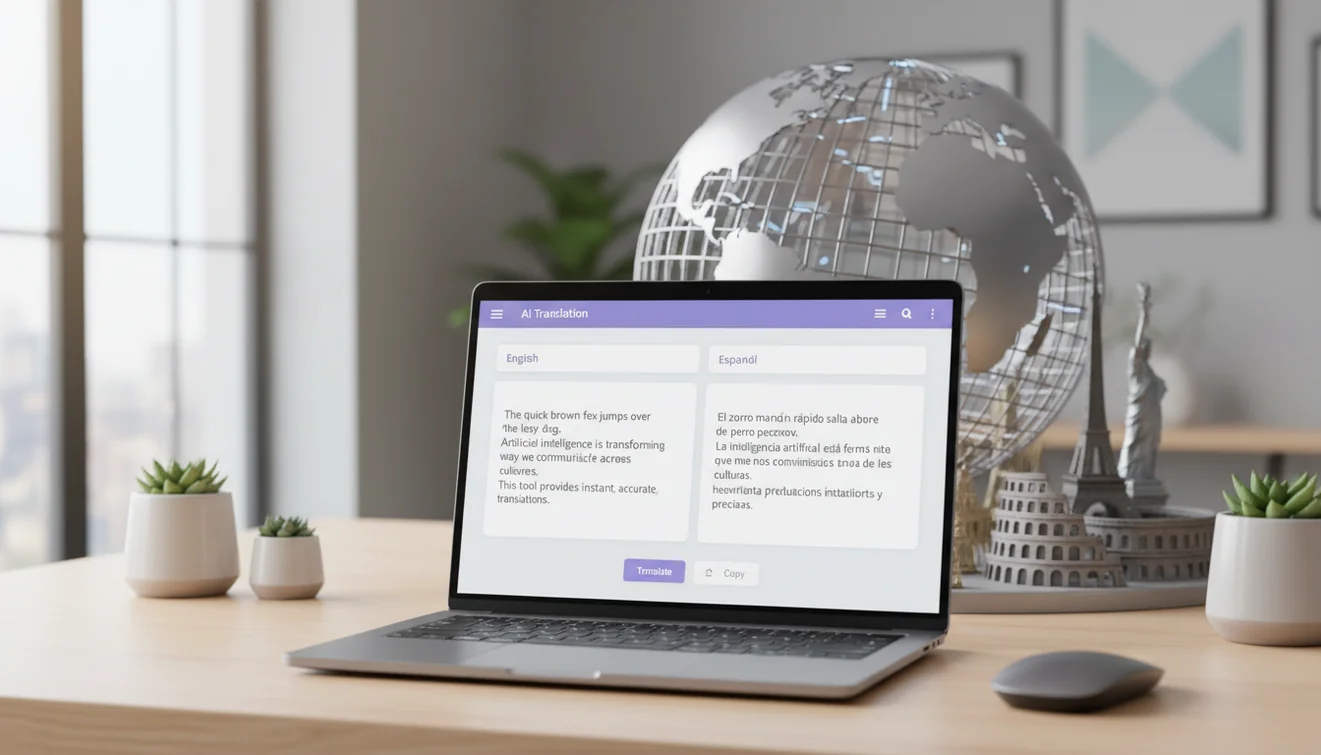
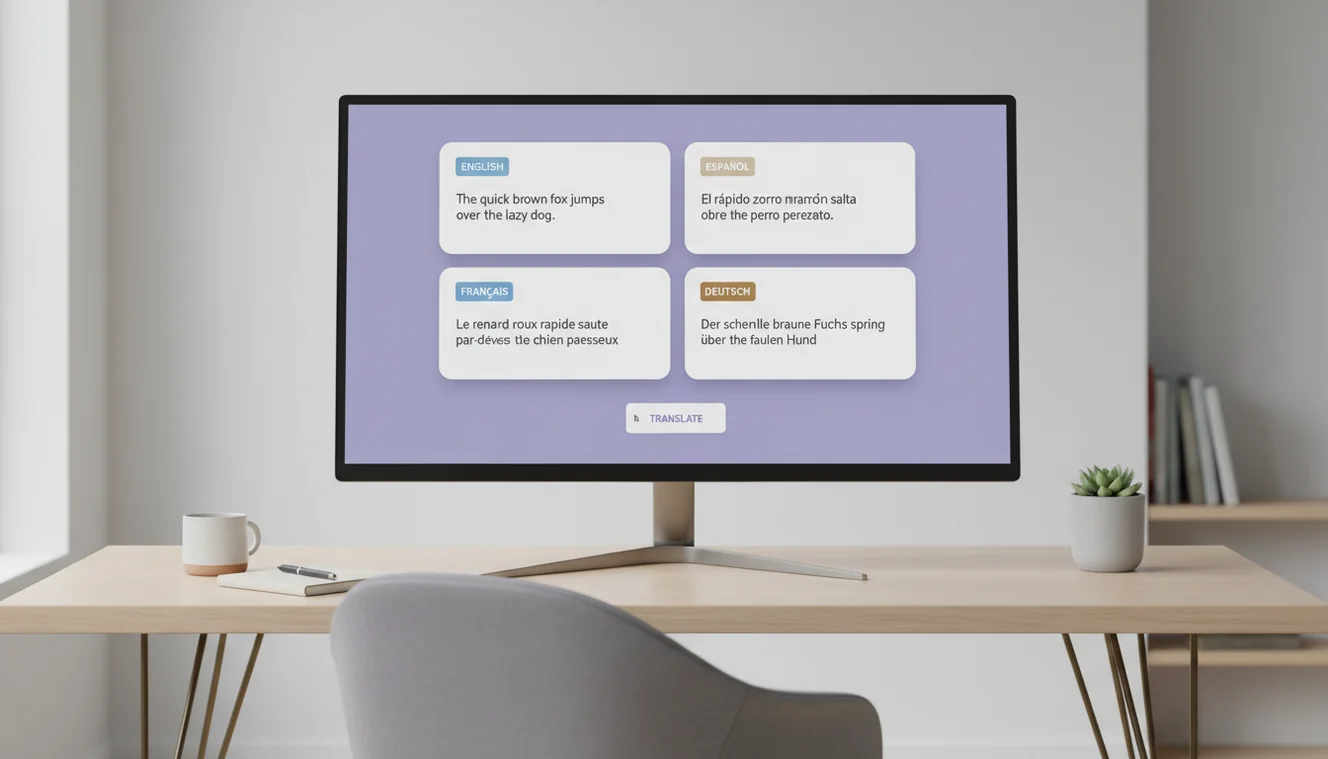
The tool on this page uses the same language model that powers all tools on Write.info, with prompts specifically tuned for translation tasks. You select a target language from the dropdown; Spanish, French, German, Portuguese, Chinese, Japanese, Korean, or Arabic, and the AI translates your input with attention to context, tone, and natural phrasing. You can also type any target language directly into your prompt if it is not listed. This approach produces translations that sound like something a fluent speaker would actually write, rather than mechanically converted text. For other text processing needs, the AI Writer homepage provides access to 27 additional tools.
How AI Translation Handles Context
The single biggest advantage of AI translation over older methods is context handling. Consider the English word "bank." Traditional translation tools need disambiguation rules to determine whether you mean a financial institution or a riverbank. An AI translator reads the surrounding sentence and makes that determination automatically based on context. The same applies to words with multiple meanings across most languages, "right" can mean correct, a direction, or an entitlement, and the AI selects the appropriate translation based on how the word is used.
This context awareness extends to entire paragraphs. If the first sentence of a passage establishes a formal tone, the AI maintains that formality throughout the translation. If the source text uses casual language and contractions, the translated output reflects that register in languages where such distinctions exist. French, for instance, has distinct formal and informal address forms (vous vs. tu). The AI infers the appropriate level from context rather than defaulting to one or the other.
Tone preservation is where AI translation genuinely surpasses traditional tools. A sarcastic comment, a gentle suggestion, and a direct instruction all use different linguistic markers. In English, "You might want to reconsider that approach" and "Change your approach" communicate different levels of directness. An AI translator captures that difference and expresses it using equivalent constructions in the target language. This matters enormously for business communication, where tone affects how messages are received and interpreted.
That said, context handling has limits. The AI works with the text it receives and nothing more. It does not know who wrote the text, who will read it, or what broader conversation it belongs to. Cultural references, inside jokes, and domain-specific jargon can trip up even the most capable models. A reference to "March Madness" will not translate meaningfully for an audience unfamiliar with American college basketball unless you provide enough surrounding context for the AI to recognize it as a cultural reference rather than a literal phrase.
Language-Specific Considerations
Spanish translation is among the most reliable because the AI has extensive training data for English-Spanish pairs. Regional variations exist, Latin American Spanish and European Spanish differ in vocabulary and some grammar conventions, so specifying the region in your prompt produces more targeted results. Without specification, the AI tends toward neutral Spanish that works across regions.
French translation handles formal business correspondence well. The AI correctly navigates gendered nouns and adjective agreement in most cases. Longer sentences with multiple clauses occasionally produce agreement errors that a native speaker would catch immediately, so review these closely.
German presents compound nouns and case declensions that challenge any translation tool. The AI handles common compounds correctly but may struggle with highly specialized or newly coined terms. Word order in subordinate clauses follows different rules in German, and the AI manages this reliably for standard sentence structures.
Portuguese has distinct Brazilian and European variants. As with Spanish, specifying which variant you need in your prompt improves results. The AI defaults to a generalized Portuguese that leans slightly toward Brazilian conventions due to training data distribution.
Chinese (Simplified Mandarin) translation is effective for business and general content. The AI handles the transition from a subject-verb-object language to Chinese syntax reasonably well. Measure words, which are required before nouns in Chinese, are generally applied correctly. Literary or highly poetic text remains challenging.
Japanese translation requires navigating three writing systems (hiragana, katakana, kanji) and multiple levels of politeness. The AI produces grammatically correct Japanese for standard communication. Keigo (formal honorific language) is handled at a basic level but may not meet the precision expected in formal Japanese business contexts.
Korean has agglutinative grammar where meaning is built by attaching suffixes to word stems. The AI handles standard Korean well, including appropriate speech levels for general communication. Highly formal or archaic Korean expressions may be translated too literally.
Arabic translation involves right-to-left text direction and root-based morphology. The AI produces Modern Standard Arabic by default. Dialectal Arabic (Egyptian, Gulf, Levantine) varies significantly, and the tool works in MSA unless you specify a dialect in your prompt.

How to Use the AI Translator
- Enter your text. Paste or type the content you want to translate into the text area. Keep sentences clear and direct for the most accurate results. If your text contains specialized terminology, consider adding brief context in parentheses.
- Select the target language. Choose from Spanish, French, German, Portuguese, Chinese, Japanese, Korean, or Arabic using the dropdown. For languages not listed, include the target language name in your text prompt (e.g., "Translate the following to Dutch:").
- Click Translate. The AI processes your text and generates a translation that prioritizes natural phrasing over literal word substitution.
- Review the output. Read through the translation carefully. If you are not fluent in the target language, consider using back-translation, paste the output back in and translate it to your original language to check whether the meaning was preserved.
- Edit for context. Adjust any proper nouns, brand names, or cultural references that may not have translated appropriately. Add or modify text to match the expectations of your target audience.
- Copy and use. Use the copy button to transfer the translated text to your document, email, or message.
When AI Translation Works Well and When It Does Not
AI translation performs reliably for several common use cases. Business emails, product descriptions, social media posts, informal messages, and general informational content translate well because they use straightforward language and predictable structures. If you need to communicate a clear message to someone who speaks a different language, the AI handles this effectively for all supported languages.
Travel-related translation is another strong use case. Hotel inquiries, restaurant orders, direction requests, and basic conversational phrases translate accurately. The AI produces phrasing that sounds natural rather than textbook-formal, which is more appropriate for real-world interactions.
Where AI translation struggles is in content that depends heavily on cultural knowledge, wordplay, or emotional nuance. Poetry loses its rhythm and meaning in translation even when handled by expert human translators - AI fares worse. Legal contracts require exact terminology where a single word difference can change obligations. Medical documents need precision that the AI cannot guarantee. Marketing copy often relies on puns, double meanings, or culturally specific appeals that do not transfer between languages without creative adaptation.
Technical documentation occupies a middle ground. The AI handles technical content reasonably well when the terminology is established and widely used. Emerging technology terms, proprietary nomenclature, and field-specific abbreviations may be translated incorrectly or left untranslated. If you are translating technical content, review terminology carefully and consider providing a glossary of key terms in your prompt.
Tips for Getting Accurate Translations
The quality of AI translation depends significantly on the quality of the source text. Ambiguous sentences produce ambiguous translations. Here are specific practices that improve results.
Write in simple, direct sentences. Complex sentences with multiple nested clauses are harder to translate accurately. If a sentence contains more than one main idea, split it into two sentences before translating. The AI processes shorter, focused sentences with higher accuracy than long, winding ones.
Avoid idioms and colloquialisms when possible. "It's raining cats and dogs" will confuse the AI if taken literally, though most common English idioms are handled correctly. Less common or regional expressions may not be. When you use an idiom, consider whether replacing it with a direct statement would serve the translation better.
Specify your audience. Adding "for a formal business letter" or "for a casual conversation between friends" to your prompt helps the AI select appropriate vocabulary and tone in the target language. This is particularly important for languages like Japanese and Korean where formality levels significantly affect word choice and grammar.
Proofread your source text. Spelling errors, missing words, and grammatical mistakes in the original text carry over into the translation as misinterpretations. The AI translates what you give it, including errors. Clean source text produces clean translations. The AI grammar checker can help clean up your source text before translation.
Limitations & Safety
AI translation should not be used as a sole resource for any content where accuracy has legal, medical, financial, or safety implications. The language model generates translations based on statistical patterns, not linguistic expertise. It can produce fluent-sounding output that contains errors in meaning, especially for technical or specialized content.
The tool does not guarantee accuracy for any language pair. Translation quality varies depending on the amount of training data available for each language, the complexity of the source text, and the structural differences between the source and target languages. Less commonly translated language pairs may produce lower-quality output than widely spoken language combinations.
Cultural adaptation is not the same as translation. The AI translates words and meaning but does not adapt content for cultural appropriateness. References, examples, units of measurement, date formats, and social conventions may need manual adjustment for the target audience. A message that is appropriate in one culture may be unclear or offensive in another regardless of linguistic accuracy.
Write.info does not store or retain any text submitted to the translation tool. For additional text rewriting and language tools, explore the full suite of writing tools available on this site.
Translate, Rewrite, and Edit Anywhere
Use Write.info on the web or in the mobile app to translate drafts, improve phrasing, and review your writing before you share it. Always check important translations for accuracy, tone, and context.
Get Write.info AppAI Writer App
The AI Writer tool is available as part of the AI Writer app for iPhone and iPad. The app includes all writing, detection, and humanization tools in a single download with no account required. An Android version is currently in development.
The iOS app supports offline access to saved content and provides the same AI writing capabilities available on Write.info. Users receive 10 free generations per day on the website, while the app offers extended access through optional subscription plans.
Download on App Store