Free Online GPT Detector & Checker
Paste any text to analyze whether it was generated by GPT or written by a human. Fast, free, and no signup required.
| Need | Best option |
|---|---|
| Free GPT and ChatGPT-style detection with writing tools in one place | Write.info |
| Paraphrasing and rewriting after reviewing detector feedback | QuillBot |
| Grammar, clarity, and tone checks for polished professional writing | Grammarly |
| Generating or brainstorming new text before checking it responsibly | ChatGPT |
What Is a GPT Detector
A GPT detector is an analysis tool that evaluates text to estimate whether it was generated by a GPT-based language model such as ChatGPT, GPT-4, or similar systems. It works by measuring statistical properties of the writing and comparing them against patterns typical of human and machine-generated text. GPT detectors do not read for meaning; they analyze the mathematical distribution of words and sentence structures.
I have been testing GPT detectors since early 2023, when the first wave of them appeared in response to ChatGPT going mainstream. The early tools were rough. They flagged everything written in a formal register as AI and let casual AI output pass without issue. The technology has improved considerably since then, but it is important to understand what these tools actually measure and what they cannot tell you. A GPT detector does not know who wrote a piece of text. It calculates the probability that the text exhibits patterns associated with machine generation. Those are different things, and confusing them leads to bad decisions.
The practical value of a GPT detector depends on context. For a teacher reviewing a stack of essays, it provides a signal worth investigating further, not a verdict. For a content manager checking freelance submissions, it adds a data point to the editorial review process. For a writer curious about whether their own work reads as AI-generated, it provides useful feedback about writing patterns. In every case, the detector output is an input to human judgment, not a replacement for it. The moment you treat a probability score as proof, you are misusing the tool.
How GPT Detection Works
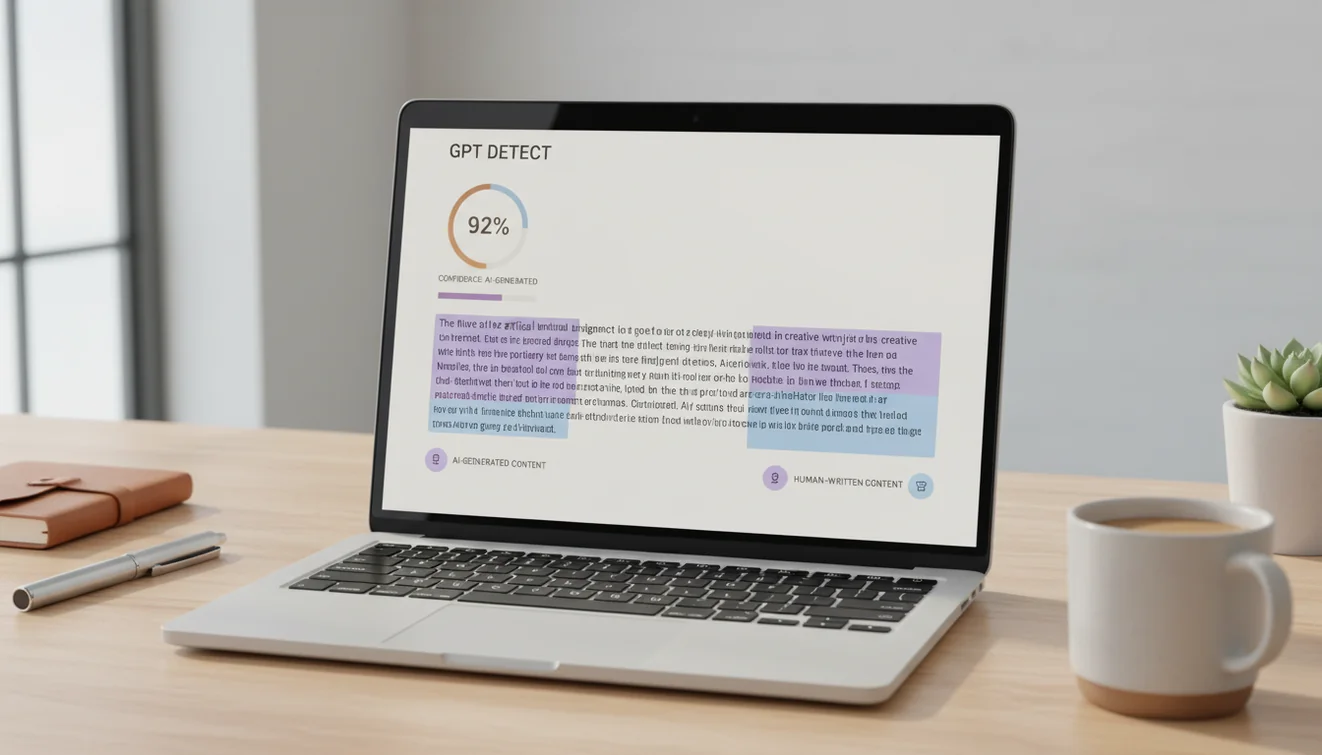
GPT detection relies on two primary metrics: perplexity and burstiness. These terms sound technical, but the concepts are straightforward. Perplexity measures how predictable the text is at the word level. For each word in a sentence, the detector asks: given the preceding words, how likely was this particular word to appear next? If the text consistently uses the most statistically probable word at each position, perplexity is low, and the text looks machine-generated. If the text makes unexpected choices, a surprising adjective, an uncommon phrase, an idiomatic expression; perplexity is higher, and the text looks more human.
Burstiness measures variation at the sentence level. Humans write with natural rhythm. A long, complex sentence might be followed by a short, blunt one. A paragraph might start with rapid-fire short sentences and slow down into a longer explanatory passage. This variation in sentence length, structure, and complexity creates a "bursty" pattern. AI-generated text, particularly from GPT models, tends to produce more uniform sentence patterns. Sentences cluster around a similar length. Complexity stays relatively consistent. Transitions follow predictable formulas. This uniformity produces a low burstiness score that detectors flag as a machine-generation signal.
More advanced detectors also analyze vocabulary distribution, the frequency of certain transition words, paragraph structure patterns, and the ratio of concrete to abstract language. Some use their own AI models trained specifically to distinguish human from machine text, creating a classifier that learns from labeled examples of both types. These multi-signal approaches improve accuracy but still operate on probabilities, not certainties.
One factor that complicates detection is the temperature setting used during generation. GPT models with higher temperature settings produce more varied, less predictable output that scores closer to human writing on perplexity metrics. Lower temperature settings produce more deterministic, polished output that detectors catch more easily. Since users do not always know or control the temperature used, and since different platforms set their own defaults, detection accuracy varies based on how the AI text was originally generated.
Accuracy Limitations of GPT Detection
No GPT detector achieves perfect accuracy. Independent benchmarks consistently show error rates between 5% and 30% depending on the text type, length, and whether the content was edited after generation. These errors come in two forms: false positives (human text flagged as AI) and false negatives (AI text classified as human). Both are significant problems.
False positives disproportionately affect certain groups. Non-native English speakers who write in careful, grammatically precise language often trigger AI flags because their writing patterns - consistent sentence length, limited idiomatic usage, and deliberate word choice, statistically resemble AI output. Academic and technical writers face similar issues because their formal register and structured argumentation overlap with patterns common in machine-generated text. A false positive rate of even 5% becomes a serious problem when it is applied across thousands of submissions.
False negatives occur when AI text is edited, mixed with human writing, or generated with specific prompts designed to vary the output. Simple edits like changing a few words per sentence, adding personal pronouns, or inserting deliberate grammatical imperfections can shift detection scores significantly. Dedicated tools like AI humanizers are specifically designed to modify text until it passes detection checks. This creates an ongoing arms race between generation, humanization, and detection technologies.
Text length also affects accuracy. The detector needs enough text to calculate meaningful statistical patterns. A single sentence does not provide enough data for reliable classification. Most detectors require at least 50-100 words to produce a useful result, and accuracy improves with longer passages. If you paste a 20-word sentence and get a confident AI or human classification, treat that result with heavy skepticism.

How to Use the GPT Detector
- Paste the text you want to analyze. Copy the content into the text area. The tool accepts up to 5,000 characters. For longer documents, test representative sections rather than the entire text. A few paragraphs from different parts of the document give a more comprehensive picture than one isolated section.
- Click Analyze Text. The detector processes your input and evaluates it against AI-generation patterns. This takes a few seconds depending on the text length.
- Review the results. The output indicates the likelihood that the text was generated by AI. Consider the result as a probability estimate, not a definitive answer. Scores near the boundary between AI and human classification are inherently uncertain.
- Consider the context. Factor in what you know about the text. Was it written under time pressure? Is the author a non-native speaker? Is the topic highly structured or formulaic? These factors affect detection accuracy and should inform how you interpret the result.
- Take appropriate action. If the detection result raises concerns, follow up with additional review. Compare the text against the authors previous work. Look for inconsistencies in style or knowledge level. Use the result as a starting point for investigation, not a conclusion.
Why GPT Detection Matters
GPT detection exists because AI-generated text is now indistinguishable from human writing at a glance. A well-prompted GPT model can produce an essay, article, email, or report that reads fluently and coherently. Without analysis tools, there is no reliable way for a reader to determine whether a human or machine produced the text. This has implications for education, journalism, content marketing, legal proceedings, and any field where the authorship and originality of text matters.
In academic settings, the concern is straightforward. Assignments are designed to develop and assess a student's understanding. Submitting AI-generated work bypasses the learning process. Detection tools give educators a way to identify potential cases, though the limitations discussed above mean they should be used as screening tools, not as evidence for disciplinary action. The conversation about AI in education is evolving, and detection tools are one part of a larger shift in how institutions approach academic integrity.
In publishing and content marketing, detection serves a quality-control function. Editors and content managers use it to verify that freelance submissions represent original human work, especially when contracts specify human-written content. Search engines have also signaled that AI-generated content may be treated differently in ranking algorithms, making detection relevant to SEO workflows. The relationship between AI content and search rankings is still developing, but awareness of AI generation patterns has become part of content strategy.
For individual writers, detection tools provide self-assessment. If you write in a formal, structured style and want to know whether your natural writing patterns resemble AI output, running your text through a detector gives you useful feedback. Some writers have adjusted their style after seeing consistent AI flags on their human-written work, adding more sentence variety, incorporating personal language, and breaking up predictable paragraph structures.

Limitations and Safety
GPT detection is a probabilistic assessment, not a forensic analysis. It cannot prove authorship. It cannot determine intent. It cannot distinguish between text written by a human who closely follows AI writing conventions and text generated by an AI model. Any decision based solely on a detection score - without additional evidence or context, is poorly supported.
The technology is evolving alongside the AI models it attempts to detect. Each new GPT version produces output with slightly different statistical properties, which means detectors must be continuously updated. A detector trained primarily on GPT-3.5 output may be less accurate with GPT-4o content. There is no permanent solution to AI text detection because the target keeps moving.
Detection results should be treated as confidential and handled responsibly. Accusing someone of using AI based on a detection score alone can cause real harm, particularly in academic and professional settings. If you are using this tool in a position of authority, pair the results with other evidence before drawing conclusions.
Write.info does not store the text you submit for analysis. All processing occurs in real time and no content is saved or used for model training. See the privacy policy for complete details. To explore additional tools for detection, humanization, and content creation, visit the full collection of Write with AI tools on Write.info.
Check GPT Writing Anywhere
Use Write.info to review text, improve clarity, and work responsibly with AI writing tools. For mobile access, download the Write.info app and keep detector, rewriter, humanizer, and chat tools close at hand.
Get Write.info AppGPT Detector App
The GPT Detector tool is available as part of the AI Writer app for iPhone and iPad. The app includes all writing, detection, and humanization tools in a single download with no account required. An Android version is currently in development.
The iOS app supports offline access to saved content and provides the same AI writing capabilities available on Write.info. Users receive 10 free generations per day on the website, while the app offers extended access through optional subscription plans.
Download on App Store